
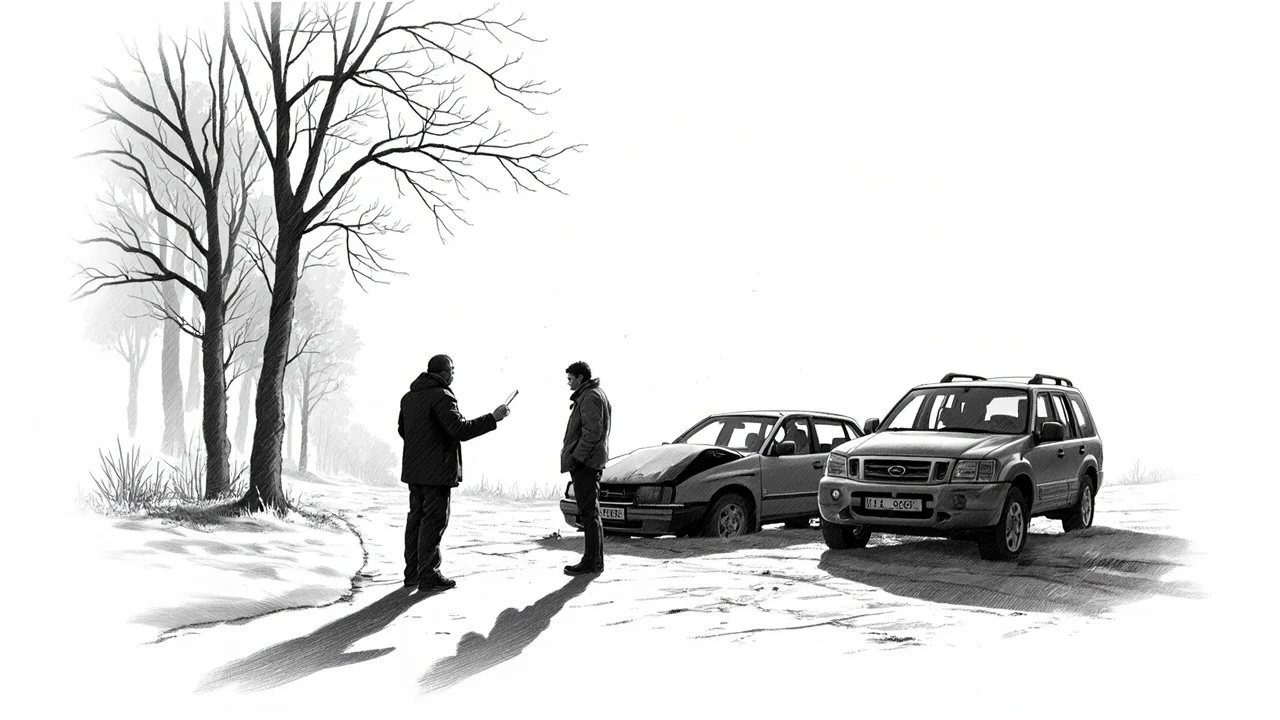
Finland's road safety authorities are analyzing a common but perplexing traffic incident after a low-speed head-on collision between two passenger cars in Mänttä-Vilppula. The crash occurred Sunday afternoon at an intersection on Hopunmäentie, with emergency services recording the alert at 2:31 PM. According to the Pirkanmaa Rescue Department, the accident happened at a low situational speed, yet both vehicles sustained damage requiring towing. Paramedics examined the occupants of the accident vehicles, while police launched an investigation into the causes. This routine report underscores a persistent challenge in Finnish traffic safety: understanding why serious damage and injuries occur even when speed limits are ostensibly low.
The Mänttä-Vilppula Intersection Incident
Initial details from rescue officials point to a classic intersection collision, a scenario familiar to traffic investigators across the country. The term 'nokkakolari' specifies a head-on impact, typically involving the front ends of two vehicles. Despite the low speed cited, the outcome—vehicles damaged beyond drivable condition—highlights the significant forces involved even in slow-speed traffic conflicts. Police investigators will now reconstruct the event, examining factors like right-of-way, driver attention, potential distractions, and road conditions on the Sunday afternoon. The thorough investigation standard for even minor crashes is a cornerstone of Finland's data-driven approach to reducing traffic harm, providing crucial input for national safety strategies.
A National Focus on Low-Speed Collision Dynamics
This incident in Pirkanmaa region fits into a broader national analysis of low-speed accidents. While high-speed crashes dominate fatal statistics, low-speed collisions represent a substantial portion of property damage and minor injury reports. The Finnish Transport and Communications Agency, Traficom, consistently studies these events to improve vehicle safety standards and urban planning. "Even at low speeds, the geometry of a collision can direct crash forces into vulnerable areas of a vehicle's structure or cause unexpected whiplash injuries," explains a senior Traficom safety engineer familiar with crash dynamics. The agency's research feeds directly into Finland's proactive stance within the European Union's vehicle safety regulation discussions, advocating for designs that protect occupants across all speed ranges.
The Human Factor in Routine Traffic Conflicts
Beyond vehicle engineering, Finnish safety campaigns increasingly target driver behavior in mundane driving situations. The intersection crash in Mänttä-Vilppula will inevitably lead investigators to consider human factors. Was a driver momentarily inattentive, misjudging the other car's speed or distance? Did a sun glare or a roadside obstruction play a role? The Finnish National Police Board emphasizes that most accidents stem from a chain of events, not a single cause. Educational programs run by organizations like the Finnish Road Safety Council often highlight that familiar, local roads can breed complacency, reducing a driver's alertness precisely where complex interactions with other road users are most frequent.
Local Infrastructure and Nationwide Safety Goals
Every traffic incident is also a micro-audit of local infrastructure. Finnish municipalities bear responsibility for the safety of their road networks, guided by national design manuals. An intersection crash prompts local officials to review sight lines, signage clarity, and road markings. Could a simple redesign, like improving visibility or adding a roundabout, prevent future similar events? This local action is integral to achieving the ambitious goals set in Finland's national road safety strategy, which aims to halve serious injuries by 2030. The strategy, endorsed by the Ministry of Transport and Communications, requires continuous data collection from incidents large and small to measure progress and identify new risk patterns.
The Economic and Insurance Implications
The financial ripple effect of such collisions is significant. While no serious injuries were reported in Mänttä-Vilppula, the economic cost includes vehicle repair or write-off, insurance administration, police and emergency service resources, and potential lost productivity. The Finnish Motor Insurers' Centre (LVK) meticulously tracks claim data, noting that intersection accidents constitute a major cost category. These aggregated costs ultimately influence premium levels for all policyholders. Furthermore, repair costs for modern vehicles, even in low-speed impacts, can be surprisingly high due to complex sensor arrays and lightweight body materials designed for higher-speed crash safety, creating a paradox where safety technology increases minor crash repair expenses.
A Model for Systematic Post-Crash Response
The response to this collision demonstrates Finland's systematic approach. The integrated chain—from the emergency call logged at a precise time, to the rescue service's on-scene assessment, the paramedics' check, and the police investigation—creates a closed loop of information. This data is anonymized and entered into national registers, becoming a single point in a vast statistical map of Finnish traffic safety. This map informs everything from driver's license education curricula to the planning of new bypass roads. It is a model of evidence-based policy that other nations, particularly within the EU, often reference, though its effectiveness relies on consistent funding for traffic police and rescue services—a perennial topic in municipal and state budget negotiations.
Looking Beyond the Single Incident
For the residents of Mänttä-Vilppula, the Sunday crash will be a temporary talking point, a reminder of personal vulnerability on the road. For national authorities, it is another data point in a long-term campaign. The ultimate goal, as stated repeatedly by Finnish transport ministers, is Vision Zero: a road system with no fatalities or serious injuries. While distant, this vision shapes current actions. Each investigated crash, even a non-fatal one at low speed, tests the resilience of the transport system. It asks whether vehicle design, road engineering, law enforcement, and public education are working in concert. The answer is never perfect, but the process of asking—and diligently seeking answers from every Hopunmäentie across Finland—is what defines the nation's relentless pursuit of safer roads. The true test of a safety culture is not just how it handles catastrophic failures, but how it learns from the routine, everyday warnings of risk that occur at a low situational speed on a Sunday afternoon.