
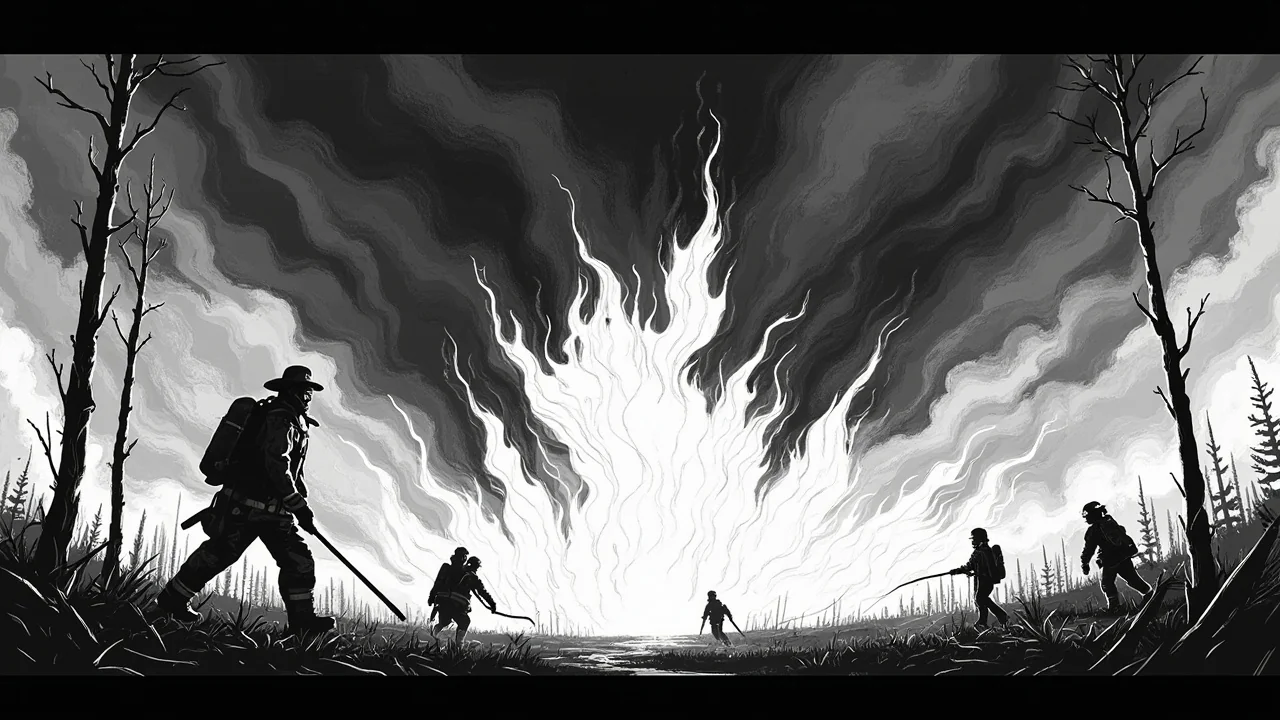
Finland's Luumäki municipal hall fire of 1986 remains a searing memory for the firefighters who faced an inferno that no force could stop. The piercing wail of the siren cut through the dark, freezing January night in Taavetti village. For Reijo Hämäläinen, a veteran firefighter thrust into the role of incident commander, and Kai Kaltto, a young fireman responding to the call, the events of January 8th would define their careers and haunt their recollections. "Not even the god Ukko could have saved it," Hämäläinen would later reflect, a stark testament to the fire's ferocity. This is the story of a blaze that consumed not just a building, but a community's administrative heart, revealing the vulnerabilities of a pre-digital era and the raw courage of a small-town fire brigade.
A Siren in the Freezing Dark
In 1986, emergency response in rural Finland relied on a starkly simple technology: the community siren. There were no personal pagers or mobile phones. When the Luumäki municipal hall on Linnalantie street caught fire, that siren's penetrating sound was the only alert. Kai Kaltto, then a young firefighter, recalls the immediate scramble. He lived close to the fire station, adjacent to the burning hall. As he rushed to the station, he could already see flames licking from the windows of a second-floor apartment within the wooden structure. The building, housing the local government's offices and archives, was a total-loss fire from the moment the alarm sounded. The extreme cold of the Finnish winter night, often dipping below -20°C, created a brutal contrast with the intense heat about to be unleashed.
Reijo Hämäläinen, a long-serving member of the Luumäki fire brigade, still dislikes recalling that evening. By chance, he was the senior officer on duty, standing in for the fire chief who was on leave. The responsibility for directing the response to one of the most destructive fires in Luumäki's history fell squarely on his shoulders. His leadership would be tested against an impossible task. The fire's origin, later determined to be arson, and its rapid, aggressive spread through the old timber building created a scenario where containment, not salvation, became the only realistic goal. The firefighters' mission shifted from saving the hall to preventing the conflagration from jumping to neighboring properties.
The Unstoppable Inferno
The response of the Luumäki fire brigade was swift, but the fire was faster. Historical accounts and the firefighters' memories describe a blaze of terrifying intensity. The municipal hall, like many older Finnish public buildings of its time, was constructed primarily of wood. This traditional material, while culturally significant, offered little resistance to a well-established fire. The flames found ample fuel in the structure itself, the furnishings, and the vast quantities of paper records housed within. Firefighting in such extreme cold presented its own nightmarish logistics; water lines and equipment were prone to freezing, and the icy conditions underfoot made the operation perilous for the crews.
Hämäläinen's grim assessment—that not even Ukko, the supreme god of thunder and weather in Finnish mythology, could have intervened successfully—encapsulates the feeling of powerlessness against such a total fire. The comment speaks to a profound professional frustration. It was a recognition that some disasters, once set in motion, exceed human capacity to rectify. The firefighters battled the flames through the night, their efforts illuminated by the hellish glow of the burning hall against the winter darkness. By morning, the scale of the loss was clear. Where the community's administrative center once stood, only ruins remained. The silhouette of a chimney stack stood sentinel over the ashes, alongside the surviving archive vault, which somehow withstood the destruction.
The Aftermath and a Lost Archive
The immediate physical aftermath was a smoldering plot on Linnalantie. The destruction of the municipal hall was a severe blow to Luumäki's civic operations. Beyond the loss of the building itself, the fire consumed irreplaceable paper archives documenting the daily life, decisions, and history of the municipality. In the 1980s, digital backups were non-existent. The records of local government, minutes of meetings, property deeds, and historical documents were often singular paper copies stored in filing cabinets and basements. The survival of the main archive vault was a minor miracle, but it likely represented only a fraction of the total documentary heritage. This loss created administrative chaos and severed a tangible link to the past, a common tragedy in pre-digital era fires.
For the firefighters, the aftermath was psychological as much as physical. Incidents of such magnitude, particularly in close-knit communities where the firefighters are neighbors and friends of those they serve, carry a heavy emotional toll. Hämäläinen's reluctance to revisit the memory is telling. Commanders often bear the weight of outcomes beyond their control, questioning decisions made in the heat and confusion of the moment. For Kaltto, who would go on to complete a 40-year career in the fire service, the Luumäki hall fire was a brutal early lesson in the limits of emergency response. The event underscored the critical importance of fire prevention, building materials, and the ever-present threat of arson to public safety and community memory.
A Fire Service Transformed
The Luumäki fire of 1986 occurred at a transitional moment for Finnish emergency services. The reliance on community sirens, while effective for mobilizing a local volunteer brigade, highlighted a system ripe for modernization. In the decades since, Finnish fire and rescue services have undergone significant changes. The introduction of emergency telephone numbers (first the local 000, then the nationwide 112 in 1993), digital paging systems, and eventually mobile communications has drastically reduced response times and improved coordination. Fire safety regulations for public buildings have also been strengthened, with greater emphasis on fire-resistant materials, compartmentalization, and sprinkler systems, especially for structures housing important archives or large numbers of people.
The professionalization of fire services, even in rural areas, has also advanced. While volunteer brigades remain the backbone of coverage across Finland's vast geography, their training, equipment, and integration with regional and national emergency response networks are now far more sophisticated. The lessons from fires like Luumäki's have been incorporated into national fire safety strategies. These strategies now balance response capability with a stronger focus on prevention, public education, and building design that either prevents fires from starting or contains them long enough for effective intervention. The god Ukko may not be available, but technology, training, and regulation have significantly improved the odds.
The Enduring Shadow of the Flames
Nearly four decades later, the Luumäki municipal hall fire persists as a local historical landmark, a before-and-after moment for the community. For historians, it represents a point where a thread of continuous record-keeping was severed. For older residents, it is a vivid memory of a dramatic night that altered the town's visual and administrative landscape. For the fire service veterans like Reijo Hämäläinen and Kai Kaltto, it is a defining episode of their professional lives—a night where they confronted a force of destruction at its most potent. Their recollections provide a vital human perspective on a historical event, moving it from an entry in a ledger to a story of human endeavor, limitation, and resilience.
The fire also serves as a sobering reminder of the fragility of physical archives and the communities they document. In an age where we assume digital permanence, the Luumäki fire illustrates how quickly a community's institutional memory can turn to ash. It prompts questions about how we preserve our history and protect the places where our shared civic life is administered. The courage of the firefighters who answered the siren that freezing night is undeniable. Their battle was ultimately lost, but their effort forms its own important part of Luumäki's story—a story of a community facing disaster and the individuals who stood against it, even when the outcome was foregone.