
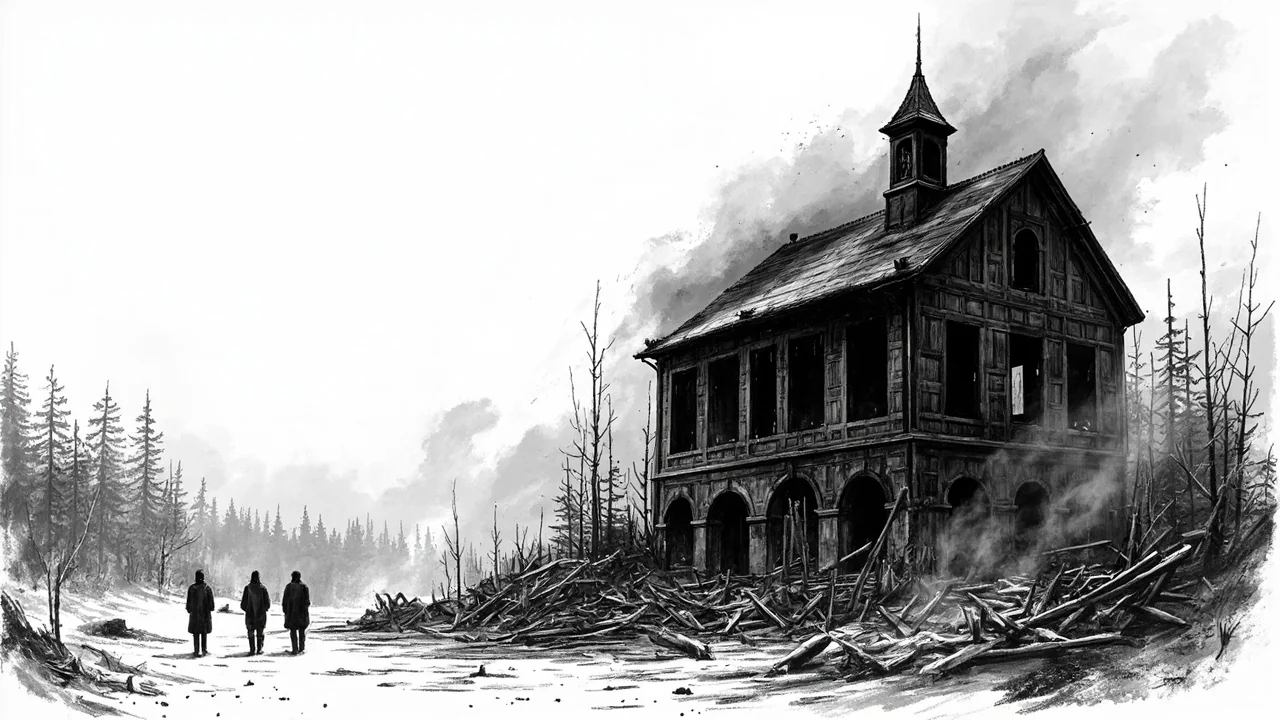
Finland’s Luumäki municipality faced a profound civic crisis forty years ago when its wooden town hall was consumed by a fierce fire during a freezing winter night. Residents became instant first responders, rushing into the smoldering ruin to salvage smoke-damaged documents from the collapsing structure. The blaze destroyed the administrative heart of the community, a loss that reverberated for years and offers enduring lessons about communal resilience and the fragility of public memory.
A Frigid Night Alight
The fire erupted in the deep cold of a Scandinavian winter, a time when temperatures plummet and the landscape rests under a thick blanket of snow. The Luumäen kunnavirasto, or municipal office, was a characteristic post-war Finnish public building. Constructed in the 1950s, it featured a wooden frame sheathed externally with large mineral wool boards, a common and practical design of its era. On that fateful night, this ordinary building became the center of an extraordinary community effort. As flames illuminated the dark winter sky, the call went out not just to the official fire brigade but to every able-bodied citizen. The response defined the evening's chaos. Locals did not stand by as spectators; they joined the rescue operations, forming human chains to pass precious files and records from the burning wreckage to safety. Their actions saved fragments of the municipality's administrative history from total annihilation.
The Physical and Symbolic Heart
To understand the magnitude of the loss, one must consider the role of a kunnavirasto in rural Finnish society of the 1980s. It was far more than an office block. This building served as the primary interface between the state and the citizen, a place for registering births, deaths, and marriages, applying for permits, and conducting local democracy. Its destruction meant the sudden disruption of all these essential services. The physical architecture also held symbolic weight. The 1950s design spoke to a nation rebuilding itself after war, emphasizing functionality, modesty, and communal progress. The mineral wool cladding, while practical for insulation, proved no match for the intense heat. The fire did not just destroy paperwork and furniture; it burned a chapter of the town's material history. The salvage operation, with residents hauling out smoke-scented documents, became a powerful metaphor for a community clutching at its own institutional memory as it literally slipped through their fingers.
Immediate Aftermath and Long-Term Recovery
The morning after revealed a scene of stark devastation: a charred skeleton of a building against the bright snow, with volunteers and officials sifting through the damp, ash-covered remnants. The immediate practical challenges were immense. Municipal staff were displaced, and critical records for thousands of residents were either lost or severely damaged. The continuity of local government was thrust into uncertainty. In the days and weeks that followed, temporary offices were likely established in schools, community centers, or other public spaces—a common Finnish solution in times of civic disruption. The process of reconstructing lost documents would have been a painstaking task, requiring citizens to re-submit information and officials to rebuild registries from scattered salvage and central archives. This administrative recovery period, often overlooked in the drama of the fire itself, would have been a slow, frustrating, and vital process for restoring normalcy.
Analysis: Community Response and Institutional Vulnerability
From a contemporary perspective, the Luumäki fire serves as a potent case study in pre-digital disaster response and community cohesion. "This event perfectly encapsulates the Finnish concept of talkoot—communal voluntary work," notes Dr. Eero Mikkonen, a Finnish historian specializing in social history. "When a crisis hit a small municipality, the formal resources of the state were distant. The first and most effective line of defense was the community itself. Their spontaneous action to save documents wasn't just about paper; it was an instinct to preserve their shared identity and governance." The fire also highlights the profound vulnerability of smaller municipalities before the digital era. A single catastrophic event could erase land records, financial documents, and personal identification data, creating legal and bureaucratic tangles that took years to resolve. Today, while cloud backups and distributed digital systems mitigate the risk of total information loss, the Luumäki event reminds us that a community's institutional knowledge is a precious and sometimes fragile asset.
Legacy and Modern Parallels
Four decades later, the lessons of that winter night remain relevant. Modern disaster planning for municipalities now must account for both cyber and physical threats to critical infrastructure. The human element witnessed in Luumäki—the willingness of citizens to engage directly in protecting their communal assets—remains a cornerstone of resilient societies. The fire likely accelerated Luumäki's eventual adoption of new technologies and record-keeping practices, pushing the municipality from a purely paper-based system toward digital solutions. The destroyed 1950s building was eventually replaced, a necessary step forward that also closed a distinct architectural chapter. The event lives on in local oral history, a story told about the night the town hall burned and everyone pitched in. It underscores a fundamental truth about Finnish provincial life: the line between the government and the governed is often thin, and in moments of crisis, it disappears altogether. The final question posed by the Luumäki fire is not about what was lost, but what was revealed—the depth of a community's commitment to its own survival and continuity.