
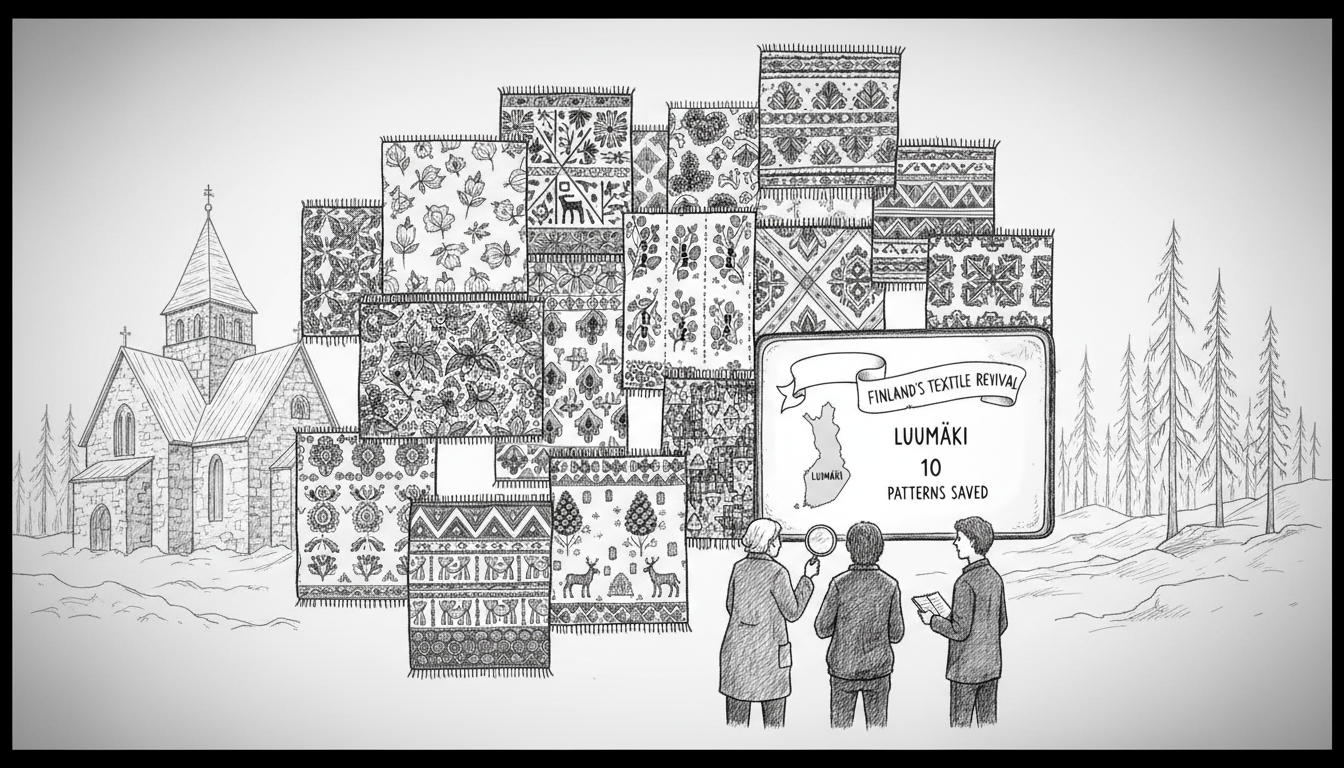
Finnish textile traditions are experiencing a quiet renaissance, driven by the meticulous work of individuals who saved local crafts from oblivion. In the early 1970s, home economics teacher Kyllikki Pukki undertook a crucial mission in the municipality of Luumäki, documenting ten distinct patterns for the traditional 'kuvatäkki', a woven coverlet that was once a cornerstone of a Finnish bride's dowry. Her work, which preserved instructions that might otherwise have been lost, has become a vital link to a tangible piece of national heritage, sparking renewed interest in these intricate handicrafts.
The Dowry Treasure That Captured Royal Attention
A kuvatäkki, also known in Karelian as 'kirjutostäkki', was far more than a simple blanket. In the 19th century, it was an essential component of a bride's 'kapio'—a decorated storage chest that held her trousseau. The size and quality of the woven coverlet were direct reflections of a family's wealth and the bride's own skill. Historical accounts note it had to be large enough to cover a husband, wife, and a small child. In some regions, a bride would even step onto the coverlet as she arrived at the wedding house, a public display of the value she brought to the new union. The craft's significance was such that examples from Luumäki, renowned for their specific local patterns, were considered prestigious gifts, even finding their way to the Swedish royal court.
Kyllikki Pukki's project was a race against time. As modernization accelerated in post-war Finland, the knowledge of how to create these specific woven coverlets, with their technique of 'pujotus' or inserted patterning, was concentrated in the hands of a dwindling number of elderly artisans. Pukki systematically sought them out, recording not just the final patterns but the precise techniques and instructions required to recreate them. This archive moved beyond mere documentation; it created a reproducible blueprint for future generations.
A Technique Woven into Finnish Identity
The kuvatäkki represents a specific branch of Finnish textile heritage. It is a 'pujotuspeite', meaning a coverlet where the patterned motifs are inserted during the weaving process itself, row by row. This technique is distinct from the western Finnish tradition of applying embroidery or appliqué onto a finished woven base. Experts compare the meticulous, row-by-row process to that of creating a 'ryijy' rug, another iconic Finnish textile art form. The patterns themselves—geometric, symbolic, and often unique to specific families or villages—are a visual language. They speak to the Karelian influences in the region and embody a practical artistry where beauty was inextricably linked to function and social ritual.
“Preserving these patterns was an act of cultural rescue,” explains a Finnish textile historian familiar with Pukki’s collection. “In the 1970s, the focus was on modernity. Traditional crafts like these were not widely valued as art or important history. Individuals like Kyllikki Pukki operated on foresight and personal passion. She understood that the loss of this technical knowledge would be permanent. Her work provided the foundation upon which any contemporary revival must be built.” This perspective highlights how preservation often hinges on the dedication of single individuals before institutions recognize a craft's endangered status.
From Archival Boxes to Contemporary Looms
The impact of Pukki's work became publicly visible decades later. In the autumn of 1995, the Luumäki Handicraft Centre hosted an exhibition showcasing a variety of kuvatäkki coverlets, many reliant on the patterns she secured. This event served as a catalyst, moving the craft from private memory and archival notes back into the public eye. Today, that revival is gaining momentum. There is a growing movement among Finnish artisans and hobbyists to reconnect with local heritage through handicrafts. The drive for sustainability and locally sourced, meaningful goods has dovetailed with a renewed appreciation for the skill and story embedded in traditional textiles.
Contemporary weavers now use Pukki’s documented patterns not merely for replication but as inspiration. While some artisans strive for historical accuracy, using traditional materials and techniques, others adapt the classic geometric forms into modern wall hangings, cushion covers, or artistic installations. This evolution is seen as healthy by cultural experts; it allows the tradition to live and adapt rather than remain a static museum piece. The kuvatäkki has transitioned from a mandatory dowry item to a chosen symbol of cultural identity and artistic expression.
The Broader Fabric of Finnish Heritage Preservation
The story of the Luumäki kuvatäkki is a microcosm of a nationwide challenge and effort. Across Finland, similar local crafts—specific knitting patterns, lace-making techniques, or woodworking styles—have faced near-extinction. Their survival frequently depends on a similar chain: a knowledgeable practitioner, a dedicated documentarian like Pukki, and a subsequent generation willing to reinvest time in learning complex, slow skills. Organizations like the Finnish Heritage Agency and various craft societies now actively support this work, but the initial salvage operation often remains informal and community-based.
This revival is not merely nostalgic. It represents a re-engagement with a form of material culture that emphasizes quality, durability, and a deep connection to place. In a globalized world, the unique pattern from a specific Finnish parish carries a powerful resonance. It tells a story of migration, family, and landscape that a mass-produced item cannot. The physical act of weaving a kuvatäkki, following the same steps as a weaver from the 1800s, creates a tangible link across centuries.
A Legacy Measured in Threads and Persistence
Kyllikki Pukki’s legacy is measured in the ten pattern sets she preserved and the community of practice they continue to sustain. Her work underscores a critical truth about cultural heritage: the most vulnerable elements are often the localized, everyday arts practiced by women in the domestic sphere. Their economic and social value can fade quickly, leaving their artistic and historical significance vulnerable to being forgotten. The fact that these Luumäki coverlets were once deemed fit for a king highlights how domestic craft could achieve extraordinary heights of recognition.
Today, the question is no longer whether the kuvatäkki will survive, but in what form it will flourish. The meticulous patterns saved fifty years ago are now meeting 21st-century values of sustainability, artisan craftsmanship, and cultural authenticity. The ongoing revival ensures that this thread of Finnish tradition is not just preserved in a museum case but is actively woven into the nation's contemporary cultural fabric, one row at a time. The story of the Luumäki kuvatäkki ultimately reminds us that heritage is not inherited passively; it must be actively chosen, learned, and carried forward.