
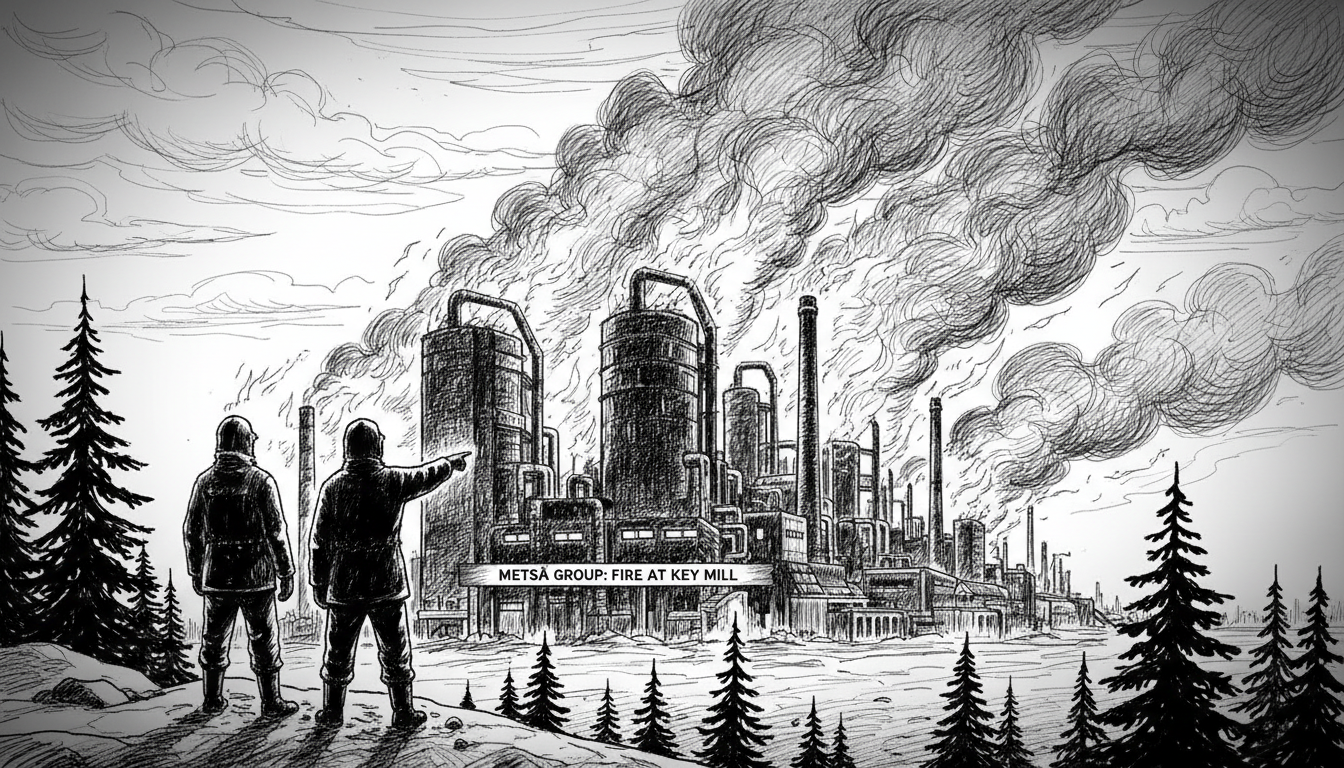
Finland's Metsä Group faced a major industrial fire at its flagship 1.2-billion-euro Äänekoski bioproduct mill on Tuesday. A blaze ignited in a wood chip silo, triggering a large-scale emergency response from the Central Finland Rescue Department. While firefighting operations successfully contained the fire to the single silo, the incident spotlights risks at the heart of the nation's critical forestry sector.
Flames and smoke billowed from the chip silo at the vast industrial complex in central Finland. The Keski-Suomen pelastuslaitos (Central Finland Rescue Department) deployed multiple units to the scene. Their efforts continued for hours as firefighters worked to fully extinguish the deep-seated fire in the biomass material. Mill director Janne Rantanen confirmed the situation was brought under control. "The fire has been confined to the chip silo," Rantanen stated, providing a crucial update to concerned stakeholders.
The immediate operational impact appears limited, according to the company's initial assessment. Rantanen emphasized that the silo itself was taken offline but noted there was "no direct impact on the mill's production." This suggests the mill's other production lines continued operating. The cause of the fire remains unknown. "We'll put it out first and then see if there's damage, investigate the root cause, and take corrective measures," Rantanen said, outlining the post-incident procedure.
Assessing the Risk to a Forestry Giant
The Äänekoski mill is no ordinary facility; it represents a cornerstone of modern Finnish forest industry strategy. Operational since 2017, it is one of the largest wood-processing plants in the Nordics. Its annual pulp production capacity stands at 1.3 million tonnes. The mill consumes a staggering 6.5 million cubic meters of wood each year, sourced from sustainably managed Finnish forests. A prolonged shutdown of any part of this complex would have ripple effects through Metsä Group's supply chain.
Industry analysts are watching closely. "Any fire at a facility of this scale is a serious event," commented a Helsinki-based industry analyst familiar with the pulp sector, who requested anonymity as the investigation is ongoing. "The key questions are the extent of the structural damage to the silo and how long it will take to repair or replace. While production may continue, logistics and raw material handling could be disrupted." The analyst noted that silo fires in wood-processing plants can be notoriously difficult to fully extinguish due to smoldering embers within the biomass.
The Economic and Environmental Stakes
The financial stakes are enormous. The mill represents a 1.2-billion-euro investment, a figure that underscores its importance to Metsä Group's portfolio. As a bioproduct mill, Äänekoski is designed to maximize resource efficiency, creating not just pulp but also bioenergy, tall oil, and turpentine from every log. It is a model for the circular bioeconomy that Finland promotes. The facility's environmental profile is also a key part of its identity, making any incident involving emissions or waste a potential reputational concern alongside the operational one.
For the local region of Central Finland, the mill is a vital economic engine. It provides hundreds of direct jobs and supports thousands more in the forestry and logistics sectors. The town of Äänekoski is intrinsically linked to the mill's operations. Local officials and residents likely monitored the smoke plume with deep anxiety, understanding the plant's centrality to the community's wellbeing. The swift containment of the fire would have brought significant relief.
Safety Protocols Under Scrutiny
This event will inevitably lead to a thorough review of safety protocols at the site. Finland has stringent workplace safety regulations, enforced by the Työsuojelu (Occupational Safety and Health Administration). Industrial facilities handling combustible materials like dry wood chips must have comprehensive fire prevention and suppression systems. The investigation led by rescue authorities and likely involving the company's own safety experts will scrutinize everything from equipment maintenance and thermal monitoring systems to operator response procedures.
"Modern mills have extensive automation and sensor networks designed to detect heat and smoke at the earliest possible stage," said the industry analyst. "The investigation will determine if those systems functioned as intended and what the ignition source was—whether electrical, mechanical, or due to biological processes within the wood chip pile." Spontaneous combustion in large piles of organic material is a known industrial hazard.
Looking Ahead for Metsä Group
The coming days will be critical for Metsä Group's communications and operational teams. The company must provide transparent updates on the investigation's progress, the assessment of damage, and any anticipated impacts on delivery schedules. Its customers across Europe and Asia will seek reassurance. The Nordic forestry industry is highly competitive, and operational reliability is a key metric. Shareholders and investors will also expect a clear account of the incident and its financial implications.
For now, the situation seems stabilized. The fire is out, and production continues. The true cost—in repairs, lost efficiency, and safety upgrades—will be tallied later. This incident serves as a sharp reminder that even the most advanced, automated industrial complexes are not immune to sudden, disruptive events. It reinforces the perpetual need for rigorous safety culture, constant risk assessment, and resilient operational planning in Finland's most important export industry.
The final report from the rescue authorities will be pivotal. Its findings will not only guide Metsä Group's corrective actions but could also inform safety standards across the entire Nordic forest sector. In an industry built on managing a natural, combustible resource, the lesson from Äänekoski is clear: vigilance can never be allowed to falter.