
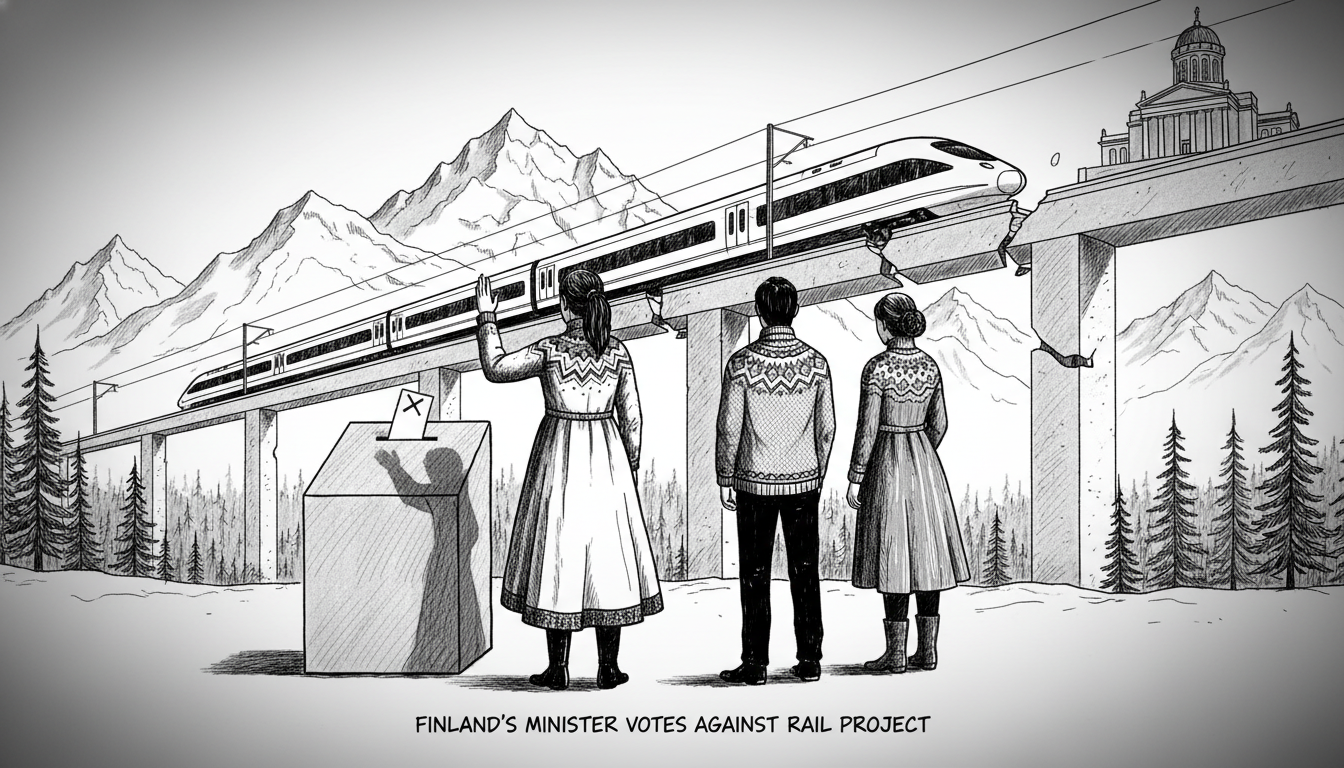
Finland's ambitious Turku One Hour Train project has hit a significant political obstacle. Education Minister Anders Adlercreutz, who also serves as a local councilor in Kirkkonummi, voted against a crucial shareholder agreement for the Länsirata railway, a project explicitly endorsed in the government program he helped create. This move exposes a deep tension between national coalition commitments and local political interests, testing the unity of Prime Minister Petteri Orpo's right-wing coalition.
Adlercreutz, chairman of the Swedish People's Party (RKP), cast his vote in the Kirkkonummi municipal council on Monday evening. The council ultimately rejected the Länsirata shareholder agreement by a decisive margin of 36 votes to 15. The minister defended his position by stating he was acting in the interests of his municipality. "I have been critical of the Länsirata from Kirkkonummi's perspective for practically my entire political career," Adlercreutz explained. "I consider the benefits for Kirkkonummi to be limited and the risks quite significant."
A Direct Challenge to Government Unity
The vote creates an immediate and public contradiction within the governing coalition. The Orpo government's policy program clearly states its commitment to building the first phase of the Länsirata, specifically the Espoo–Kirkkonummi–Vihti–Lohja section. As a party leader within the coalition, Adlercreutz is bound to this agreement. His decision to oppose a key step in its implementation raises questions about discipline and shared purpose. Adlercreutz acknowledged the awkwardness, calling the situation "challenging" because it involves a written government commitment.
Prime Minister Petteri Orpo, a Turku native and strong proponent of the faster rail link, was reportedly informed of Adlercreutz's intended vote beforehand. This prior knowledge suggests the issue was negotiated within coalition corridors but not resolved, allowing a public split to occur. The incident highlights the complex dual roles many Finnish politicians hold, serving simultaneously in the national Eduskunta and in local municipal councils, where conflicting loyalties can emerge.
The Local vs. National Infrastructure Dilemma
Adlercreutz's rationale centers on a classic conflict in Finnish regional policy. He argues his primary duty in the Kirkkonummi council is to represent local interests. "I was elected to the Kirkkonummi council to look after specifically Kirkkonummi's interests," he stated. The minister attempted to separate the council's vote on the shareholder agreement from the broader project's fate, calling them "two different things." He claimed there is no contradiction with the government program, framing the vote as merely defining Kirkkonummi's position on a specific financial agreement.
However, political analysts see a clearer conflict. The rejection of the shareholder agreement by a key municipality along the planned route represents a substantial practical hurdle. Large-scale Finnish infrastructure projects often require buy-in and financial participation from municipalities through such agreements. Kirkkonummi's opposition could delay planning, complicate financing, and embolden opposition in other towns along the route. The 'Turku One Hour Train' project, designed to cut travel time between Finland's capital and its oldest city, has faced years of debate over its environmental impact, cost, and regional benefits.
Testing Coalition Cohesion and Protocol
This episode serves as a stress test for the Orpo government's internal protocols. The coalition, comprising the National Coalition Party (Kok), the Finns Party, the Swedish People's Party (RKP), and the Christian Democrats, must balance party autonomy with collective responsibility. Adlercreutz's vote demonstrates a party leader prioritizing a local mandate over a cabinet-level agreement. While he notified the Prime Minister, he did not alter his course, suggesting limits to central party control in local matters.
Political observers will watch closely to see if this sets a precedent. Will other ministers or coalition MPs feel empowered to publicly oppose government program items when they clash with local council positions? The situation is particularly sensitive because it involves a flagship infrastructure project personally championed by the Prime Minister. The government's ability to navigate this dissent without public reprimand or policy reversal will signal its internal strength and conflict-resolution mechanisms.
The Rocky Path of the Länsirata Project
The Länsirata, or Western Rail Line, is central to the "Turku One Hour Train" vision. The project aims to upgrade and build new tracks to allow faster, more reliable service between Helsinki and Turku, potentially boosting economic integration across the Uusimaa and Southwest Finland regions. The first phase included in the government program is a major investment in regional connectivity. Kirkkonummi's location makes it a critical junction, and its council's skepticism is not new; concerns often involve land use, environmental disruption, noise, and whether the municipality bears a disproportionate burden for a national asset.
Monday's vote does not legally kill the project, but it injects significant uncertainty. The national government can override municipal planning objections in matters of national significance, but doing so is politically contentious and contradicts the principle of local self-government. The preferred path is cooperation and agreement. Kirkkonummi's rejection, led by a government minister, forces the state back to the negotiating table or toward a more confrontational approach.
Analysis: A Symptom of a Wider Tension
This conflict is symptomatic of a broader challenge in Finnish politics: reconciling top-down national strategies with bottom-up local democracy. Ministers with local council seats are not uncommon, but such a direct clash on a high-profile government project is notable. It underscores how Finland's consensus-driven political culture can be strained by major infrastructure decisions that create clear winners and losers at the municipal level.
From an EU perspective, the incident also highlights the complexities of meeting transnational connectivity goals while managing domestic political friction. Efficient rail links are a pillar of EU transport policy, but their implementation rests on national and local political will. Adlercreutz's vote shows how local resistance can manifest at the highest levels of national government, potentially slowing down projects aligned with broader European infrastructure ambitions.
The coming weeks will reveal the government's response. Will Prime Minister Orpo demand stricter adherence to the coalition program, or will he accept this expression of local dissent as part of the democratic process? The resolution will set a tone for the remainder of this government's term. For the Länsirata project, the path forward just became steeper, proving that in Finnish politics, the tracks to a major infrastructure achievement must be laid not only through landscape but through a complex political terrain where ministers sometimes stand in their own government's way.