
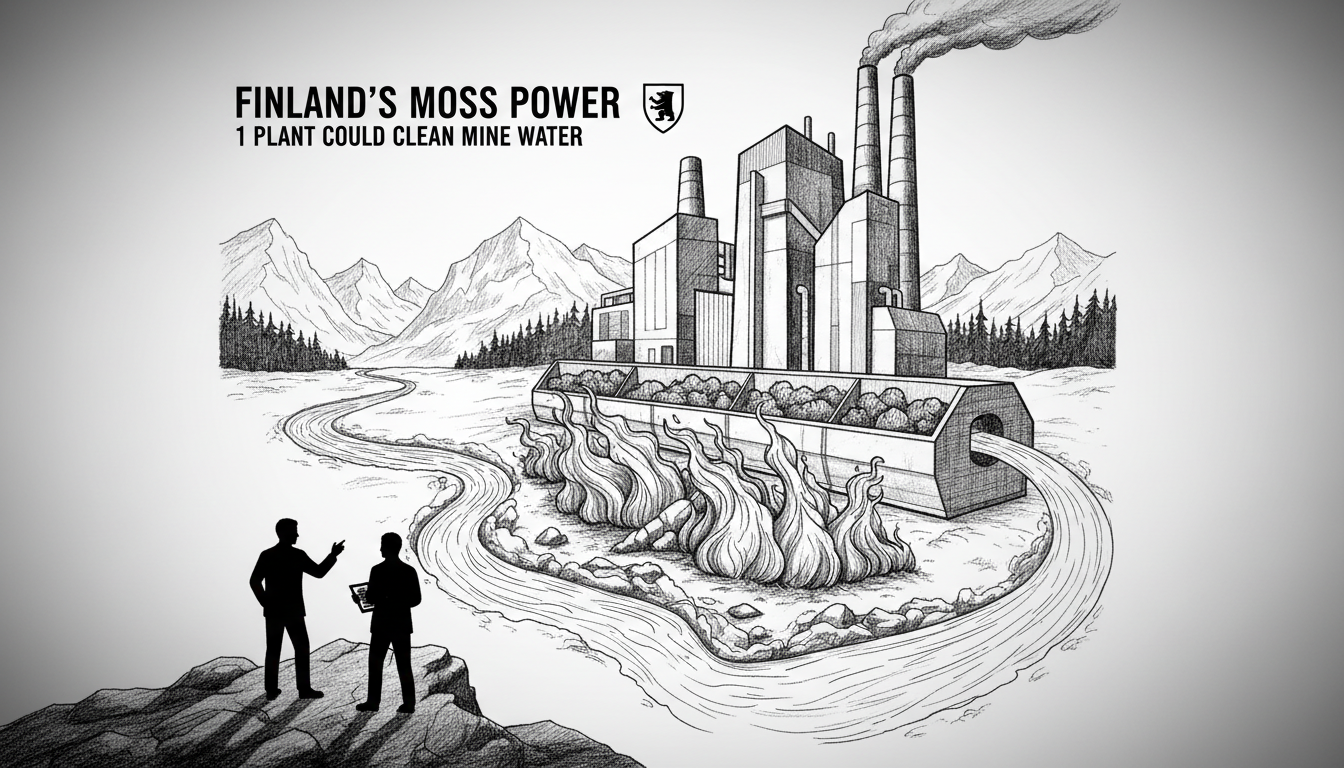
Finland's mining and forestry industries face a persistent environmental challenge: how to clean vast quantities of water contaminated with heavy metals. A new study from the University of Oulu offers a surprisingly elegant solution rooted in the country's own peatlands. Researchers have identified a specific moss, thriving in the harsh conditions of a mine site, that shows exceptional promise for natural water purification.
From Mine Walls to a Scientific Breakthrough
The research began with a discovery at the Pyhäsalmi mine, one of Finland's deepest base metal mines. Scientists found a particular moss, Warnstorfia fluitans (nevasirppisammal in Finnish), growing abundantly in the water near the mine's flood embankment. This was unusual. Very few plants can survive in the acidic, metal-rich waters typical of mining environments. The moss, dubbed a "power moss" or "tehosammale" by researchers, demonstrated a remarkable tolerance. The University of Oulu team then began investigating the biological mechanisms behind this resilience, focusing on the symbiotic relationship between the moss and its associated microbes. This partnership appears to be key to the organism's ability to accumulate and potentially lock away metals extracted from the water.
A Dual Environmental Challenge for the North
This research addresses two major, interconnected sources of metal pollution in Finland and similar Nordic regions. First, the legacy and ongoing operations of the mining sector. Finland has a long mining history and dozens of active sites, alongside numerous abandoned mines and tailings ponds. These sites require long-term, sustainable water management solutions to prevent metals from leaching into surrounding watersheds. Second, the impact of intensive forestry. To improve tree growth, Finland has drained approximately 60,000 square kilometers of peatlands through extensive ditching networks. This practice alters hydrological systems and accelerates the oxidation of soil, leading to increased metal runoff—particularly iron—that discolors and degrades water quality in rivers and lakes.
Climate change acts as a multiplier for both issues. In northern regions, warmer temperatures and altered precipitation patterns are accelerating the natural release of metals from soil and bedrock into water systems. This creates a pressing need for scalable remediation technologies. "The power of these mosses will next be tested in iron-stained forest ditches," the University of Oulu researchers stated, indicating the next phase of their applied work.
The Symbiotic Science of Purification
The core of the discovery lies not just in the moss itself, but in the biological community it supports. The study explores how the moss and its microbiome work together. Scientists believe certain microbes living on or within the moss may help process the metals, possibly transforming them into less soluble or less toxic forms. This natural, symbiotic filtration system is a stark contrast to conventional, energy-intensive water treatment methods often used in industrial settings, such as chemical precipitation or reverse osmosis. A biological solution could be lower-cost, require less energy, and create less secondary waste. It represents a form of phytoremediation—using plants to clean contaminated environments—specifically adapted for cold-climate conditions.
Expert Perspectives on Potential and Hurdles
Environmental scientists familiar with the field see significant potential but caution that the path from promising research to widespread application is long. "The findings are highly encouraging because they offer a nature-based solution that aligns with Nordic ecosystems," said one Finnish environmental biotechnologist not directly involved in the study, who preferred to speak on background. "The moss is native, hardy, and appears to thrive in the very conditions we need to address. This is a major advantage over introducing non-native species for cleanup."
The expert emphasized that critical questions remain. Future research must quantify the moss's metal uptake capacity and saturation points. Scientists need to determine how long the moss remains effective and, crucially, what happens to the metal-laden biomass at the end of its life cycle. Safe disposal or potential metal recovery from the moss will be essential for a truly circular solution. Furthermore, scaling the technique from lab and pilot tests to treat the massive volumes of water from a large mine or across thousands of kilometers of forest ditches presents a formidable logistical challenge. The technology would need to be integrated into existing land and water management practices.
Implications for Finnish Industry and Policy
For Finland, a country where the mining and forest industries are economically vital but under increasing environmental scrutiny, this research has tangible policy and operational implications. The Finnish government and the European Union are pushing for stricter environmental standards and a transition to a more circular economy. A proven, cost-effective biological treatment method could help mining companies meet discharge limits and improve the sustainability profile of their operations, potentially easing the permitting process for new projects. For the forestry sector, managed by a mix of large companies and private family owners, a simple moss-based system could become a best practice for mitigating the water quality impact of ditching, especially in sensitive areas.
The research also speaks to Finland's strategic strengths in cleantech and bioeconomy innovation. Developing and exporting such nature-based environmental technology could become a new niche. It aligns with national goals of achieving carbon neutrality and protecting the country's vast network of lakes and rivers, which are central to Finnish identity and recreation.
Looking Ahead: From Laboratory to Landscape
The University of Oulu team's planned field tests in forest ditches are a vital next step. Success in these real-world conditions, which involve different metal compositions and flow dynamics than mine waters, will broaden the technology's applicability. Concurrently, research must continue to unravel the fundamental science of the moss-microbe symbiosis. Genetic studies could reveal the specific genes and metabolic pathways responsible for metal tolerance and accumulation. This knowledge could lead to optimizations, such as selecting or cultivating even more effective strains of moss or engineering the microbial community to target specific metals like nickel, zinc, or arsenic common in Finnish mines.
The vision is ambitious: deploying mats or controlled zones of this power moss in mine drainage channels, settling ponds, and the headwaters of stained forest ditches. Over time, as the moss grows and harvests metals from the water, the cleaned water could be released back into the environment. The contaminated moss would then be collected and processed. While challenges around scale, speed, and biomass management are real, the study provides a compelling new direction. In a nation defined by its forests and lakes, the answer to a persistent industrial problem may have been quietly growing on a mine wall all along. The coming years will determine if this Finnish moss can move from a scientific curiosity to a cornerstone of sustainable water management in the North.