
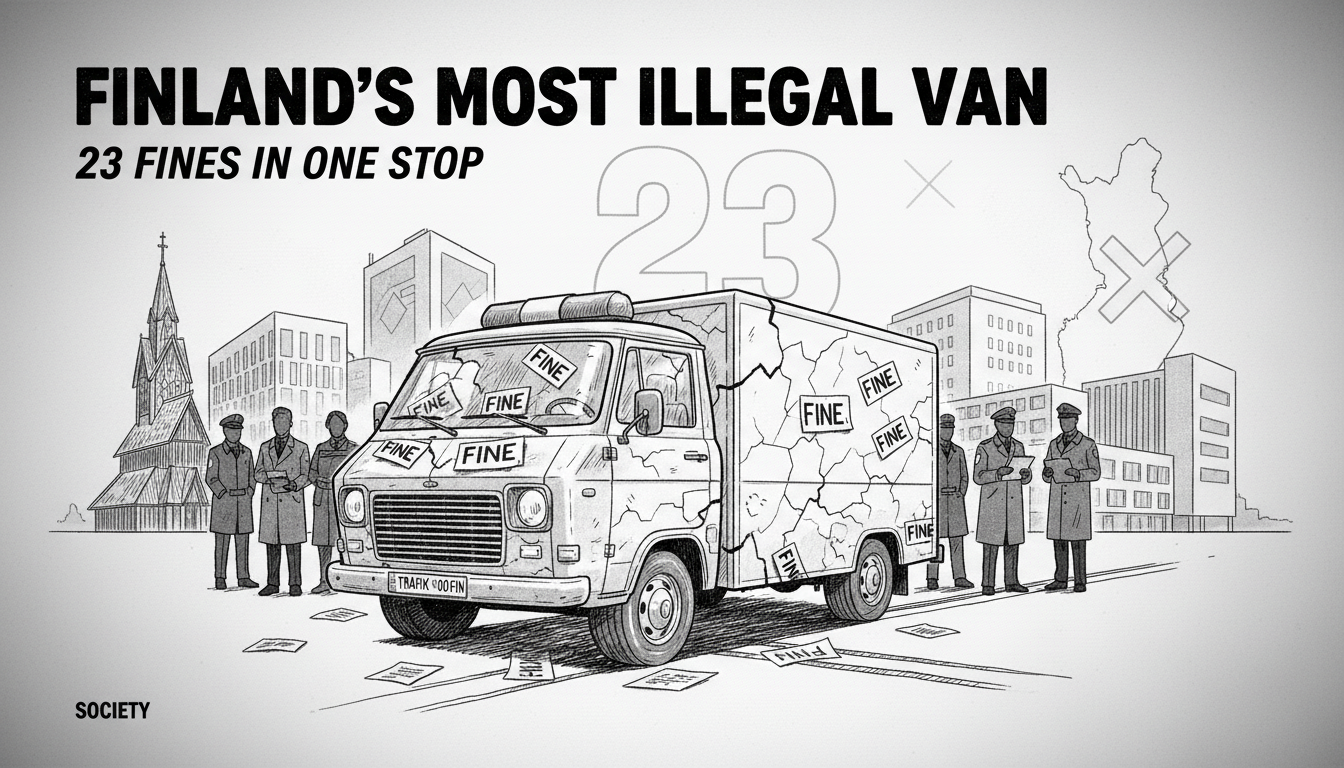
Finland traffic violation enforcement reached a new benchmark this week when Helsinki Police revealed a single Mercedes-Benz van had accumulated a staggering list of offenses. The vehicle, stopped in the capital's Länsisatama port district, was found to be 2000 kilograms overweight, uninspected, sporting illegal foreign plates, and riddled with technical faults. The driver received 23 day-fines in a single enforcement action, a case that has become a prime example of the risks police aim to eliminate from Finnish roads.
Chief Inspector Dennis Pasterstein, known for his public traffic safety campaigns on social media, posted the details on platform X. His caption was blunt: "A total of 23 day-fines for multiple violations and the plates removed." The accompanying image showed a white Mercedes-Benz Sprinter-type van, its appearance belying the severe dangers it posed. This was not a case of a single broken taillight or an expired registration; it represented a comprehensive failure to meet basic road safety and legal standards.
A Catalogue of Critical Failures
The list of violations read like a checklist of what not to do. Finnish law sets strict limits on vehicle weights to ensure braking systems and chassis can handle the load safely. This van's permitted total mass was 3500 kg. When weighed, it tipped the scales at 5500 kg—a 57% overload. This excess strain compromises handling, increases stopping distances dramatically, and puts excessive stress on tires. Speaking to that point, one of the van's tires was found to be overloaded by more than 60% of its rated capacity, creating a high risk of a catastrophic blowout at speed.
Furthermore, the vehicle had not undergone its mandatory periodic vehicle inspection, known in Finland as katsastus. This state-administered check is a cornerstone of national road safety, ensuring brakes, lights, emissions, and structural integrity meet minimum standards. Driving without a valid inspection sticker is a serious offense. Adding to the infractions, the van displayed foreign license plates that were not legally registered for its use in Finland, a tactic sometimes used to evade taxes, inspections, or identification.
The Social Media Strategy for Safer Roads
Chief Inspector Pasterstein's post is part of a deliberate strategy by Helsinki Police and the broader Finnish law enforcement community. By publicizing specific, egregious cases, they aim to educate the public and deter potential violators. The message is clear: such comprehensive neglect for safety will be detected and punished severely. The 23 day-fines represent a significant financial penalty, as day-fines are calculated based on the offender's daily disposable income.
"The usual traffic offenders are usually guilty of only one offense, but in this new post the list of illegalities is breathtakingly long," Pasterstein noted in his social media commentary. This shift from minor single violations to a vehicle representing multiple major risks highlights a different category of offender. It speaks to either deliberate disregard for the law or a profound level of negligence regarding basic vehicle maintenance and legal compliance.
Expert Analysis: Why This Case is So Dangerous
Traffic safety experts point to the compounded risk factor in this single vehicle. "An overloaded vehicle has significantly longer braking distances, and its handling becomes unpredictable, especially in evasive maneuvers or on slippery surfaces," explains a Finnish traffic safety researcher familiar with such cases. "When you combine that with uninspected brakes and potentially faulty tires, you have a moving hazard. The risk isn't just to the driver; it's to every other road user around them."
The legal penalties, while substantial, are designed to match the severity of the threat. Removing the license plates immediately immobilizes the vehicle, preventing it from being driven until all violations are rectified. The cumulative day-fines ensure the punishment has a tangible financial impact. From a legal perspective, this case serves as a stark precedent. It demonstrates that the police are equipped to conduct thorough inspections and will apply the full breadth of the law when confronted with such flagrant violations.
The Bigger Picture of Finnish Road Safety
This incident in Länsisatama is not an isolated event but a data point in Finland's continuous effort to maintain its roads among the safest in the world. The country's proactive approach combines strict, regularly updated legislation with visible enforcement and public education. The mandatory vehicle inspection system is a critical pillar, theoretically catching technical faults before they lead to accidents.
Cases like this Mercedes van, however, show the system's limits when individuals actively circumvent it. They also validate the police's tactic of targeted checks in areas like port districts, where commercial vehicles and international traffic are concentrated. The use of social media to amplify the consequences extends the reach of the enforcement action far beyond the one driver fined, serving as a powerful warning to thousands.
What Happens Next for the Driver and the Van?
The immediate consequence—the 23 day-fines and confiscation of plates—is just the start. The vehicle cannot be legally driven on public roads until it passes a full inspection and is re-registered with correct plates. The financial burden will be considerable: paying the fines, towing the vehicle, repairing the technical faults, undergoing an inspection, and properly registering it. For the driver, a record of such serious violations could also impact future insurance premiums and, if they hold a professional driving license, their employment.
The case raises broader questions about responsibility. Was this a privately owned van used for informal logistics, or was it connected to a business operation cutting corners? Finnish authorities often pursue not just the driver but also the holder of the vehicle permit or a company that may have compelled the use of an unsafe vehicle. The investigation following the initial stop may reveal further layers of liability.
This single traffic stop in Helsinki encapsulates a clear philosophy: road safety is non-negotiable. The detailed public shaming of the vehicle's condition is not about spectacle but about transparency and deterrence. It sends an unequivocal message that Finland's traffic laws are enforced rigorously for a reason. The 2000 kg of excess weight was not just a number on a scale; it was a quantifiable measure of increased danger to the public. As police continue their vigilance, the question remains: how many other such "rolling bombs" are still on the roads, awaiting discovery before tragedy strikes?