
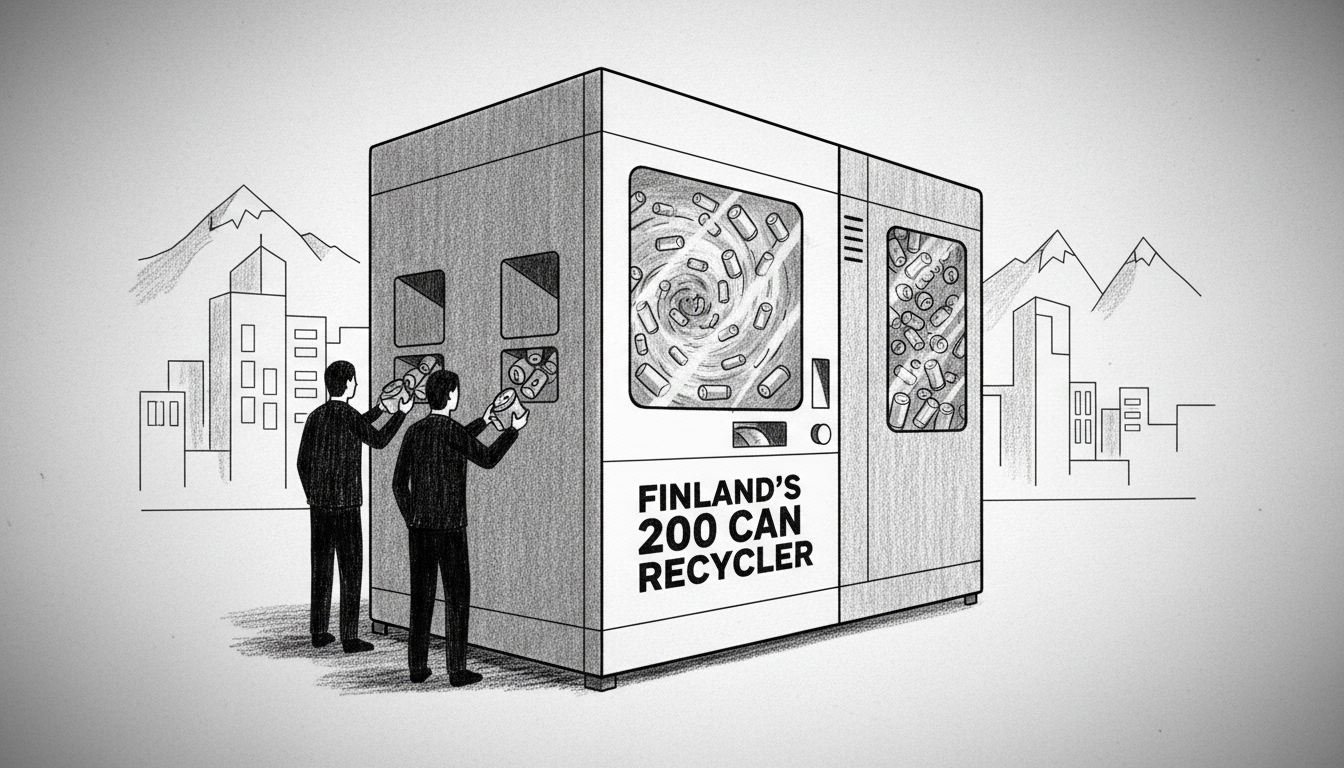
Finland's deposit-return system just got a major efficiency upgrade at the Prisma supermarket in Riihimäki. Two new, state-of-the-art reverse vending machines now dominate the store's bottle return hall, each capable of accepting up to 200 cans or bottles in a single continuous load. The investment by retailer Osuuskauppa Hämeenmaa installs the largest return point in the Kanta-Häme region, transforming a routine chore into a high-capacity recycling operation. This local upgrade highlights the continuous evolution of a national system that already boasts some of the world's highest return rates.
For Finnish consumers, the Sunday bottle run is a cultural ritual. The familiar clatter of containers passing through a machine has long been part of the weekly grocery trip. Now, that process is getting faster. The new units in Riihimäki represent the latest technical model available, designed to handle the steady stream of aluminum, plastic, and glass with fewer interruptions. Store management has not disclosed the exact cost of the investment, but its scale signals a strong commitment from the retailer to its role in the circular economy chain. 'It's quite a factory in there now,' one local shopper remarked, describing the expanded return area.
The Engine Behind Finland's Recycling Success
The machines are just the visible endpoint of a meticulously designed national system. Finland's deposit-refund scheme, launched for cans in 1996 and expanded to plastic bottles in 2008, is a cornerstone of its environmental policy. Consumers pay a small deposit—typically 0.10 to 0.40 euros—on each beverage container at purchase. This deposit is refunded in full when the empty container is returned to an approved collection point, almost always within a grocery store. The financial incentive is powerful and effective. Return rates consistently exceed 90% for many container types, with refillable glass bottles seeing near-total recovery.
The system is managed by Suomen Palautuspakkaus Oy (PALPA), a non-profit company owned by the beverage and retail industries. PALPA coordinates the logistics, ensuring returned materials are sorted, processed, and channeled back to manufacturers as raw materials. This closed-loop model reduces litter, saves energy, and cuts demand for virgin resources. Retailers' participation is mandatory for stores of a certain size, but investments like Riihimäki's go beyond basic compliance, aiming to improve customer experience and operational flow.
Retailers as Key Circular Economy Hubs
Osuuskauppa Hämeenmaa's move is part of a broader trend where retailers actively enhance recycling infrastructure. Supermarkets serve as the critical collection interface for millions of containers annually. Efficient, well-maintained machines reduce queues, encourage compliance, and keep the system running smoothly. For the retailer, it is a customer service issue as much as an environmental one. A slow or frequently full machine creates frustration. High-capacity, reliable machines make the return process quick and reliable, integrating environmental responsibility into a positive shopping experience.
Experts in waste management view such upgrades as essential for maintaining the system's high performance. 'The technical reliability and capacity of the collection network are fundamental,' notes a circular economy researcher from the Finnish Environment Institute (SYKE). 'As consumption patterns change and volumes remain high, the backend infrastructure must keep pace. Investments in the latest machinery reduce downtime, improve sorting accuracy, and ensure the collected materials are of high quality for recycling.' This local investment in Riihimäki, therefore, supports national targets for resource efficiency and waste reduction.
A Nordic Model with Proven Results
Finland's system is a standout example of the Nordic deposit-refund approach, often compared to neighboring Sweden and Norway. These systems share high return rates but differ in operational details. The Finnish model is praised for its simplicity for the end-user and its cost-effectiveness for the industry. The success is quantifiable. Beyond the 90%+ return rates, the system recycles over 2 billion containers annually, turning waste into a valuable material stream. This performance directly contributes to Finland's ambitions under the EU's Circular Economy Action Plan, which mandates stricter recycling targets for member states.
The EU context is increasingly important. The European Commission is pushing for higher recycling rates for packaging waste, and effective deposit systems are recognized as a key tool. Finland's experience provides a case study in building a system with strong stakeholder buy-in from producers, retailers, and consumers. The system's administrative costs are relatively low as a percentage of the material value, demonstrating that environmental goals can align with economic practicality.
Looking Ahead: Digitalization and Future Challenges
The evolution of bottle return is not over. Discussions in Finland and across the Nordics now focus on digitalizing the deposit system. Pilot projects explore 'digital deposits' where a container's barcode is scanned at purchase and the return is logged via a mobile app, potentially eliminating the need to physically bring containers to a store. While such a future may be on the horizon, the current physical infrastructure—epitomized by the new machines in Riihimäki—remains indispensable. The next challenge is expanding the system to cover new types of packaging, such as small bottles for juices and dairy products, to capture a wider stream of materials.
The two new machines in Riihimäki's Prisma are more than just convenient appliances. They are a tangible sign of a functioning circular economy. They represent the ongoing collaboration between policy, commerce, and consumer habit that makes the system work. As Finland refines its world-class recycling model, these incremental upgrades ensure the system stays fast, efficient, and capable of meeting future demands. The quiet hum of the machine processing 200 cans at a time is the sound of a system that works.