
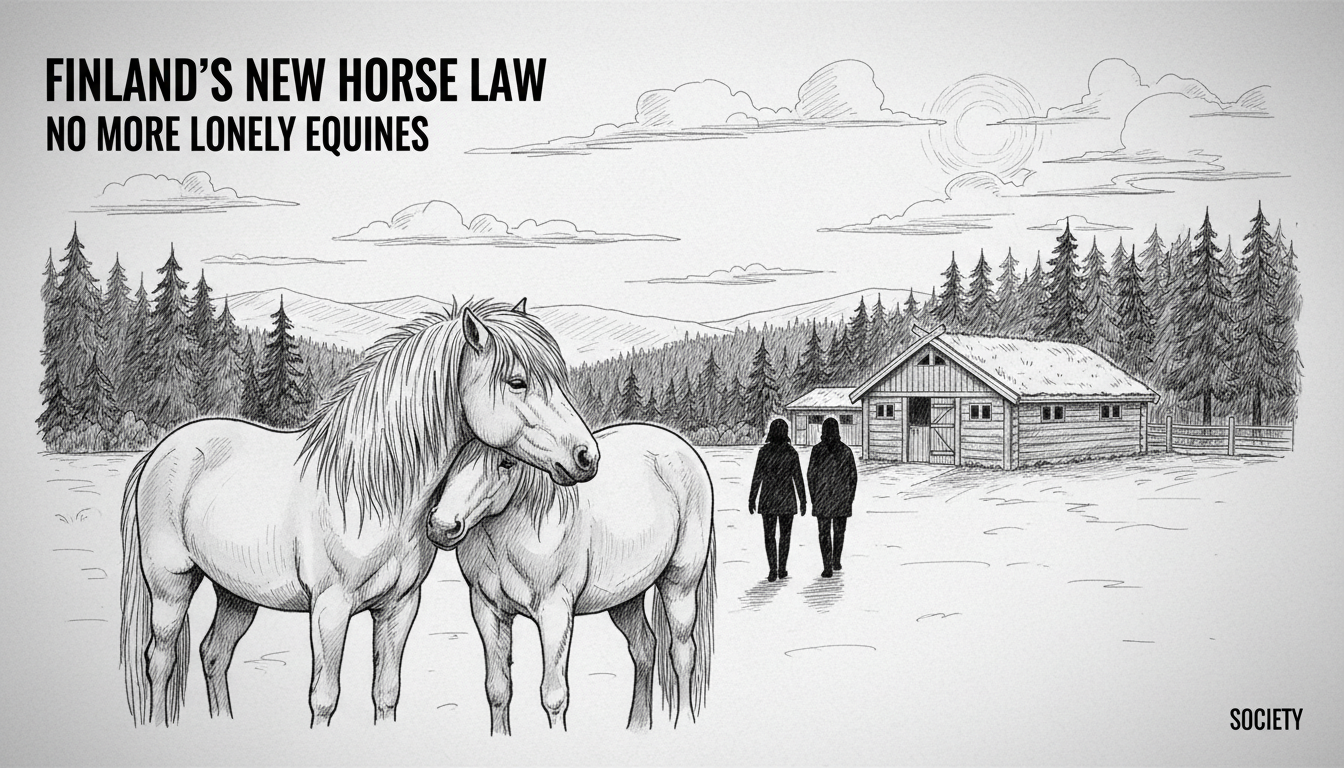
Finland's new animal welfare act mandates that horses cannot be kept alone starting January 1, 2024. The landmark legislation requires all horses, with a notable exception for stallions, to have both visual and auditory contact with another horse in their permanent enclosure. This legal shift from viewing horses as livestock to recognizing them as social beings marks one of Europe's most progressive animal welfare policies, compelling thousands of owners to adapt their stables and routines.
"This is a fundamental change in how we legislate animal welfare," said Minister of Agriculture and Forestry, Sari Essayah, during the act's parliamentary reading. "Scientific evidence is clear: social isolation causes significant stress and behavioral issues in herd animals. Our legislation must reflect that understanding." The new rules stem from a 2022 government proposal that received broad cross-party support in the Eduskunta, Finland's parliament, aligning national law with evolving EU animal welfare principles.
The Specifics of Socialization
The core of the new regulation is straightforward: equine solitude is now illegal. For a horse's primary living space, constant visual and auditory contact with another horse is mandatory. Furthermore, the animal must have the opportunity for daily muzzle-to-muzzle contact, which can be arranged through shared time in a paddock, pasture, or designated meeting area between stalls. This daily physical interaction is considered crucial for bonding and social grooming.
Recognizing real-world complications, the law includes necessary flexibility. If a horse is suddenly left alone due to the death or sale of a companion, the owner has a grace period of up to 12 weeks. During this time, they must either acquire a new equine companion or move the remaining horse to a location where it can socialize. The regulation also introduces stricter space requirements for group housing and provides more detailed specifications for shelter structures in paddocks.
The Stallion Exception and Practical Debates
A critical exemption within the act has sparked discussion: the daily muzzle contact requirement does not apply to stallions. This clause acknowledges the practical challenges and potential safety risks of housing intact male horses together. However, they are still bound by the requirement for constant visual and auditory contact, meaning they must be able to see and hear other horses.
This exception highlights the balancing act policymakers faced. "The welfare of the animal and the safety of both animals and handlers must be considered together," explained Professor Laura Hänninen, an animal welfare ethologist at the University of Helsinki. "For stallions, the stress of forced co-habitation could outweigh the stress of limited physical contact. The visual and auditory connection is a vital compromise." Some smaller breeders have expressed concern over the costs of modifying stables to meet the new spatial and structural requirements, particularly for creating safe, adjoining enclosures for stallions.
From Nordic Tradition to EU-Aligned Policy
Finland's relationship with horses is deeply rooted in its rural and cultural history. For centuries, horses were primarily working animals in forestry and agriculture. The modern shift towards equestrian sports and leisure ownership has gradually changed public perception, paving the way for welfare-centric legislation. This new act represents a significant step beyond basic care standards, mandating psychological well-being.
The policy aligns Finland with a growing European trend. Several other EU member states, including Sweden and Austria, have introduced similar social requirements for horses in recent years. The Finnish law, however, is particularly detailed in its operational specifications. It builds upon the EU's general principle of animal sentience—the recognition that animals are conscious, feeling beings—which was formally incorporated into the Treaty on the Functioning of the European Union over a decade ago. Finland is now implementing that principle in concrete, enforceable national law.
Implementation and Industry Adaptation
Enforcement of the new rules falls to local food safety authorities, who conduct routine welfare inspections. Non-compliance can result in official orders to rectify the situation and, in persistent cases, administrative fines. The Finnish Equestrian Federation has been actively informing its members through seminars and guidelines, emphasizing solutions like shared paddock time, stable grids that allow for safe interaction, and cooperative ownership models.
For many professional stables, the changes are manageable. "We've always believed horses need company," said Anna Korhonen, who runs a riding school in Hämeenlinna. "For us, it's mostly about formalizing what we already do. The challenge is for the single-horse owner who keeps their pet in the backyard. They need to get creative—perhaps partnering with a neighbor for daily turnout." The law is expected to increase demand for retired or companion horses, potentially benefiting equine rescue organizations.
A Broader Shift in Animal Welfare
This legislation is not an isolated measure. It is part of a comprehensive update to Finland's Animal Welfare Act, which also introduces stricter regulations for other pets, livestock, and animals used in entertainment. The government's move reflects a societal consensus that is increasingly intolerant of practices that compromise an animal's natural behavioral needs.
Animal welfare scientists have largely applauded the move. Decades of research show that socially isolated horses exhibit higher levels of stress hormones, increased stereotypic behaviors like weaving or crib-biting, and can develop deeper anxiety issues. By legally mandating companionship, Finland is using policy to prevent these welfare problems before they start. The law places the responsibility squarely on the owner to provide an environment that supports the horse's innate social nature.
As the January 1 deadline passes, the focus turns to adaptation and compliance. Finland's new law sets a high bar for equine welfare, transforming the classic image of a lone horse in a field into a relic of the past. It asks a fundamental question that extends beyond stables: if we recognize animals as sentient, what are we obligated to provide beyond just food and shelter? For Finland's horses, the answer now legally includes a friend.