
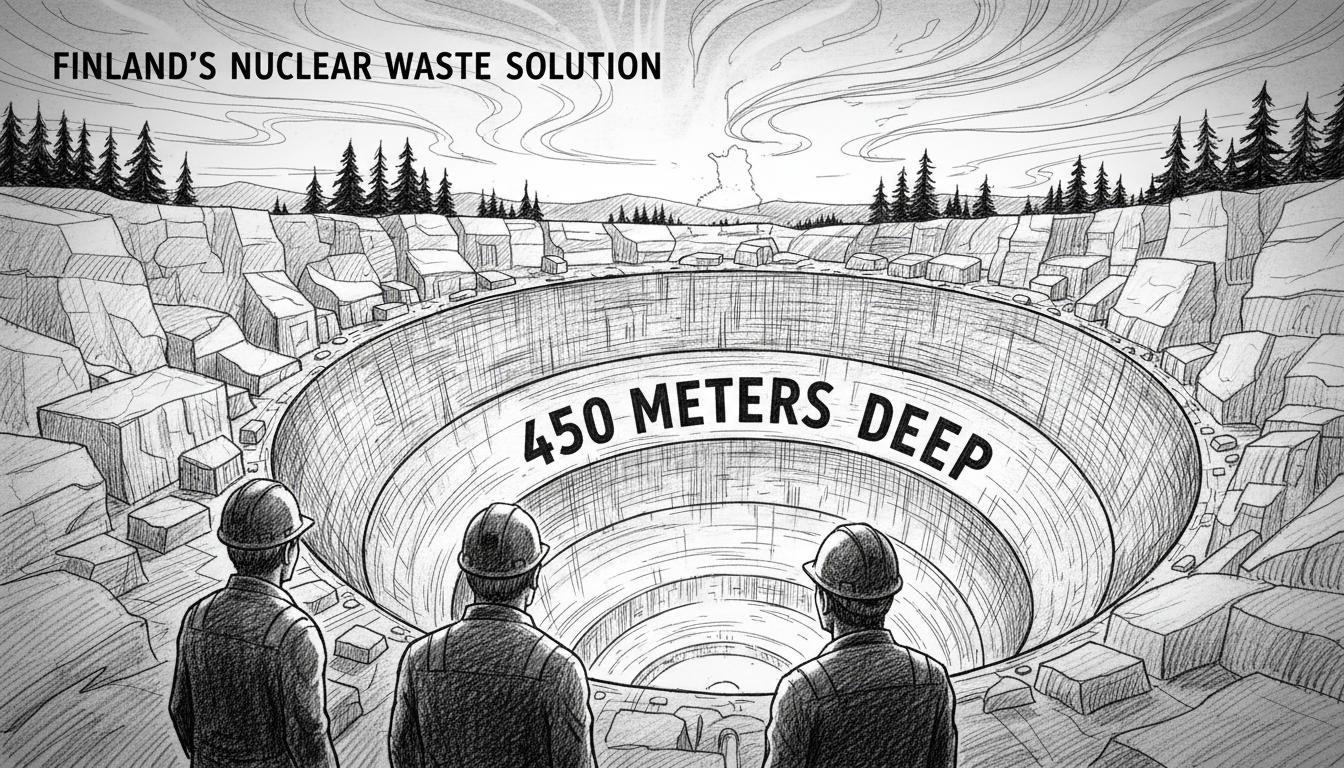
Finland's nuclear waste disposal project is descending 450 meters into bedrock, setting a global standard for permanent radioactive storage. The Onkalo repository represents a monumental engineering feat, addressing one of humanity's most persistent environmental challenges. From my perspective covering Danish society and integration, this Finnish success story highlights the power of societal consensus and long-term policy planning—elements that resonate deeply in Nordic governance models. While Denmark has chosen a different energy path, the lessons from Finland offer valuable insights into how societies manage complex, intergenerational responsibilities.
The Deepest Answer to a Nuclear Question
A 70-second elevator ride plunges workers eight meters deeper every second into the Finnish bedrock. This descent into the Onkalo spent nuclear fuel repository feels like a controlled fall towards the Earth's core. Finland has pioneered this approach out of necessity, relying on nuclear power for over 30% of its electricity. The country ratified the Joint Convention on the Safety of Spent Fuel Management in 1997, committing to responsible disposal long before many nations even acknowledged the problem. In contrast, Danish energy policy has historically avoided nuclear power, focusing instead on wind and renewables. Yet the Finnish model demonstrates how technological innovation coupled with strong public trust can solve seemingly intractable issues. Their process involved decades of research, transparent communication with municipalities, and a legislative framework that prioritized safety over speed.
Engineering Eternity: How Onkalo Works
The core concept at Onkalo involves encapsulating spent nuclear fuel in copper canisters, then burying them in tunnels deep within the stable bedrock. These canisters are surrounded by bentonite clay, a natural material that swells when wet, creating an additional barrier against water intrusion. Posiva Oy, the company owned by Finnish power firms Fortum and TVO, manages this project with an estimated cost in the billions of euros. Operational costs will continue for decades as the facility is gradually filled and monitored. Experts emphasize the importance of geological stability here; the Finnish bedrock has remained unchanged for over a billion years, offering a predictable environment. The depth of 400-450 meters places the waste far below groundwater systems, minimizing risk of contamination. This engineering solution is designed to isolate waste for up to 100,000 years, essentially creating a permanent tomb for radioactive material.
A Nordic Consensus: Trust and Technology
Finland's achievement stems from a unique Nordic blend of high institutional trust and technological pragmatism. Public acceptance was crucial, built through extensive dialogue with local communities near Olkiluoto. Municipalities were involved from the start, ensuring that social and economic impacts were addressed. This mirrors successful integration policies in Danish society, where community engagement in cities like Copenhagen has proven vital for social cohesion. In Denmark, we see similar trust-based approaches in welfare system reforms and immigration policy, where stakeholder inclusion often leads to more sustainable outcomes. Statistics from Finnish studies show that over 70% of local residents support the Onkalo project, a stark contrast to the protests that have halted similar initiatives in other countries. This consensus reflects a broader Nordic willingness to make difficult decisions for long-term benefits, a trait evident in Denmark's ambitious climate policies.
Global Implications and Danish Reflections
Onkalo serves as a critical case study for nations grappling with nuclear waste, including those with existing reactors like Sweden and potential future adopters. However, the specific geological conditions in Finland are not universally applicable, requiring tailored solutions elsewhere. From a Danish standpoint, while we have no high-level nuclear waste, the principles of responsible long-term planning are relevant. Denmark manages other hazardous wastes through rigorous regulations and municipal cooperation, akin to the Finnish model. The Danish welfare system often emphasizes preventive measures and future-oriented thinking, such as in education and social policy. For instance, Denmark's integration policies for immigrants focus on long-term societal benefits through language training and job placement, paralleling the incremental, trust-building approach seen in Finland's waste management. The Finnish success underscores that technological fixes must be underpinned by social license, a lesson that resonates in Danish policy debates on everything from energy transitions to urban development.
What Happens in 100,000 Years?
The Onkalo repository forces us to confront timescales beyond human comprehension. Engineers and scientists have designed markers and records to warn future civilizations of the buried danger, but this raises profound questions about our responsibility to distant generations. In Danish society, we engage with similar intergenerational equity issues in pension system reforms and environmental protection. The Danish approach often involves consensus-building across political spectrums, much like Finland's cross-party support for Onkalo. As climate change accelerates, Denmark and other Nordic countries are increasingly focused on sustainable solutions that balance immediate needs with future risks. The Finnish nuclear waste project, while unique, exemplifies the Nordic capacity to merge innovation with integrity, offering a template for global challenges. Ultimately, it reminds us that the deepest holes we dig are not just in the ground, but in our collective conscience, demanding answers that last longer than our lifetimes.