
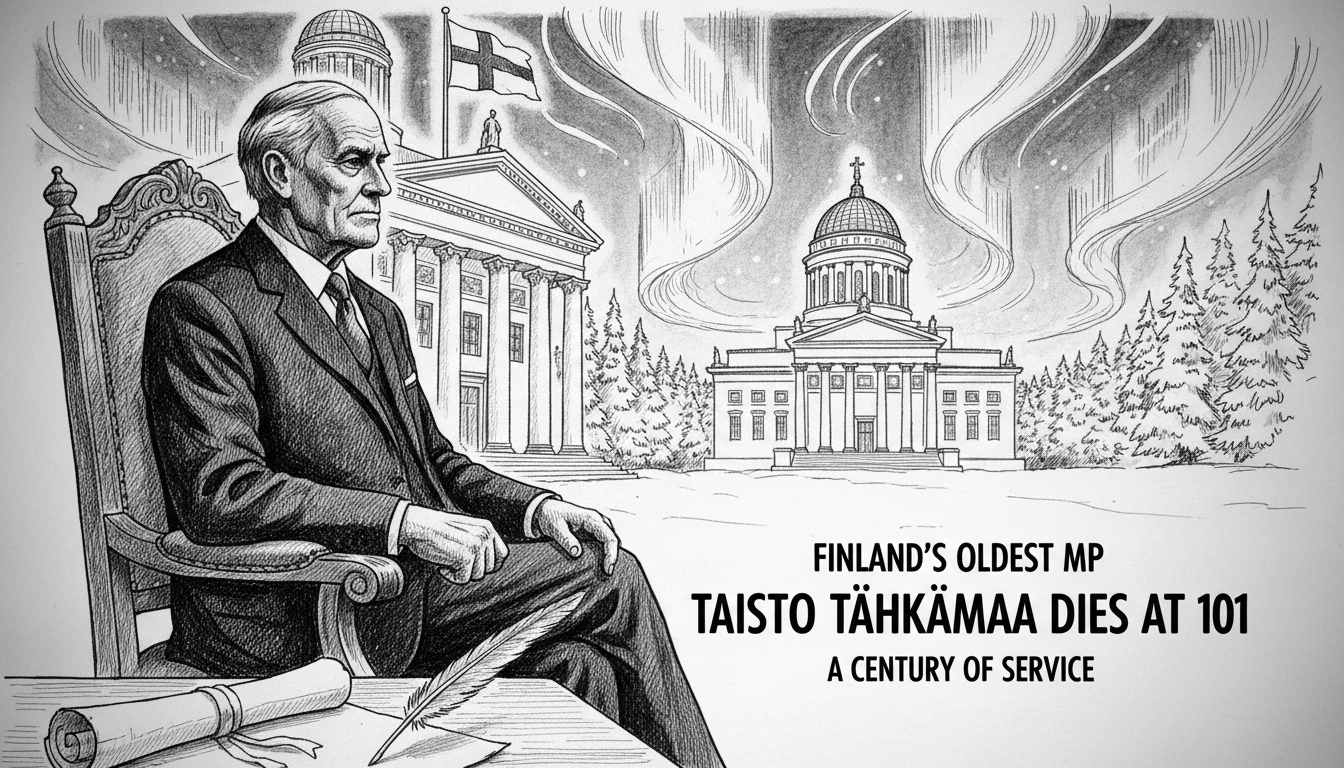
Finland's former minister and centenarian politician Taisto Tähkämaa has died at the age of 101. His daughter Sanna Tähkämaa confirmed he passed away peacefully in his sleep during the early hours of Sunday in a nursing home in Kaarina. This marks the end of a life that spanned Finland's transformation from a post-war agrarian society to a modern EU member state.
Tähkämaa's death closes a chapter on a generation of leaders who shaped the nation's 20th-century identity. Born in 1924 in Parainen, he witnessed the Winter War, the reconstruction era, and the country's integration into Europe. His career as a farmer turned statesman reflects the core values of Finland's Centre Party, formerly the Agrarian League, which long championed rural interests.
A Peaceful Passing and a Century of Life
Taisto Tähkämaa spent his final years in the Kaarina care home, where staff described him as a respected figure. His daughter noted he had remained mentally sharp, often reflecting on his political service. At 101, he was the oldest living former parliamentarian in Finland, a title that now passes to another.
His longevity offered a living link to Finland's past. Tähkämaa was born when the country was just seven years independent. He grew up during the economic struggles of the 1930s and served in non-combat roles during the Second World War. These experiences fundamentally informed his political outlook, emphasizing self-sufficiency and national resilience.
From Farm to the Eduskunta
Before entering politics, Tähkämaa worked as a farmer and earned the title of agricultural advisor (maanviljelysneuvos). He first won a seat in the Finnish Parliament, the Eduskunta, in 1970. He represented the southern electoral district of Turku for the Centre Party continuously until 1991.
His election coincided with a period of significant change. Finland was navigating its delicate relationship with the Soviet Union while building a Nordic welfare state. Tähkämaa's agrarian background made him a vocal advocate for farmers and rural communities in the legislature. He argued for subsidies and policies to maintain the viability of agriculture across the country.
Ministerial Tenures in a Defining Era
Tähkämaa's parliamentary service led to roles in three governments during the 1970s and 1980s. He served as Minister of Agriculture and Forestry, a critical portfolio for his party's base. Later, he took on the role of Minister of Defence, a position of immense trust during the Cold War.
As defence minister, he oversaw Finland's policy of neutrality and military preparedness. This was a time when Finland balanced its independence with the realities of geopolitics. His work focused on maintaining a credible national defence while adhering to international treaties and a cautious foreign policy.
Political commentator Juhani Siika-aho highlighted this dual role. "Suomen vuosisata oli myös Tähkämaan vuosisata. Hän oli keskeisiä vaikuttajia Suomen turvallisuuden vahvistajana ja yhteiskunnan rakentajana," Siika-aho said. This translates to Tähkämaa being a central figure in strengthening Finland's security and building its society.
Analysis: A Pillar of Post-War Finland
Political analysts see Tähkämaa's career as emblematic of a specific Finnish political tradition. The Centre Party's dominance in mid-century politics was built on rural support, and figures like Tähkämaa were its standard-bearers. His move from agriculture to defence illustrates the interconnectedness of domestic and foreign policy in a small, border-state nation.
"He represented a generation for whom politics was about stewardship, not spectacle," said Dr. Elina Korhonen, a political historian at the University of Helsinki. "His work in agriculture was about securing food production, a national security issue. His work in defence was about securing sovereignty. Both were grounded in a deep, pragmatic patriotism."
This generation oversaw the creation of Finland's modern infrastructure and social systems. They managed the transition from a largely rural economy to a more diversified one, all while maintaining social cohesion. Tähkämaa's policies, particularly in agriculture, helped cushion the shock of urbanization and industrialization for many communities.
The Cold War Context and EU Precursor
Tähkämaa's time as defence minister occurred during the late stages of the Cold War. Finland's doctrine of neutrality, known as the Paasikivi-Kekkonen Line, required meticulous diplomacy. Ministers like Tähkämaa operated within strict parameters to avoid provoking the Soviet Union while building ties with the West.
This era set the stage for Finland's later foreign policy shifts. After the Cold War ended, Finland joined the European Union in 1995, a move that transformed its agricultural and trade policies. Tähkämaa, who retired from politics in 1991, witnessed the beginning of this debate. His legacy includes the stable foundation upon which that EU membership decision was later made.
His approach to defence emphasized conscription, territorial integrity, and credible deterrence. These principles remain cornerstones of Finnish security policy today, even as the country has joined NATO. Analysts note that his tenure helped professionalize the defence ministry during a complex geopolitical period.
Personal Legacy and Political Reflection
Beyond politics, Tähkämaa was known as a family man deeply connected to his roots in Southwest Finland. Colleagues recalled his calm demeanor and willingness to listen, traits that served him well in coalition governments. Finland's political system often requires compromise between multiple parties, and his style was conducive to building consensus.
His death prompts reflection on the changing nature of the Centre Party. Once the dominant force in Finnish politics, it has seen its rural base shrink due to demographic changes. The party now struggles to redefine itself in an urbanizing Finland. Tähkämaa's career represents its peak influence, when agrarian interests directly shaped national policy.
Current Centre Party leaders have issued statements praising his dedication and service. They highlight his commitment to both the land and the nation's security as ideals the party still aspires to represent, even as its policy platforms evolve.
Final Years and National Memory
In retirement, Tähkämaa remained a keen observer of politics. He lived through the tenures of numerous presidents and saw Finland adopt the euro. His perspective was unique, encompassing nearly the entire history of independent Finland.
His passing is noted not just as the loss of a former minister, but as the loss of a living archive of 20th-century Finnish statecraft. Few individuals have had such a direct hand in both feeding the nation and defending it during such a pivotal century.
As Finland now navigates a new geopolitical landscape within NATO and the EU, the principles Tähkämaa embodied—caution, resilience, and a deep connection to the land—remain part of the national discourse. His life serves as a reminder of the foundations upon which modern Finland was built, prompting the question: how will these values adapt to the challenges of the 21st century?