
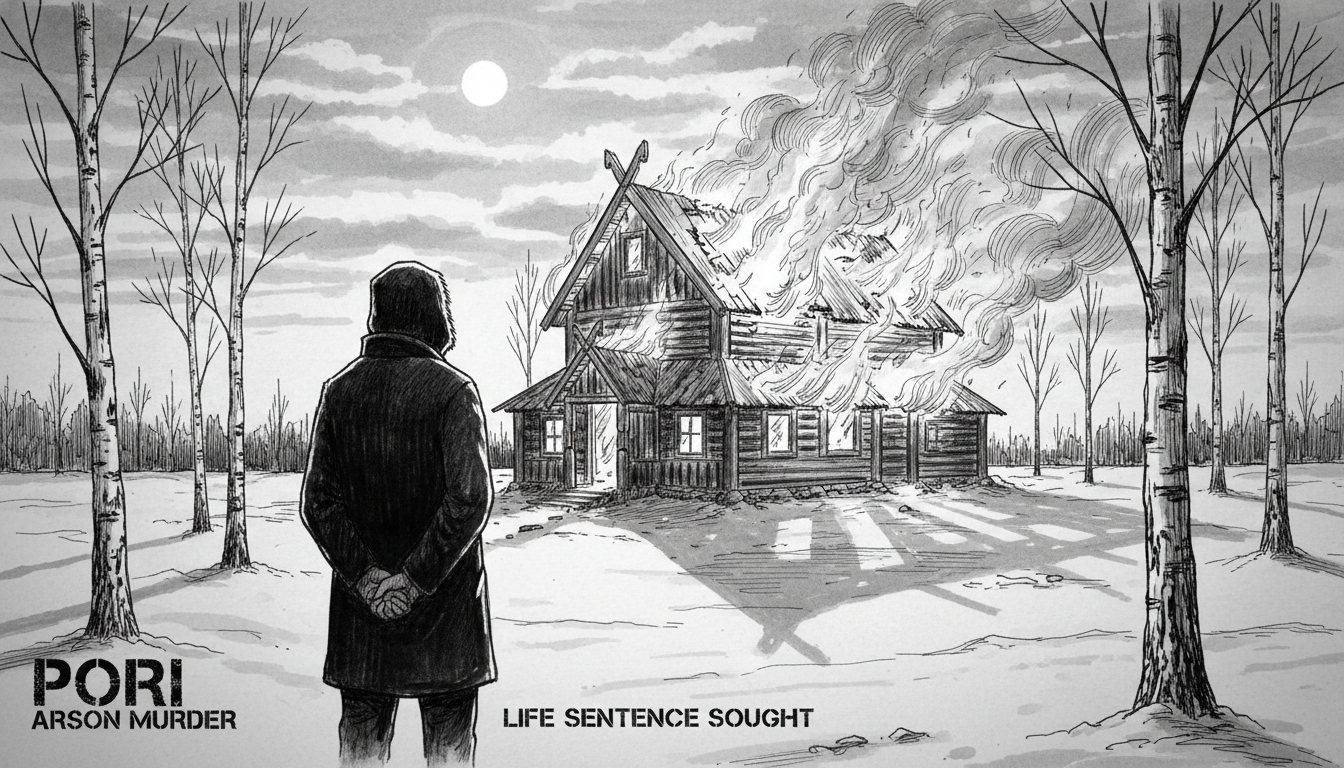
Finland's criminal justice system is confronting a case of extreme brutality as a prosecutor demands a life sentence for a 43-year-old man accused of burning his neighbor alive. The trial, unfolding in the Satakunta District Court in Pori, alleges a crime of exceptional cruelty against a victim who was himself a convicted murderer. This case tests the foundational principles of Finnish law, where every defendant is entitled to due process, regardless of the victim's history or the horror of the alleged acts.
According to the prosecution's detailed charge sheet, the events began with a car collision outside the men's row house in the Lavila district of Pori. The 50-year-old victim was allegedly sitting or crouching in the driveway. The situation escalated violently into the yard, where the accused is said to have struck the victim in the head with a two-kilogram stone, causing bleeding wounds.
The violence then moved inside the victim's apartment, progressing to rear dressing and laundry rooms. There, the prosecutor states the accused struck the victim at least four times in the head with the leg of a chair or a stool. The victim was then undressed. In a deliberate act of humiliation, the accused allegedly used a carpet knife or similar sharp instrument to carve the word 'rotta' – Finnish for 'rat' – into the victim's back and cut off his hair. Nylon cable ties were fastened around the victim's neck.
An Allegation of Immolation
The prosecution's core allegation is that the accused then doused the victim in a flammable liquid and set him on fire while the man was still alive. The accused then left the apartment. The victim's body was discovered deceased the following evening. The prosecutor characterizes the homicide as "especially brutal and cruel," containing elements of torture and degradation, and demonstrating a "persistent intent to kill."
The accused man denies the murder charge. He admits to aggravated assault but presents a different version of the fatal moments. His defense claims the victim had some kind of "canister" in his hands in the laundry room, followed by a sudden, uncontrolled flash of fire – described with the word 'mossahdus'. This account is used to explain why both men suffered burns to their palms, lower backs, armpits, and the accused's face.
A Victim with a Notorious Past
This case carries a unique and grim dimension: the victim was known to Finnish authorities and the public as a convicted dismemberment murderer. This fact inevitably colors public perception, though it holds no legal bearing on the current defendant's guilt or innocence. The court's sole focus is on the evidence presented about the events in Pori. The principle of rule of law demands that even the most reviled individual is entitled to safety and justice, a cornerstone of the Finnish constitutional state.
A second man is also implicated in the case, charged with protecting a criminal. He is accused of calling emergency services after the incident, but specifically to seek help for the burns sustained by the primary suspect, not initially to report the attack on the victim.
Finland's Homicide Context and Legal Process
While this case is shocking in its details, it occurs within a country known for a low overall homicide rate. Finland typically records around 1.2 homicides per 100,000 inhabitants, a figure that is low by global standards. The clearance rate for murders in Finland is also consistently high, often exceeding 90%, reflecting effective investigative work. This case, however, stands out for its alleged sadistic methodology.
"The prosecution's description, if proven, depicts a level of premeditated cruelty that is very rare in Finland," says a Helsinki-based criminologist who requested anonymity due to the ongoing trial. "The transition from physical violence to symbolic humiliation through carving, and then to immolation, suggests a deep-seated rage and a desire to utterly annihilate the victim. The legal system's challenge is to dissect this narrative forensically, separating established fact from allegation."
Legal experts note that the defense's strategy of admitting to assault but denying murder hinges on creating reasonable doubt about intent and the final, fatal act. The sequence of events, the severity of the victim's prior injuries, and the accused's actions after the fire will all be critical points of contention. The burden remains entirely on the prosecution to prove the murder charge beyond a reasonable doubt.
The Weight of a Life Sentence
The prosecutor's demand for a life sentence is Finland's most severe penalty. In practice, a life sentence typically means a minimum incarceration period of 12 to 14 years before the prisoner can apply for parole, though for the most severe crimes, longer minimums can be imposed. The Parole Board then assesses danger to society. A life sentence is reserved for the gravest murders, particularly those involving exceptional brutality, cruelty, or multiple victims.
The trial in the Satakunta District Court is just the first step. Its verdict can be appealed to the Court of Appeal and potentially to the Supreme Court. This process ensures multiple layers of judicial scrutiny, especially in a case carrying such a severe potential penalty. The proceedings are methodical, evidence-driven, and removed from the court of public opinion.
For the city of Pori, a quiet coastal community, the case is a disturbing anomaly. It raises uncomfortable questions about violence, vengeance, and the coexistence of individuals with violent pasts within ordinary communities. The fact that both men lived in the same row house suggests a proximity that turned fatally toxic.
As the district court hears testimonies and examines forensic evidence, it must navigate a narrative of almost unimaginable violence. The outcome will hinge on cold, hard evidence: the forensic pathology of the burns, the analysis of the crime scene, and the credibility of witness accounts. The court must determine whether this was a murder by immolation, as the state claims, or a tragic escalation of mutual violence culminating in a horrific accident, as the defense suggests.
The case serves as a stark reminder that even in societies with low crime, human beings are capable of profound darkness. The Finnish system's response is not one of outrage, but of meticulous, calm deliberation. The search for truth in the Pori arson murder case continues, one piece of evidence at a time, behind the solemn doors of the district court.