
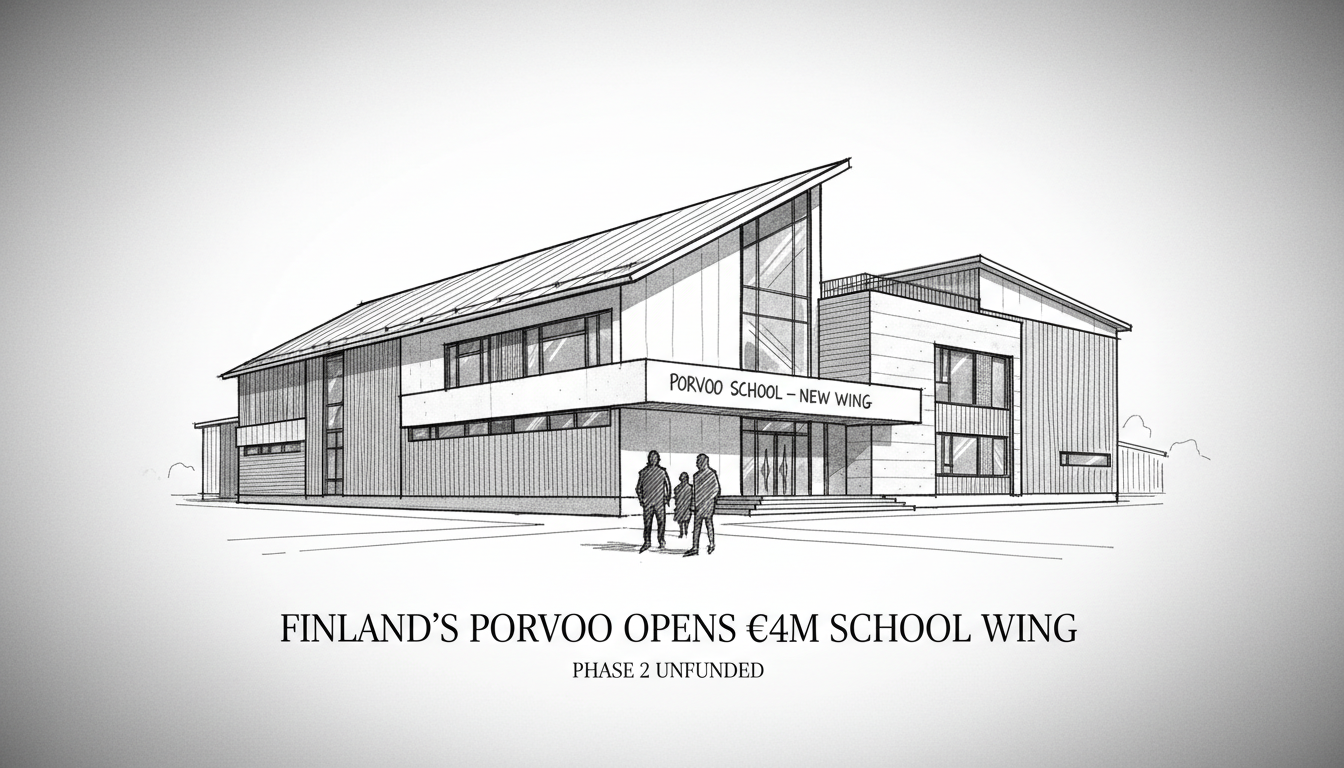
Finland's Porvoo municipality has opened a new 3.95 million euro extension at Kvarnbackens skola, a key investment in local education infrastructure. The modern wing entered use last week, providing immediate relief for the Swedish-language school's space needs. Yet the project remains incomplete, with a crucial second phase designed for flexible learning spaces now stalled due to a lack of municipal funding approval.
This situation in the historic coastal city highlights a recurring tension in Finnish municipalities: balancing ambitious educational goals with strict budgetary realities. While the first phase addresses capacity, educators argue the unfunded second phase is essential for modern pedagogical methods that Finland champions globally.
A Modern Solution with an Incomplete Vision
The newly opened extension at Kvarnbackens skola, locally known as Kvaba, represents a significant capital investment for Porvoo. The 3.95 million euro sum was allocated to construct additional classrooms and basic facilities, directly responding to growing student numbers and the need to update aging infrastructure. Municipal officials celebrated the opening, emphasizing its role in maintaining high-quality education standards in the city's Swedish-speaking community.
However, the original architectural and pedagogical plan for the school's expansion was more comprehensive. It included a second phase specifically designed to create smaller group workspaces and adaptable learning environments. These flexible spaces are increasingly seen as critical for the collaborative and project-based learning that defines contemporary Finnish education. Without them, teachers at Kvaba may find themselves in modernized classrooms but still constrained by traditional, inflexible layouts.
The Municipal Budgetary Squeeze
Porvoo's dilemma is not unique. Across Finland, municipalities bear the primary responsibility for funding and operating comprehensive schools. They must weigh educational investments against other pressing needs like social care, infrastructure maintenance, and cultural services. A municipal finance analyst, speaking on background, explained that multi-phase projects are often vulnerable. "The first phase, which solves the most visible problem like overcrowding, often gets funded," the analyst said. "Subsequent phases that enhance quality or future-proof the building are harder to justify politically when budgets are tight. They become discretionary items that are easy to postpone."
This funding delay occurs despite broad political consensus in Finland on the value of education. The Finnish Parliament (Eduskunta) sets the national framework and core curriculum, but the financial burden for implementation falls locally. There is no current national grant program specifically targeted for completing such school modernization phases, leaving Porvoo's city council to find the funds from its own revenue streams, which include income tax and state subsidies.
Educational Experts Stress the Pedagogical Cost
Education specialists express concern over the stalled second phase. Dr. Elina Saarelainen, a researcher in learning environments at the University of Helsinki, states that infrastructure directly supports pedagogy. "Finnish education succeeded by focusing on equity, teacher professionalism, and student well-being," Saarelainen notes. "The physical environment is a key component of that ecosystem. Flexible spaces are not a luxury; they allow for the differentiation and group work that are central to our curriculum. Investing in only half of a modern learning environment ultimately limits what teachers can achieve."
Teachers at Kvarnbackens skola now face a mixed scenario. They have gained new, modern classrooms from the first phase, which will improve daily conditions. Yet they lack the specialized spaces that would allow them to fully implement innovative teaching methods. This could mean continuing to use standard classrooms for activities better suited to breakout zones or project labs, potentially diluting the intended educational impact of the entire expansion project.
The Path Forward for Porvoo and Kvaba
The future of the second phase now depends on Porvoo's political and budgetary priorities. The issue will likely resurface during the next municipal budget cycle, where it will compete with other capital projects and operational demands. Advocates, including parents and school staff, may lobby council members to allocate the necessary funds. They could argue that delaying the completion is a false economy, potentially leading to higher costs later or a diminished return on the initial 4-million-euro investment.
Alternative funding avenues appear limited. While some Finnish municipalities have partnered with private foundations for specific educational projects, this is less common for basic infrastructure. The most probable path is through municipal borrowing or the re-prioritization of existing capital expenditure plans. The decision will serve as a concrete indicator of how Porvoo values long-term educational quality against short-term fiscal balance.
A Microcosm of a National Conversation
The situation at Kvarnbackens skola reflects a broader, quiet conversation happening across Finland. As pedagogical practices evolve, many school buildings from the late 20th century require renovation or adaptation. The question of who pays for these updates—and how to sequence them in a fiscally responsible way—challenges many local governments. The Finnish model of municipal autonomy gives cities like Porvoo great freedom but also places the full financial responsibility on them.
This case demonstrates that even in a country lauded for its education system, maintaining that standard requires continuous, and sometimes difficult, investment. The opening of the new wing is a positive event for Porvoo's students and a testament to the municipality's commitment. But the unfunded second phase hangs as a reminder that in public finance, vision and reality are often phased differently. The community's ability to complete its vision for Kvaba will show how Finland sustains its educational excellence at the local level, one school and one budget decision at a time.