
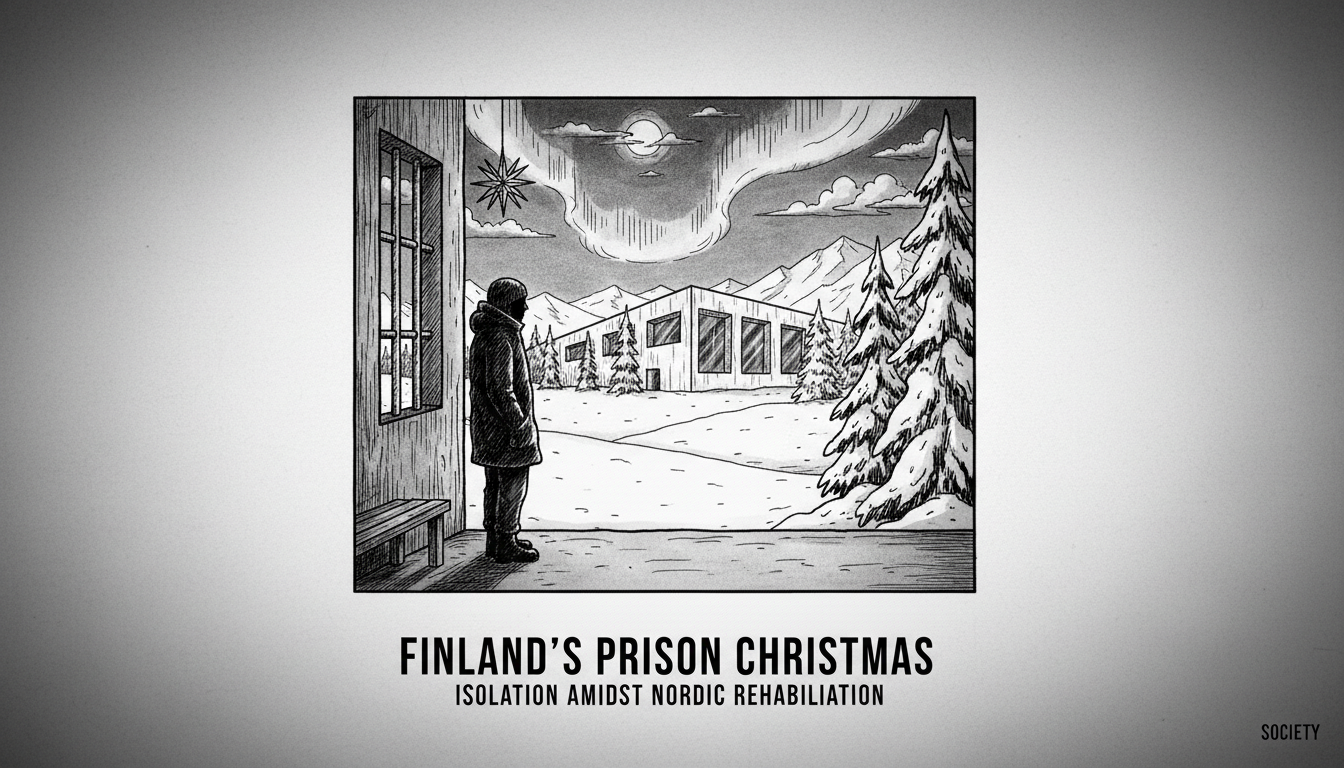
Finland's prison system, celebrated globally for its humane and rehabilitative approach, confronts its most profound annual paradox during the Christmas season. While the Nordic model emphasizes normalization and dignity, the holiday's intense focus on family and home life casts a stark light on the isolation inherent to incarceration. For inmates like Tino Brunfeldt, 32, who has spent more Christmases behind bars than in freedom since adulthood, December 25th is a day to be endured, not celebrated. "You could say it's about five Christmases I haven't been in prison since I became an adult," Brunfeldt said, highlighting a grim familiarity with the holiday's unique pains. His coping mechanism is starkly pragmatic: view it as just another day to get through.
This tension between Finland's progressive penal philosophy and the raw emotional reality for its prisoners defines the holiday period inside institutions like Kuopio Prison. Here, the traditional Finnish hymn "Näin sydämeeni joulun teen" ("Thus I Make Christmas in My Heart") echoes through the chapel, a bittersweet soundtrack for men separated from everything the song represents. The system's efforts to provide normalcy—special meals, religious services, occasional extra phone calls—collide with an unavoidable truth. For many, as one inmate bluntly put it, "Many an old guy would like to be in civilian life now." Christmas magnifies the loss of liberty, making the Nordic model's comforts feel, for a few days, like a beautifully furnished cage.
The Nordic Model Meets a Nordic Tradition
Finland's prison philosophy is built on principles of normalization, proportionality, and reintegration. Prison conditions are designed to mirror life outside as closely as possible, with an emphasis on privacy, education, and preparing inmates for a crime-free future. The country boasts one of Europe's lowest incarceration rates, a point of national pride. Recidivism rates are a central metric, with policies actively designed to maintain family ties and community connections, understood as critical factors in preventing re-offending. This approach is studied worldwide as a potential blueprint for humane justice.
Yet, Christmas presents a unique stress test for this system. In Finland, more than in many cultures, Christmas (Joulu) is a sacrosanct family holiday centered on the home. Traditions like the Christmas sauna, festive dinner, and quiet time with immediate family are deeply ingrained. The holiday period is a national pause, a time when societal activity grinds to a halt and focus turns inward to the hearth. For prisoners, this universal cultural shutdown externally amplifies their internal separation. The very normality the system tries to foster outside makes their absence from it more acutely felt inside. The gap between the prison's attempt at a normalized Christmas and the authentic experience widens dramatically.
Chapel Services and Coping Mechanisms
Within prison walls, chaplains and volunteers work to create islands of seasonal solace. The Christmas service in Kuopio Prison's chapel is a key event, offering spiritual reflection and a break from routine. For some inmates, these services provide genuine comfort and a connection to tradition. For others, they are merely a diversion, a scheduled activity in an otherwise long, empty day. The lyrics of the hymns, often about peace, home, and newborn hope, can resonate with painful irony.
Inmates develop personal strategies to manage the emotional weight. Like Brunfeldt, some adopt a cognitive approach, mentally minimizing the day's significance. "The situation is easier if you think it's just one day, after which Christmas is already over," he explained. Others might immerse themselves in work details if available, lose themselves in books or television, or use the permitted extra communication to reach loved ones. These calls, however, can be double-edged swords—a precious connection that also underscores physical distance and missed moments. The prison administration may authorize special festive meals, but a Christmas ham eaten in a cell block cafeteria lacks the taste of home.
Expert Analysis: Rehabilitation and Seasonal Strain
Criminologists and penal reform experts acknowledge this seasonal challenge within an otherwise successful system. They point out that the emotional downturn during holidays isn't just a matter of sadness; it has concrete implications for the system's core goal: rehabilitation. "The holiday season can be a critical period for mental health inside prisons," explains a Finnish criminologist familiar with prison welfare. "Feelings of depression, anxiety, and loneliness are exacerbated. If not supported, this can lead to behavioral issues, internal conflicts, and set back an individual's rehabilitation progress."
Experts strongly emphasize that maintaining strong family bonds is one of the most powerful tools against recidivism. Christmas, a time when those bonds are culturally activated, thus becomes a period of high risk and high importance. The support provided—through chaplains, psychologists, and understanding staff—is seen not as a luxury but as integral to institutional safety and long-term public security. The Finnish system's willingness to acknowledge and address this pain, rather than ignore it, is cited as a strength. It aligns with the principle of treating prisoners with dignity, even when that dignity is wounded by the circumstances.
A Comparative View: Humane Conditions, Universal Emotions
Internationally, Finland's prisoners experience Christmas under conditions many would envy. Comparisons with overcrowded systems where basic needs are barely met are stark. Finnish inmates have personal space, access to healthcare and education, and are treated under laws designed to protect their rights. The seasonal "hardship" here is primarily psychological and emotional, stemming from separation, not from physical deprivation or threat.
This distinction is crucial. It shows that even in the world's most humane prisons, incarceration's fundamental punishment—the removal of liberty and separation from society—cannot be designed away. The Nordic model mitigates the harms of imprisonment but cannot eliminate them, especially during potent cultural moments. The loneliness felt by an inmate in Finland is as real as that felt by an inmate elsewhere; it simply occurs in a cleaner, safer, and more respectful environment. This reality checks any tendency to romanticize the model. It succeeds brilliantly in many areas, but it cannot grant freedom.
The Longest Days and the Path Forward
For the prison staff, the holiday season also brings a nuanced shift. Their role balances security and humanity, enforcing rules while recognizing the heightened emotional strain on those in their care. The atmosphere in a prison before Christmas is often described as tense, quiet, and thick with unspoken emotion. Staff vigilance for signs of distress or conflict increases.
The broader question for Finnish penal policy is whether more can be done to bridge the holiday gap. Some advocates suggest exploring facilitated family visits on Christmas Day under strict supervision, or enhanced virtual visitations. Others focus on increasing therapeutic and group support sessions in the weeks leading up to the holiday. Any such measures, however, must be weighed against security protocols, resource constraints, and the overarching principle of normalization—the idea that prison life should not have perks unavailable to the poor in free society.
As the last notes of "Näin sydämeeni joulun teen" fade in the Kuopio chapel, the inmates return to their units. They carry with them the contrast of the message of hope and their reality of restriction. Finland's system, for all its merits, ultimately confronts the same immutable truth as all prisons: it locks people away from society. At Christmas, when Finnish society turns most firmly inward towards the family hearth, that lock feels heaviest. The system's humanity is revealed not in erasing that pain, but in acknowledging it, providing spaces for solace, and steadfastly maintaining its focus on ensuring that, for each inmate, this Christmas in prison might be one of their last.