
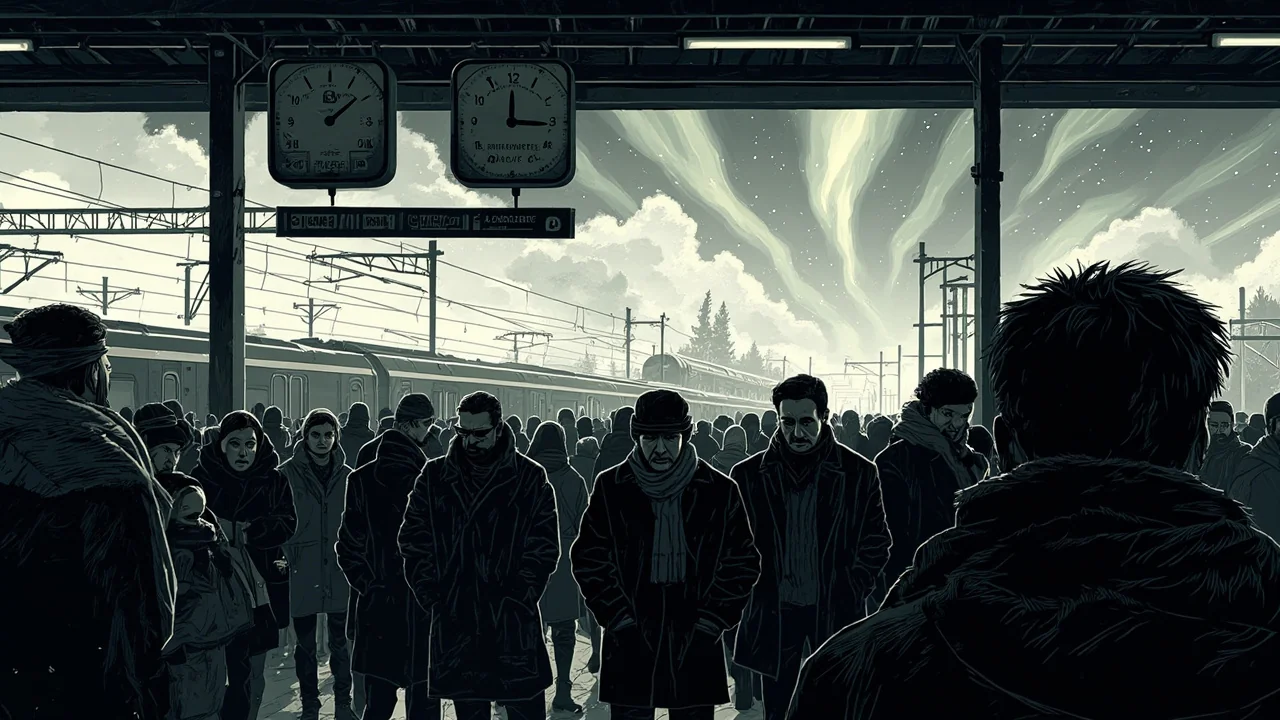
Finland's railway network faced severe disruption on Friday morning, with commuter and long-distance trains delayed by up to 90 minutes after a critical system failure near Kerava. The incident, attributed to winter conditions affecting multiple track switches, highlights the perennial vulnerability of the nation's transport infrastructure to harsh weather, despite extensive preparations by the Finnish Transport Infrastructure Agency (Väylävirasto).
A minor obstruction—a clump of wind-blown snow, a piece of ice, or a stone—can trigger a safety mechanism that shuts down an entire chain of track switches. This precise scenario unfolded during the morning rush hour, creating a cascade of delays that frustrated thousands of passengers. While many took to social media to lament that "winter always surprises VR," the state-owned passenger rail operator, the responsibility for the tracks and switches lies squarely with Väylävirasto.
"Of course winter challenges us. We do a lot of work to ensure it doesn't, but these kinds of conditions certainly do challenge us," said Eero Liehu, the head of maintenance for the Southern Finland region at Väylävirasto. His statement underscores a familiar seasonal battle, where advanced planning meets unpredictable natural forces.
The Fragile Mechanics of Winter Rail
The core of the problem lies in the track switch, a deceptively simple but vital component. Switches guide trains from one track to another. Each is equipped with a safety system that sends a fault signal if the switch is not perfectly aligned. For safety reasons, if one switch in an electronically linked chain fails, all switches in that chain are automatically taken offline. This fail-safe protocol, designed to prevent catastrophic derailments, amplifies the impact of a single, localized issue.
"It's enough that there are some obstacles in the way of the switch so that it doesn't go exactly into the right position," Liehu explained. "This can be, for example, drifted snow, ice chunks falling from trains, or stones." The switches have electric heating elements, and pre-emptive clearing work is conducted, but the rails are outdoors at the mercy of the elements. When automation fails, maintenance crews must be deployed to clean switches manually—a time-consuming process during peak traffic.
Friday's disruption was notable for its scale. While winter typically causes faults in individual switches, this event involved several simultaneously. The first disturbance was detected around 7:30 AM and was linked to the control system apparatus that operates the switches and signals. The inability to move switches created an immediate bottleneck on one of the busiest rail corridors in the country, radiating delays across the network.
A Systemic Challenge Beyond a Single Operator
The public's quick attribution of blame to VR, the passenger train company, reveals a common misconception about Finland's rail architecture. The system is split: Väylävirasto owns, maintains, and develops the rail infrastructure, while VR and other operators run trains on it. This separation, standard in the EU to promote competition, can blur accountability in the public eye during disruptions. Passengers experience the delay on a VR service, but the root cause often stems from infrastructure under a different state agency's purview.
This incident prompts questions about the long-term resilience of the network. Finland invests significantly in winter readiness, but climate change may be altering winter conditions, producing more of the problematic, fine, drifting snow (pöllyävä lumi) that easily infiltrates machinery. The current lack of deep snow in southern Finland is deceptive; the dry, frosty snow is particularly prone to drifting into switch mechanisms.
Liehu outlined the protocol for extreme conditions: "If the forecasts show very bad weather is coming, severe frost, strong wind, and heavy snowfall, commuter traffic is reduced in advance." This proactive measure increases the system's tolerance for disruption, providing more time to fix problems before they accumulate. This winter, such pre-emptive cuts have not yet been necessary, but Friday's events show that even without a major storm, the system remains susceptible.
The Cost of Congestion and the Search for Solutions
The economic and social cost of such disruptions is substantial. Ninety-minute delays affect workers, students, business meetings, and family logistics. The knock-on effect disrupts connections across the network, requiring rescheduling of crews and rolling stock long after the initial fault is fixed. For a country that prides itself on efficiency and punctuality, these events are a significant irritant.
Solutions are a mix of low-tech and high-tech. Manual clearing remains a last resort. More robust heating systems, improved protective housings for switch mechanisms, and more frequent predictive maintenance are all part of the ongoing effort. Data analytics and weather modeling are increasingly used to predict failure points before they occur. However, there is an inherent tension between allocating vast resources to harden every switch against every possible winter event and accepting a certain level of seasonal disruption as an unavoidable cost of operating in a Nordic climate.
Furthermore, the structure of funding for rail infrastructure maintenance comes under scrutiny after repeated winter failures. Does Väylävirasto have sufficient resources for the level of resilience the public expects? The agency operates under the Ministry of Transport and Communications, and its budget is subject to political decision-making. Major investments in new lines or high-speed rail often attract more political attention and funding than the unglamorous, critical work of hardening existing switches against snow.
Looking Beyond the Immediate Fix
As crews cleared the switches and restored service, the deeper conversation continues. This event was not an anomaly but a manifestation of a chronic, seasonal challenge. It tests the coordination between Väylävirasto's infrastructure teams and VR's traffic control and customer service operations. Communication to passengers, while improved through apps and digital displays, often still fails to convey the complex technical reasons behind a delay, leading to public frustration.
The Finnish model is observing other Nordic neighbors. Sweden faces similar challenges, while Norway's mountainous terrain presents different obstacles. There is no perfect solution, only continuous adaptation. The goal is not to eliminate winter delays entirely—an likely impossible task—but to reduce their frequency, scale, and duration.
For now, commuters brace for the next cold snap. The tracks are clear, the switches are heated, and the maintenance teams are on alert. Yet, as Eero Liehu acknowledged, winter remains a formidable opponent. The battle is not against snow and ice in the abstract, but against the specific way a gust of wind can carry a handful of crystals into precisely the wrong place, bringing a nation's rail traffic to a crawl. The incident near Kerava serves as a stark reminder that in Finland, infrastructure resilience is not just about engineering, but about an ongoing, meticulous struggle against the elements. How Finland chooses to invest in this unseen battle will determine the punctuality of millions of future journeys.