
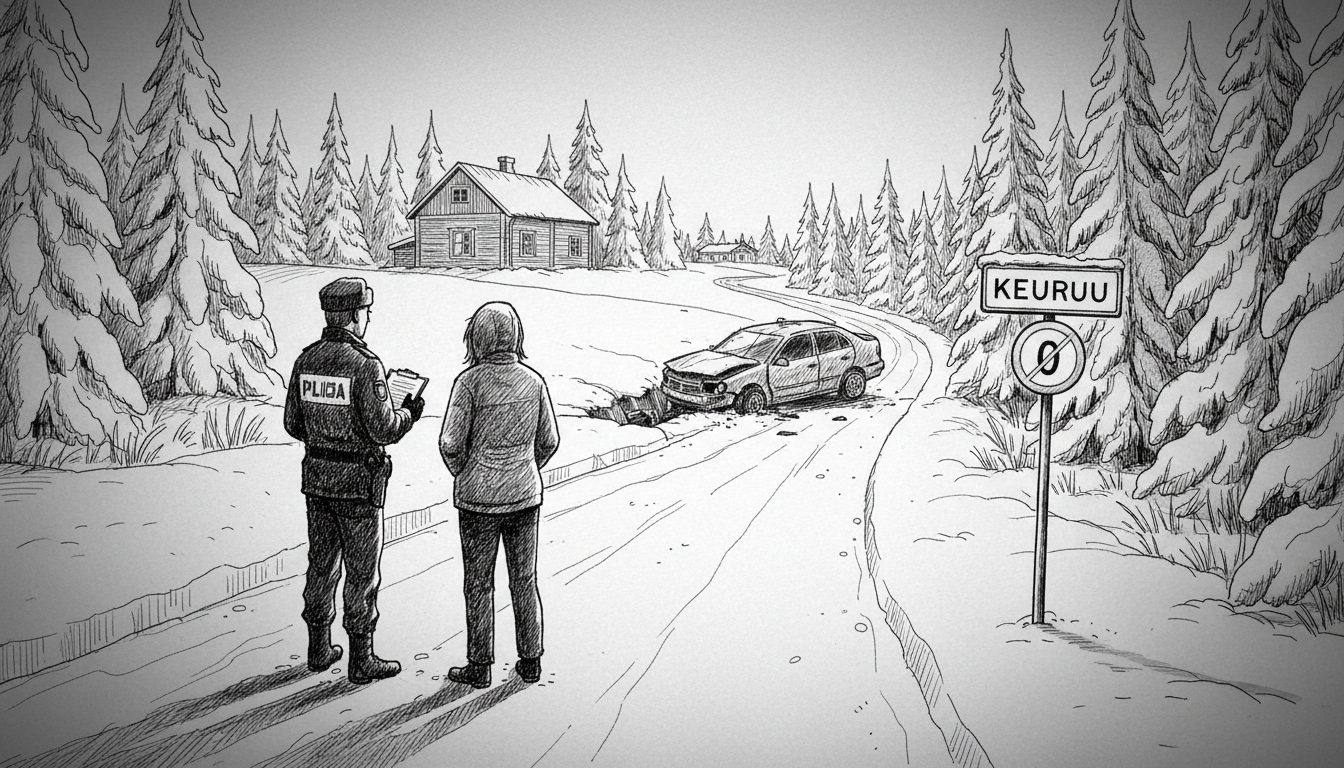
Finland's road safety systems faced a real-world test on a quiet street in Keuruu this week. A car veered off Myllymäentie and collided with a lamppost, yet both occupants walked away with only peltivaurioilla – sheet metal damage. The Tuesday morning incident, occurring around 11 a.m., resulted in no reported injuries despite the significant impact that deployed the vehicle's safety devices. This single-car accident offers a compelling snapshot of Finland's multi-layered approach to traffic safety, where vehicle engineering, infrastructure, and emergency response converge to protect lives.
A Routine Emergency Call with an Unremarkable Outcome
For the Central Finland rescue department, the call from Myllymäentie was a standard traffic incident. Their report confirmed the primary facts: a personal car had left the roadway and struck a lamppost. The vehicle's passive safety systems, including airbags and likely seatbelt pre-tensioners, activated as designed. With no medical emergency, the scene transitioned from rescue to recovery. The damaged car remained on site, awaiting a tow truck, while traffic in the area of Keuruu, a town 60 kilometers southwest of Jyväskylä, flowed normally. The absence of drama is precisely what makes this event noteworthy in a nation obsessed with systematic safety.
"The outcome here is not luck; it is the result of decades of policy," says a Helsinki-based traffic safety consultant who requested anonymity as they are not directly involved with the case. "Finnish vehicle standards, road furniture design like breakaway lampposts, and mandatory safety features create a protective environment. When an accident happens, the goal is to manage kinetic energy and prevent the transfer of force to the occupants. This appears to be a textbook example of that principle in action."
The Finnish Safety Ecosystem: From Policy to Pavement
This minor crash in Central Finland connects directly to decisions made in the Finnish Parliament, the Eduskunta, and within the EU's regulatory bodies. Finland consistently ranks among the safest countries in the world for road travel, a status hard-won through continuous effort. National traffic safety strategies, often spanning ten-year periods, set ambitious targets for reducing fatalities and serious injuries. These strategies are not mere documents; they directly influence infrastructure spending, police enforcement priorities, and public education campaigns.
Vehicle safety standards, largely harmonized across the European Union, form a critical layer. The cars on Finnish roads are among the safest globally, required to have advanced electronic stability control, numerous airbags, and crash-resistant structures. The EU's General Safety Regulation, which came into full force in recent years, mandates a suite of new technologies including intelligent speed assistance and advanced emergency braking. While the Keuruu vehicle's exact model and age are not specified, its performance suggests it met or exceeded rigorous safety benchmarks.
Infrastructure is the second pillar. Finnish road authorities prioritize forgiving road design. This includes clear signage, well-maintained surfaces, and the use of passively safe objects near roadways. Lampposts and other fixtures are often designed to break away or collapse on impact, reducing the deceleration forces on a vehicle's cabin. The goal is to prevent a single error from becoming a catastrophic event, a philosophy that likely mitigated the consequences on Myllymäentie.
Investigation and the Human Factor
While the physical outcome was positive, the cause of the Keuruu accident remains officially undetermined. Standard investigation protocol would examine several key factors. Driver alertness is a primary focus; fatigue, distraction, or a momentary lapse in concentration are leading causes of single-vehicle departures. Road conditions at the time—whether ice, wet leaves, or debris—would be scrutinized. Vehicle mechanical failure, though less common with modern cars, is also a potential line of inquiry.
Traffic safety experts emphasize that technology and infrastructure can only do so much. "The safest car in the world on the best-designed road still requires an attentive driver," the consultant notes. "Finnish driver's education is comprehensive, but human factors are unpredictable. The key is building systems that are resilient to human error. The fact that two people emerged unharmed from a collision with a solid object suggests the system worked as intended to compensate for whatever initial error occurred."
The Economic and Social Context of Safe Roads
Beyond the human toll, which was thankfully avoided here, road safety is a significant economic issue for municipalities like Keuruu and the Finnish state. Every serious accident avoided represents savings in emergency service costs, healthcare expenditures, lost productivity, and long-term social support. The investment in safe vehicles and roads is calculated to yield a high return by preventing these societal costs. Furthermore, a reputation for safe communities and reliable infrastructure is a subtle but important factor for regional development and quality of life.
This incident also highlights the efficiency of Finland's emergency response network. The integration of rescue services, police, and healthcare ensures a coordinated approach even to minor events. The rapid assessment and resolution of the Keuruu crash prevented any secondary incidents or traffic disruptions, demonstrating a system operating smoothly at a routine level.
A Model with Persistent Challenges
Despite its world-leading status, Finland's traffic safety work is never complete. Authorities are currently grappling with new challenges, including ensuring the safety of increasing numbers of elderly drivers and integrating new forms of mobility like e-scooters. The rise of distracted driving due to smartphone use is a universal concern that Finland combats through strict laws and enforcement. Each accident, even one without injuries, provides data that feeds back into policy refinement and targeted safety campaigns.
The Keuruu event is a silent testament to a successful public safety philosophy. It was not a major news story precisely because the systems in place performed their function. No headlines screamed about tragedy, no families were plunged into grief, and no lengthy hospital stays were required. In the calculus of modern governance, such unremarkable outcomes are the ultimate goal. They represent the prevention of harm rather than the reaction to it.
As the tow truck removed the vehicle from Myllymäentie, life in Keuruu continued uninterrupted. The repaired lamppost will soon stand again, and the drivers involved will likely reflect on a frightening moment that ended as well as it possibly could. For Finnish policymakers and safety engineers, this is the desired conclusion to any traffic incident: a story that doesn't need to be told, a crisis that wasn't, and a reaffirmation that the relentless pursuit of safety is a public responsibility that pays quiet, profound dividends every day on roads across the nation.