
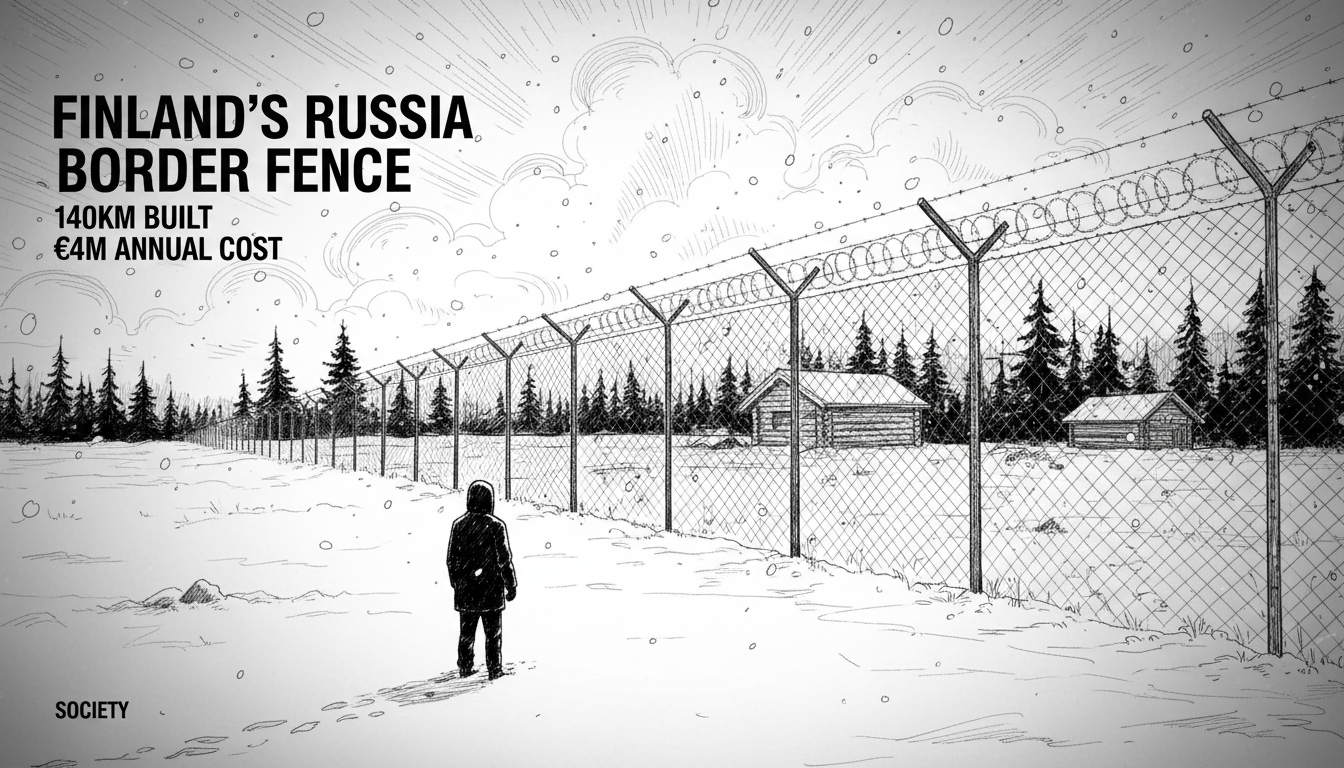
Finland's border fence with Russia now stretches for approximately 140 kilometers, a physical manifestation of a profound geopolitical shift. The Finnish Border Guard confirms the entire 200-kilometer project, concentrated on the most critical southern sections, will be completed by summer 2026. Annual maintenance for the completed barrier is projected to cost the state around four million euros, a recurring budgetary line born from the new security reality following Russia's full-scale invasion of Ukraine in February 2022.
A Barrier Born from Invasion
The decision to construct a fence was unthinkable for most Finns just a few years ago. Finland shares a 1,340-kilometer border with Russia, the longest of any European Union member state. For decades, this frontier was managed through bilateral agreements and mutual interest, characterized by pragmatic neighborly relations rather than fortification. The war in Ukraine shattered that paradigm overnight. The Finnish Parliament, the Eduskunta, moved with remarkable speed, passing legislation in the summer of 2022 to enable the construction of a permanent barrier. "This is not just a fence; it is part of a comprehensive upgrade of our border security architecture," Interior Minister Mari Rantanen of the Finns Party stated during the parliamentary debate. The project symbolizes Finland's full integration into Western defense structures, coinciding with its historic accession to NATO in April 2023.
Technical Specifications and Strategic Purpose
The structure rising in the eastern forests is more sophisticated than a simple wire fence. It is a three-meter-high steel mesh barrier topped with barbed wire, equipped with surveillance cameras, lights, and sensors. Its primary purpose, according to the Border Guard and defense analysts, is not to be an impenetrable wall but a controlled filter. It aims to prevent large-scale, orchestrated hybrid operations, such as the weaponization of migration witnessed on the Polish-Belarusian border in 2021. "The fence gives our border guards time and tactical advantage," explained a senior Border Guard official involved in the project. "It funnels movement to official crossing points, allowing for proper identification and processing, and stops vehicles from driving freely across the terrain." The chosen 200-kilometer span focuses on the southern regions, where road networks and population density make unauthorized crossing easier and more likely, leaving the remote northern wilderness largely unfenced.
The Financial and Operational Commitment
The construction represents a significant national investment, with the total cost estimated to reach several hundred million euros. The ongoing annual maintenance budget of four million euros underscores the long-term commitment. These funds will cover repairs from weather damage, potential vandalism, and the continuous operation of its electronic surveillance systems. This recurring cost is now a fixed component of Finland's border security expenditure, debated annually as part of the government's budget framework in Helsinki. Critics, primarily from the Green League and Left Alliance, have questioned the expense and environmental impact, arguing the funds could bolster other security measures. Proponents, spanning the government coalition from the National Coalition Party to the Finns Party, counter that the fence's deterrent value and role in managing hybrid threats are worth the price.
Expert Analysis: Symbolism and Practical Limits
Security experts across the Nordic region view the fence through a dual lens. "Its symbolic importance is immense," said Charly Salonius-Pasternak, a leading security policy researcher at the Finnish Institute of International Affairs. "It is a concrete signal to Moscow that the era of an open, trust-based border is over, and to NATO allies of Finland's seriousness about territorial integrity." However, analysts uniformly caution against overestimating its physical utility. A determined individual or a well-resourced state actor can bypass or breach such barriers. The fence is seen as one layer in a broader strategy that includes increased patrols, enhanced surveillance technology like drones, and closer cooperation with EU border agency Frontex and NATO intelligence. The real test, experts note, may come during a political crisis where Russia seeks to exert pressure, testing the resolve and response protocols of the Finnish authorities.
The New Normal on the EU's Eastern Edge
The fence solidifies a new status quo. Finland's eastern border crossings have been closed to Russian tourist visas since September 2022, with only limited familial and diplomatic traffic permitted. The once-busy border stations now see a fraction of their former activity. For local communities in regions like South Karelia, this means economic adjustment and a palpable change in atmosphere. The fence also places Finland at the forefront of a broader European trend of hardening external borders, influencing debate in the Baltic states and Poland. As an EU member, Finland's measures contribute to the bloc's collective security but also feed into ongoing discussions about migration management and the physical protection of the European space.
Looking Ahead to 2026 and Beyond
With the 2026 completion target set, the focus is shifting from construction to integration. The Border Guard is developing new operational doctrines to use the fence effectively. The government must ensure the maintenance budget is protected in future fiscal cycles. Meanwhile, the geopolitical landscape remains volatile. The fence, a static structure, is being built for a dynamic and uncertain threat environment. Its ultimate effectiveness will depend less on its steel mesh and more on the vigilance, resources, and political will of the Finnish state standing behind it. As the final sections are erected over the next two years, Finland is not just building a border barrier; it is institutionalizing a permanent defense posture for a more dangerous era, a sobering reality for a nation that long relied on diplomacy and deterrence alone.