
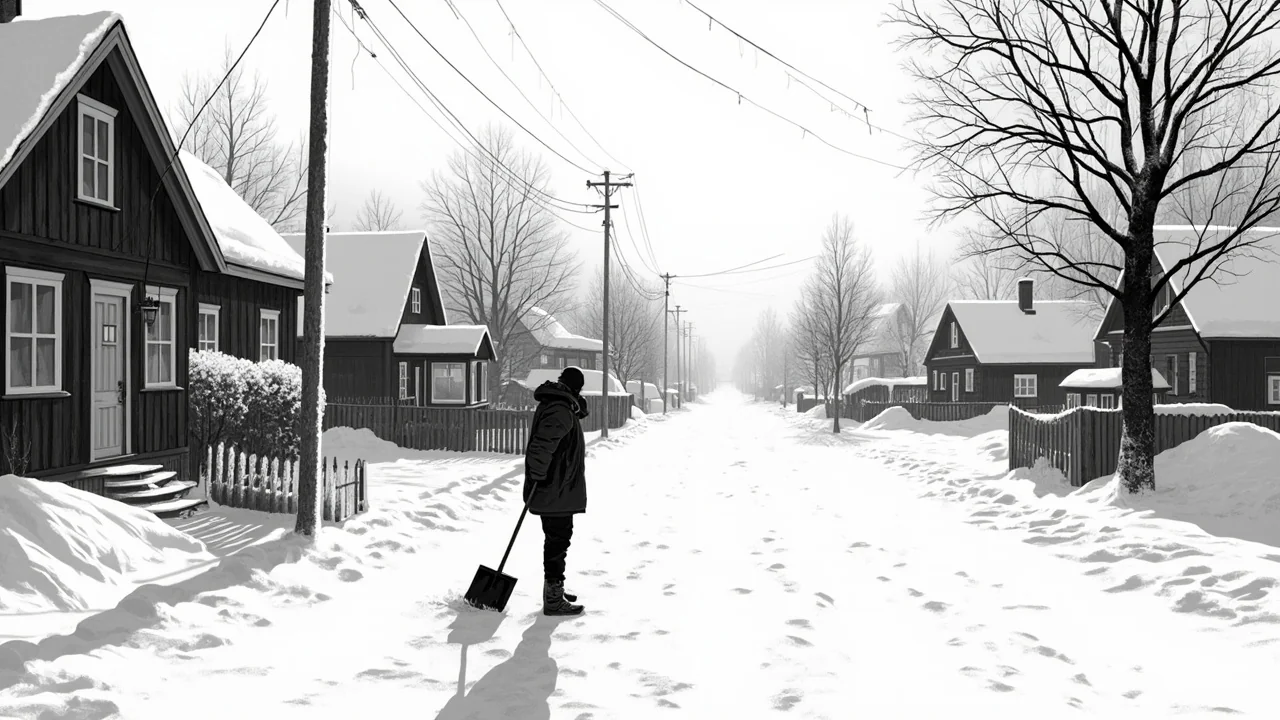
Finland's first major snowfall has blanketed the country, triggering a nationwide civic responsibility: proper snow disposal. The simple act of shoveling snow from a driveway or sidewalk carries significant legal weight, with strict rules prohibiting residents from moving snow onto public land, roads, or a neighbor's property. Sara Rintamo, a legal expert with the Property Management Association, emphasizes the point clearly: "Under no circumstances should snow be shoveled onto city land, a neighbor's side, or the road." Violations can lead to municipal threat fines, compensation liabilities, and in extreme cases, even criminal charges for trespass.
This annual winter ritual is governed by a clear principle: property owners and housing cooperatives must manage all snow within their own lot boundaries. For single-family homes and row houses, space is often sufficient. The challenge intensifies for apartment blocks and larger properties, where vast amounts of snow accumulate from parking areas and cleared pathways. "It's rarely cost-effective to haul snow away after every snowfall," Rintamo notes, explaining that snow must typically be stored somewhere on the property for a period, requiring careful advance planning during the construction phase.
The High Cost of Convenient Shoveling
The temptation to push a snowbank just slightly over a property line or onto a quiet roadside verge can be strong, especially during a heavy series of snowfalls. This act, however, plants the seed for neighbor disputes and municipal penalties. Rintamo warns that if a neighbor dumps snow on your property and the situation doesn't improve through discussion, contacting the police is a valid step. The legal framework treats such actions as an infringement on another's property rights. While criminal trespass charges are described as an "extreme situation," the pathway exists, underscoring the seriousness with which property boundaries are maintained, even under a meter of snow.
Municipalities across Finland enforce these rules through public order ordinances. A common consequence is an "uhkasakko," a threat fine issued by the city to compel corrective action. If the improperly disposed snow causes damage—for instance, melting runoff flooding a basement or a plowed snowbank blocking a municipal drain—the responsible party faces compensation claims. This transforms a simple shoveling shortcut into a potentially expensive liability, reinforcing the cultural norm of personal responsibility for one's own winter mess.
Apartment Dwellers and the Parking Space Dilemma
In Finnish apartment complexes, or taloyhtiöt, snow management creates a distinct set of challenges and common misunderstandings. Typically, maintenance contracts for housing cooperatives cover the clearing of main walkways and roadways within the property. However, individual parking spaces, especially designated spots, often remain the responsibility of the car owner. This division of labor frequently leads to frustration. "Often the yard is plowed otherwise, and this creates a problem where a snow wall forms behind the car," Rintamo explains. Maintenance companies might occasionally clear an empty spot as a courtesy, but these spaces are usually explicitly excluded from service agreements.
This system can cause resentment among residents who assume full snow removal is included in their monthly fees. The resulting snowbanks around parked cars become a personal burden to dig out. The issue highlights the importance of residents understanding their housing cooperative's specific rules and service descriptions. Clear communication from the housing board about what is and isn't covered can prevent winter-time grievances and ensure everyone knows their role in keeping the community accessible.
Proactive Planning and Winter Wisdom
The best solution to snow storage problems is proactive design. Modern construction and renovation projects increasingly consider winter logistics during the planning phase. Architects and landscape designers now factor in snow accumulation zones when drafting yard plans for building permits. These designated areas, often out-of-the-way corners or specially reinforced sections of the property, are intended to hold multiple winters' worth of snowpack without obstructing access, damaging landscaping, or reducing visibility.
For older properties without such planning, the solution requires pragmatic management. This might involve piling snow as compactly as possible, using machinery to create higher, narrower banks to conserve ground space, or, for large properties, budgeting for occasional professional removal to a designated municipal snow dump when on-site space truly runs out. The key is constant assessment throughout the winter; a small encroachment onto a forbidden area in December can become a massive, illegal snow mountain by March.
A Reflection of Finnish Societal Values
The strict enforcement of snow disposal rules is more than a practical nuisance; it reflects deeper Finnish values of respect for public order, private property, and shared responsibility. In a country where winter lasts half the year, efficient and fair snow management is essential for daily functionality. It ensures municipal snowplows can work effectively, emergency services have clear access, and pedestrians can navigate sidewalks safely. Dumping snow onto a cleared road undermines these collective efforts, creating hazards and doubling municipal costs.
This system functions on a foundation of social trust and adherence to rules. The vast majority of Finns comply without a second thought, viewing it as a natural part of winter citizenship. The potential for fines and legal action serves as a necessary backstop for the rare cases of negligence or intentional disregard. It’s a compact between the individual and the community: you manage your snow, and the system manages the rest, ensuring society keeps moving smoothly through the darkest, coldest months.
As climate change brings more variable winter weather to Finland, with potential for heavier, wetter snowfalls, these rules and their enforcement will only grow in importance. The fundamental principle, however, will remain unchanged: the snow from your property is your responsibility, from the first flurry in November to the final, slushy melt in April. It’s a small but significant duty that defines the Finnish winter experience, where every shovel of snow has its proper place.