
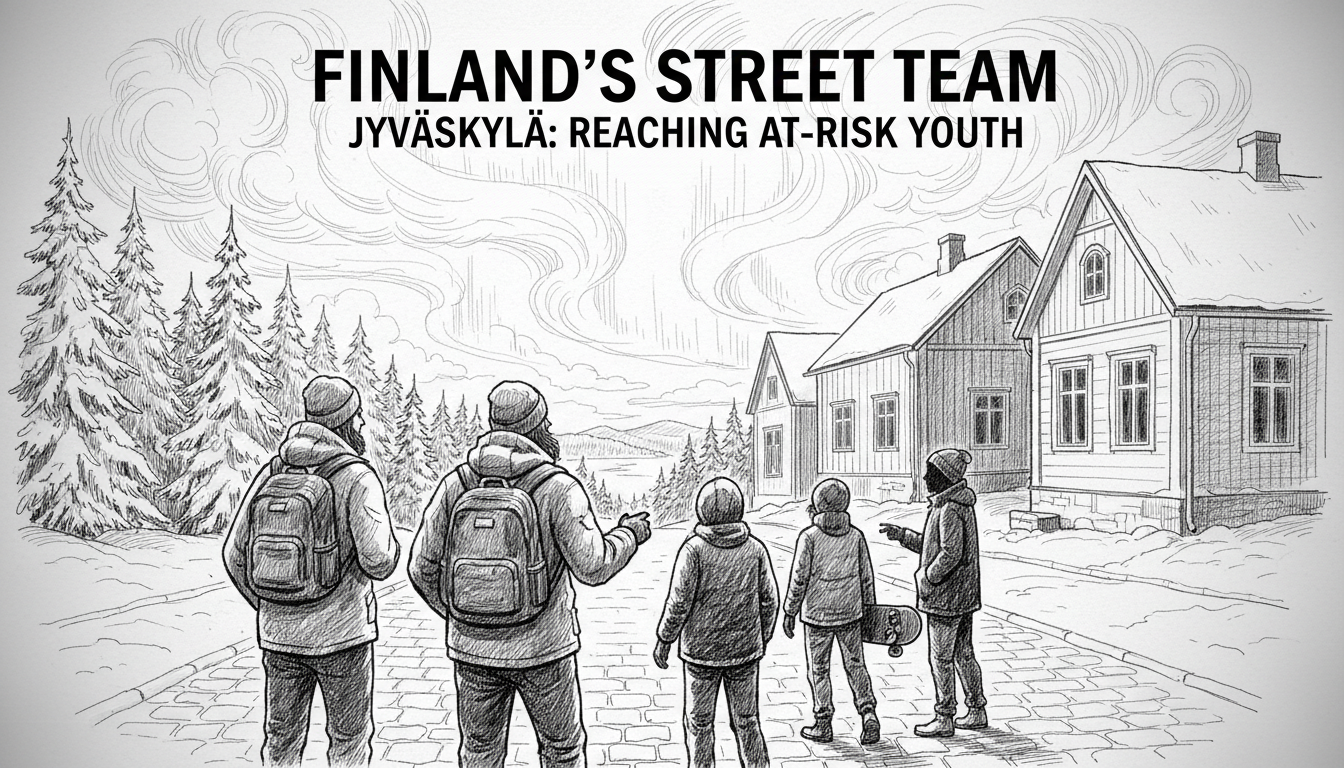
Finland youth services are taking a proactive, street-level approach to support at-risk young people in the city of Jyväskylä. A new four-person team, part of the city's 'Väkivallaton nuoruus' (Non-violent Youth) project, now walks the city's neighbourhoods and centre almost daily, asking young people how they are. Their specific focus is on those for whom the answer might not be positive.
Pia Santaja and Janne Matilainen, specialist youth workers for the city, form the core of this outreach effort. They are joined by Milla Suorsa from the Helsinki Deaconess Institute's Vamos Jyväskylä unit and Pia-Maria Hänninen from the Jyväskylä parish. The project, which launched this autumn, is funded by state subsidies from the Ministry of Social Affairs and Health's health promotion allocation.
"In the best case, young people open up about their problems to the pair and turn to them in a bad moment," said a project coordinator. Santaja and Matilainen listen and help with worries, whether they concern relationship issues or street conflicts. The goal is to address disruptive behaviour by meeting youth where they are—on the streets of Jyväskylä.
A Trust-Based Approach on the Pavement
This model of mobile youth work is a recognized method within Finland's robust social welfare framework. While municipalities are legally responsible for providing social and health services, preventative projects like this one represent an investment in early intervention. The team's consistent presence aims to build trust with a demographic that often does not seek help through official channels like social offices or health clinics.
"The foundational idea is simple: go to the spaces where young people naturally gather, without an appointment or a formal setting," explains Dr. Laura Pekkala, a researcher in social work at the University of Eastern Finland. "This lowers the threshold for contact immensely. For a young person experiencing anxiety, family trouble, or exclusion, walking into a municipal building can feel insurmountable. A friendly, familiar face in a park does not."
The work requires patience and a non-judgmental attitude. The team members are not law enforcement; they are support workers. Their initial interactions are deliberately low-key—a simple "How are you?"—allowing the young person to control the depth and direction of any conversation.
The Finnish Context of Youth Support
Finland has a long tradition of state and municipal investment in child and youth well-being, seen as a cornerstone of a healthy society. This includes universal services like schools and healthcare, but also targeted support for those at risk of marginalization. Projects like Väkivallaton nuoruus operate within this ecosystem, often bridging gaps between official services and community organizations, such as the parish.
The involvement of the Helsinki Deaconess Institute's Vamos unit brings specific expertise. Vamos operates across Finland, specializing in low-threshold youth work and support for those on the margins. Their methodology emphasizes peer support and empowering young people themselves to act as positive influencers in their own communities.
"State funding for health promotion is crucial for these experimental, on-the-ground models," says Dr. Pekkala. "It allows municipalities to test new ways of reaching citizens before problems escalate into crises that require more expensive, reactive services. It's a preventative investment."
Building Bridges Before Crises Occur
The team's daily rounds are a form of social triage. By creating casual, recurring contact, they can identify emerging issues—be it mental health struggles, school avoidance, or unsafe group dynamics—long before they result in a police incident or a emergency room visit. They can then offer direct guidance or act as a conduit to more specialized services, effectively navigating the young person into the formal support network.
This bridge-building function is critical. "A young person might tell Janne or Pia something they'd never tell a teacher or a doctor, because those figures represent authority and systems," notes a social services manager in Central Finland. "The street worker is seen as an ally first. They can then gently explain, 'What you're describing, we have a professional who can help with that. I can come with you.' That handover is where the real magic happens."
The project also represents a shift towards integrated service models. By combining municipal youth workers (Santaja and Matilainen) with a third-sector organization expert (Suorsa from Vamos) and a parish representative (Hänninen), the team can draw on a wider range of resources and community connections.
Challenges and the Road Ahead
While the approach is praised by experts, its success is inherently difficult to quantify with traditional metrics. How do you measure conflicts that didn't happen, or despair that was alleviated through conversation? The evaluation of such projects often relies on qualitative feedback from the youth themselves and tracking soft outcomes like increased engagement with other services.
Furthermore, the model is resource-intensive in terms of human effort. It requires dedicated, skilled professionals comfortable with unpredictable environments. The team's impact is also geographically concentrated on specific areas of Jyväskylä they can regularly patrol.
Despite these challenges, the proactive model aligns with a growing understanding of social work. "The 21st-century challenge is not just providing services, but ensuring they are accessible," concludes Dr. Pekkala. "Digital portals and phone lines are not enough for everyone. Sometimes, accessibility means a pair of walking shoes and the willingness to say hello. The Jyväskylä project understands that human connection is the first and most important service."
The ultimate test for the Väkivallaton nuoruus team will be the trust they earn over the coming months and years. Their work is a quiet, daily commitment to the principle that support should not wait behind a desk. In the parks and street corners of Jyväskylä, Finland's social safety net is being woven one conversation at a time.