
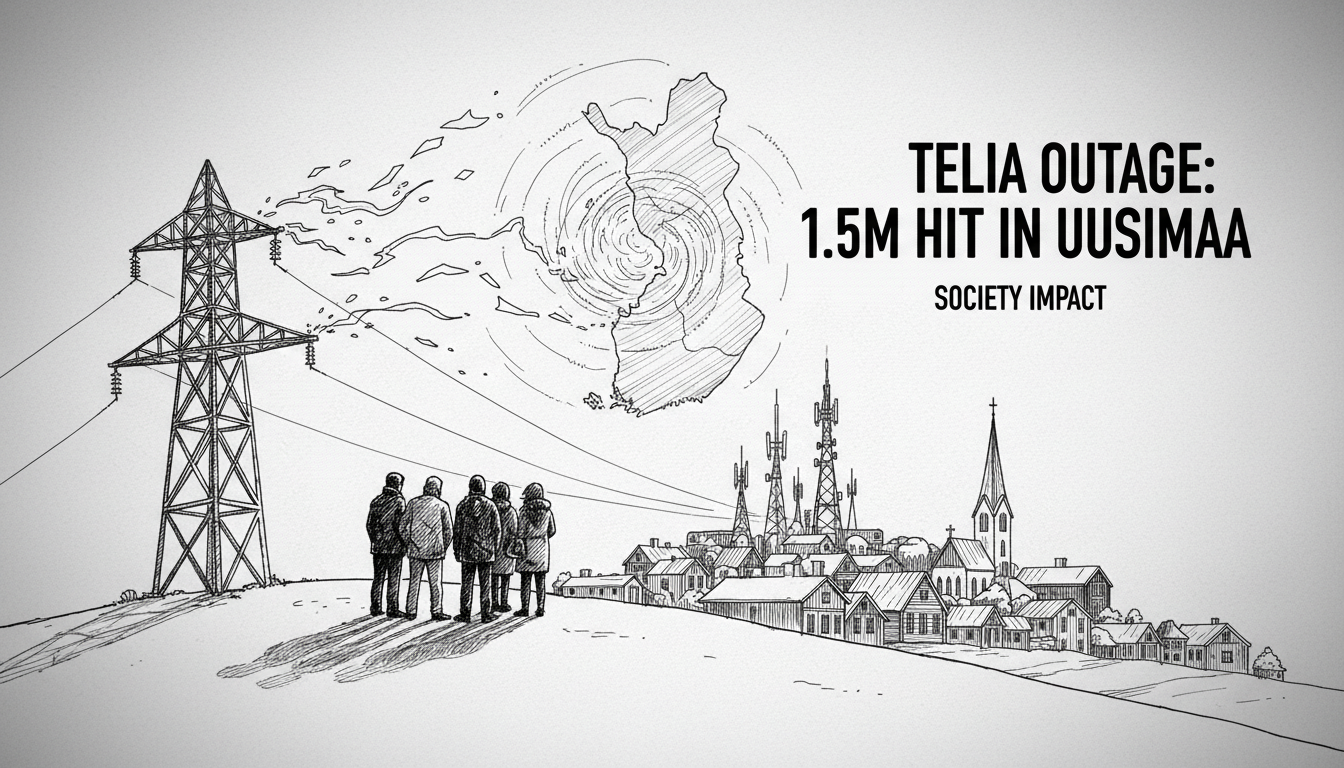
Finland's Telia broadband services experienced a major outage across the Uusimaa region on Saturday, disrupting internet access for an estimated 1.5 million residents and thousands of businesses. The disruption, which began around midday, affected fixed-line connections in the nation's most populous area, including the capital Helsinki. Telia Finland confirmed the service failure on its official channels, stating repair efforts were underway with an estimated resolution time of 8:30 PM local time. The incident highlights the critical vulnerability of Finland's highly digitalized society when core telecommunications infrastructure fails.
Reports flooded the outage-tracking website Downdetector shortly after noon, with user-submitted problem maps showing a dense cluster of disruptions across southern Finland. Telia, one of the country's three major telecom operators, provides essential connectivity for government services, financial institutions, and remote workers. The company issued a brief apology for the inconvenience but provided limited real-time details on the technical cause during the initial hours. For a nation that consistently ranks among the world's most connected, the outage served as a stark reminder of digital dependency.
A Digital Society Grinds to a Halt
The practical impact was immediate and widespread. In Helsinki, cafes and public libraries with alternative providers saw an influx of people seeking Wi-Fi to complete work or communicate. Small businesses reliant on Telia's network for point-of-sale systems or online orders reported lost revenue. The disruption also posed challenges for telemedicine services and remote monitoring, sectors that have expanded rapidly in Finland's decentralized healthcare model. While mobile networks largely remained operational, the fixed-line outage crippled home offices and corporate networks dependent on stable, high-bandwidth connections.
This is not an isolated incident but part of a broader pattern of increasing fragility. 'Our societal infrastructure is now almost entirely digital, but the physical networks underpinning it are not invincible,' noted Dr. Elina Saarelma, a professor of Networked Systems at Aalto University. 'A single point of failure in a major provider's infrastructure can cascade into a significant regional event, as we saw today. The concentration of market power among a few operators increases this systemic risk.' Her analysis points to a core tension in Finland's telecom sector: excellent coverage and speed, but potential vulnerabilities due to market consolidation.
The Economic and Regulatory Fallout
The economic cost of a multi-hour outage in Uusimaa is substantial. A 2022 study by the Finnish Transport and Communications Agency (Traficom) estimated that a nationwide 24-hour internet blackout could cost the Finnish economy over 200 million euros. While Saturday's event was regional and shorter, it likely incurred costs in the tens of millions through lost productivity, interrupted transactions, and service delays. For Telia, the financial repercussions extend to potential regulatory scrutiny and compensation claims from business customers.
Finland's Communications Regulatory Authority (Viestintävirasto) monitors such incidents closely. Operators are required to report significant disruptions and their causes. The authority assesses whether service providers have adequate backup systems and disaster recovery plans. 'Events like this trigger automatic reviews,' explained a regulatory expert familiar with the process, who spoke on condition of anonymity. 'The key questions will be: What was the root cause? Why did it affect such a large region? And were restoration times in line with the provider's own critical infrastructure standards?' The answers could influence future regulatory decisions on network resilience requirements.
Telia's Response and Customer Trust
Telia's crisis communication strategy faced its own test. The initial information was sparse, limited to a service notice on its website and a short apology. As the hours passed, customers took to social media to express frustration over the lack of detailed updates. In an era where real-time status updates are expected, the communication gap became almost as problematic as the outage itself for some users. This presents a reputational challenge for Telia in a competitive market where customer loyalty is closely tied to reliability.
The company's promise of a 8:30 PM fix placed significant pressure on its technical teams. Meeting such a public deadline is crucial for maintaining credibility. Past outages by other providers in the Nordic region have led to prolonged public relations crises and customer churn. Telia Finland, which reported revenue of 1.2 billion euros in 2023, cannot afford sustained damage to its brand as a reliable partner for both consumers and the enterprise sector. The incident may accelerate its investments in more resilient, decentralized network architectures.
A National Security Dimension in the Digital Age
Beyond economics and customer service, the outage touches on emerging national security concerns. Finland's membership in NATO and its heightened security posture following the war in Ukraine have placed new emphasis on the resilience of all critical infrastructure, including digital networks. The Finnish Security and Intelligence Service (SUPO) has repeatedly warned about hybrid threats that could include cyber-attacks on civilian infrastructure. While there is no indication this outage was malicious, it demonstrates the disruptive potential of such an attack.
'This is a live exercise in societal disruption, albeit with a technical cause,' said Marko Kiviluoto, a researcher at the Finnish Institute of International Affairs. 'It shows how quickly a digital interruption can propagate through the economy and daily life. For our security planners, it reinforces the need to ensure redundancy across different providers and to protect the physical and logical points where these networks converge.' The Finnish government's digital security strategy, updated last year, explicitly aims to strengthen the continuity of telecommunications services, making this outage a likely case study for policymakers.
Looking Ahead: Resilience in a Connected Finland
The Telia outage will likely fade from headlines once service is fully restored, but its implications will linger. For Finnish consumers, it is a reminder to consider backup connectivity options, such as mobile data plans from a second operator. For businesses, it underscores the necessity of contingency planning that assumes primary internet links may fail. For the state, it highlights the ongoing work required to translate digital dependency into digital resilience.
Finland, where approximately 90% of households have broadband access, is a pioneer in digital services. From comprehensive e-government to a thriving startup ecosystem, its modern identity is intertwined with seamless connectivity. Saturday's disruption proved that this foundation, while strong, is not unshakeable. The ultimate test for Telia and Finland's broader digital ecosystem will be how they learn from this event. Will it lead to more robust, transparent, and resilient networks, or will it be just another temporary glitch in an otherwise reliable system? As evening fell on Uusimaa, with engineers racing against the clock, the answer to that question was still buffering.