
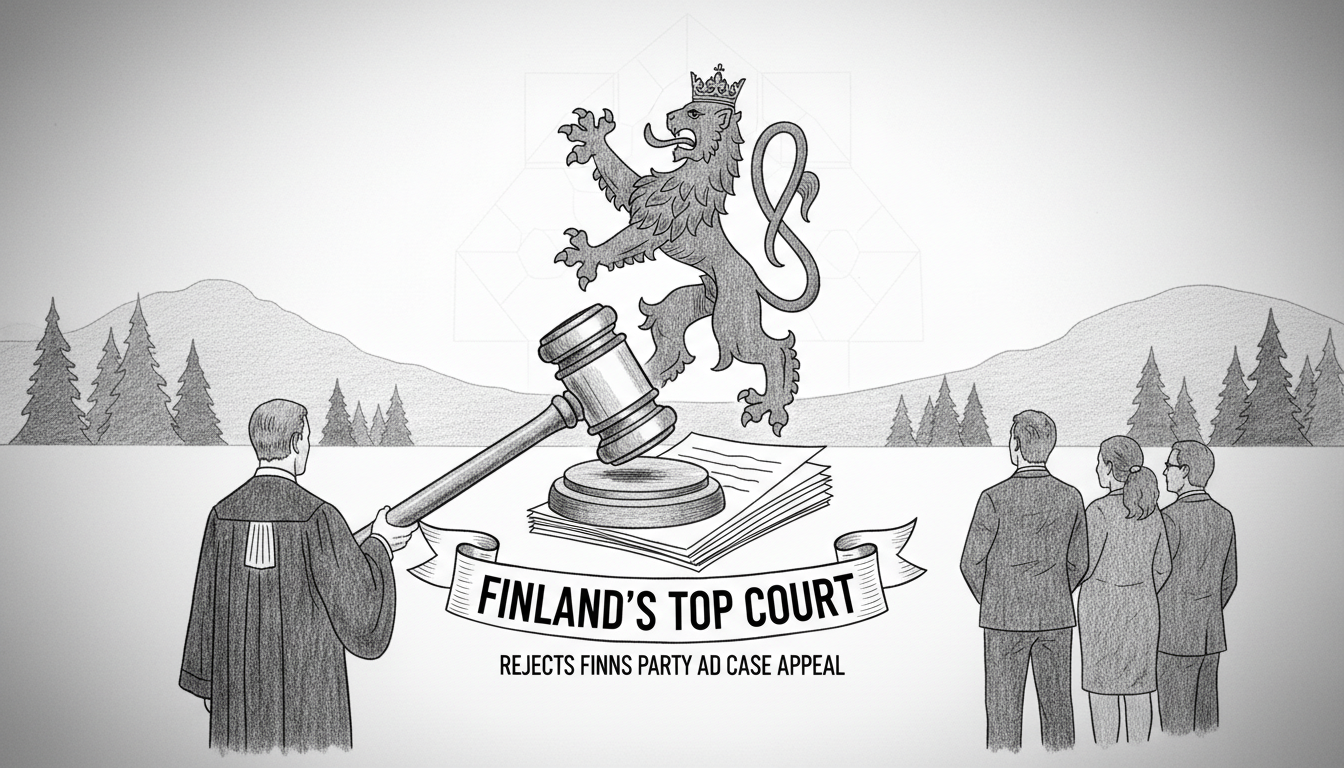
Finland's Supreme Court has rejected a final appeal from the Finns Party, ending a four-year legal battle over the removal of their controversial municipal election advertisements from Helsinki bus stops in 2021. The court refused to grant leave to appeal on Monday, letting a lower court's ruling stand that cleared former Helsinki City Transport (HKL) CEO Ville Lehmuskoski of any wrongdoing.
This decision marks a definitive legal loss for the right-wing populist party, which had accused Lehmuskoski of dereliction of duty for authorizing the removal of ads deemed offensive. The advertisements featured an image of an apartment building directory with two Finnish surnames; other name slots contained the text "skipping the line." The implication, which sparked immediate public criticism, was that immigrants received preferential treatment for public housing in Helsinki.
"Of course it's good that it ends like this," Ville Lehmuskoski, now Helsinki's City Environment Director, said in a statement. "Neither the police nor any court found that public officials acted wrongly in the matter. It's just a pity that both judicial system resources and public administration resources had to be used to process such a case. It all takes away from society."
A Controversial Campaign and Swift Removal
The case centers on the heated atmosphere preceding the 2021 Finnish municipal elections. The Finns Party, campaigning strongly on immigration and national identity issues, deployed the advertisements across Helsinki's public transport network. The ads were placed by the global outdoor advertising firm JCDecaux, which holds the contract for the city's bus and tram stop advertising spaces.
That contract contained a specific clause prohibiting advertisements that cause general public offense. Following numerous public complaints, both JCDecaux and HKL, under Lehmuskoski's leadership, independently assessed the material. They concluded the ads violated this clause and ordered their removal just days before the election period began. The Finns Party argued this action was politically motivated censorship that illegally restricted their freedom of speech and disrupted their election campaigning.
Frustrated after police declined to initiate a pre-trial investigation in the summer of 2021, the Finns Party and its Helsinki district took the unusual step of pursuing a private prosecution. They formally charged Lehmuskoski with a breach of official duty, seeking a punishment. This set in motion a lengthy judicial process that has now concluded at the nation's highest legal authority.
The Judicial Path: From District Court to Supreme Court
The Helsinki District Court was the first to rule on the substance of the case in May 2024. It found no evidence that Ville Lehmuskoski had breached his official obligations. The court essentially validated the discretion of public officials and their private partners to enforce contractual terms regarding advertising standards.
Undeterred, the Finns Party appealed to the Helsinki Court of Appeal. In January 2025, the appellate court delivered its verdict, siding with the lower court. It saw no reason to reassess the facts or the legal interpretation, affirming that Lehmuskoski acted within his rights and responsibilities. The party's final recourse was to petition the Supreme Court for leave to appeal, a request reserved for cases involving significant legal precedent or error. The Supreme Court's refusal to hear the case means the Court of Appeal's ruling is now final and legally binding.
This three-tiered judicial dismissal sends a strong message. "The courts have consistently viewed this as a matter of contractual compliance, not political censorship," said Professor Laura Ervo, a Finnish legal scholar specializing in administrative and procedural law. "The clause against causing public offense is common in advertising agreements, and its enforcement by a city-owned company falls within normal operational discretion. The courts have drawn a line between the right to political speech and the right of a property owner—in this case, the city—to control what is displayed on its assets."
Political Strategy and the 'Martyrdom' Narrative
Political analysts observe that the Finns Party's decision to pursue this case relentlessly, despite early police disinterest, fits a familiar pattern for populist movements across Europe. "There is a strategic calculus here that transcends a simple legal victory," explained Dr. Mikko Poutanen, a political scientist at the University of Helsinki. "Controversial advertisements serve a dual purpose: they resonate with a core base concerned about immigration, and the subsequent backlash or removal generates a powerful narrative of persecution and silencing by the political establishment."
This "martyrdom" narrative, Poutanen notes, can be more valuable for mobilization and media attention than the advertisements themselves. The multi-year legal battle allowed the party to repeatedly reframe the story, keeping the underlying message about immigration and public housing in the news long after the 2021 election concluded. The party framed the expenditure of public resources on the case, lamented by Lehmuskoski, as evidence of a system stacked against them.
However, the finality of the Supreme Court's rejection may blunt this narrative. The party now faces a clear, authoritative judicial statement that its claims lacked legal merit. The case also highlights the tension between provocative political messaging and community standards in shared public spaces.
Broader Implications for Political Advertising and Free Speech
The Supreme Court's decision has wider implications for the landscape of political advertising in Finland. It reinforces the authority of municipalities and their contractors to set and enforce content guidelines for advertising in spaces they control. This does not equate to a blanket right to remove political ads, but it affirms that ads which violate pre-existing, neutrally applied standards—such as a prohibition on causing public offense—can be taken down without constituting a violation of electoral fairness or free speech.
"The key distinction is between viewpoint discrimination and content-neutral rule enforcement," Professor Ervo elaborated. "Had HKL removed only Finns Party ads while allowing similarly provocative ads from other parties, that would be a serious problem. But the evidence showed the decision was based on the specific content of the ad and the contractual clause, not the party's political identity. This is a crucial boundary in democratic societies."
The case also indirectly touches on the limits of political rhetoric. While the courts did not rule on whether the ad constituted incitement to discrimination, its removal by JCDecaux and HKL suggests a private-sector assessment that it crossed a line of public decency. In a country known for consensus-driven politics, the episode underscores the growing friction between traditional norms and more confrontational, identity-based campaign tactics.
A Chapter Closes, But Tensions Remain
For Ville Lehmuskoski and Helsinki city officials, the Supreme Court's decision provides closure and vindication. The former HKL CEO's pointed comment about the waste of public resources underscores a frequent criticism of such protracted political-legal conflicts: they drain time and money from other civic needs.
For the Finns Party, the legal route has ended in defeat. The party must now absorb this loss while likely continuing to employ similar campaign strategies that test the boundaries of public discourse. The underlying issues the advertisement sought to highlight—immigration and access to public housing—remain potent topics in Finnish politics.
The final word from the Supreme Court affirms that in this instance, the mechanisms for maintaining public order in shared spaces functioned as intended. Yet, the very fact that a dispute over a bus stop advertisement reached the nation's highest court reveals the deep currents of political and cultural conflict flowing through Finnish society today. As the next election cycle approaches, the question remains: will political actors internalize the boundaries clarified by this case, or will they simply find new frontiers for controversy?