
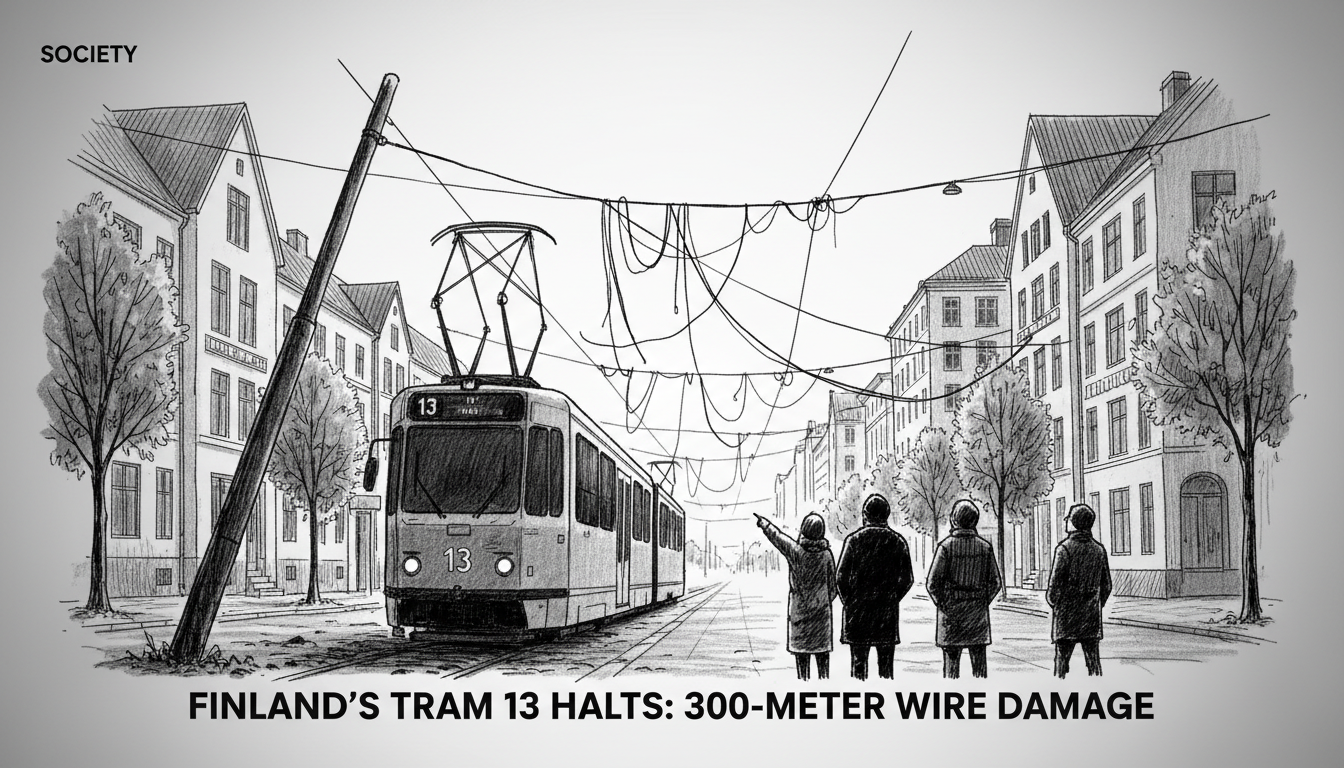
Helsinki's vital Tram 13 line faces multiple days of cancellations after a major infrastructure incident severed its power connection. A vehicle equipped with a high personnel lift snagged and brought down approximately 300 meters of critical overhead wire along Hermannin rantatie near Haukilahdenkatu on Saturday afternoon. The Helsinki Regional Transport Authority (HSL) confirms repair work is so extensive that service is unlikely to resume before Tuesday, disrupting thousands of daily commutes and highlighting the fragility of urban transit networks.
Commuter Chaos and Immediate Response
The disruption began around 2:30 PM on Saturday when the incident was reported to HSL. The damage zone stretches along a key route connecting the rapidly developing Kalasatama district to the central Pasila transport hub. For residents and workers in these areas, the tram is often the most direct and reliable link. 'The fault is so significant that the tram line will probably not run even on Sunday or Monday,' said HSL's on-duty expert Jenni Vuorio in a statement. This prolonged outage forces a major reshuffling of daily routines. Commuters accustomed to the predictable rumble of the tram must now navigate alternative bus routes, which are likely to experience increased crowding and longer travel times.
HSL has activated a contingency plan. Buses 59, 500, and 510 will bridge the gap between Kalasatama and Pasila. Additionally, buses 55 and 56 that travel along Hermannin rantatie remain in operation. A specific replacement bus service, 13X, is running a counter-clockwise loop serving Kalasatama, Koksikatu, Parrulaituri, Sompasaarenlaituri, Aallonhalkoja, Capellan puistotie, and Työpajankuju. While these measures provide a basic safety net, they lack the capacity and frequency of the twin articulated trams that usually ply Line 13 and its variant, 13H.
Anatomy of a Infrastructure Failure
This incident is not a minor glitch but a substantial physical failure. Overhead wires, or catenaries, are the lifelines of a tram system, delivering the 600-volt direct current needed for propulsion. Bringing down 300 meters of this cable is a serious event that requires specialized crews and equipment. Repair work is complex and hazardous, involving securing the area, assessing damage to supports, stringing new wire, and ensuring precise tensioning for reliable operation. The cause—a vehicle with an elevated work platform—points to a recurring challenge in cities: the conflict between street-level construction activity and elevated infrastructure. It raises immediate questions about route planning and height clearance protocols for such vehicles in transit corridors.
Helsinki's tram network is a point of civic pride and a backbone of its sustainable urban mobility strategy. First launched in 1891 with horse-drawn carriages, the system has evolved into a modern network crucial for reaching climate goals. Trams move vast numbers of people efficiently with low per-passenger emissions. Line 13 itself serves critical new urban developments in former port areas, making its reliability essential for the city's growth plans. Disruptions like this have a ripple effect, potentially pushing people toward private cars and undermining confidence in public transport.
Systemic Vulnerabilities and Expert Analysis
Public transport experts note that while such accidents are occasional, they expose systemic vulnerabilities. 'This is a stark reminder that even the most reliable systems depend on exposed physical infrastructure,' says a Finnish transport planner who asked not to be named due to their role in city government. 'The focus is often on expanding networks, but the resilience of existing corridors is equally important. Redundancy and swift recovery protocols are key.' The expert praised HSL's swift deployment of bus bridges but noted that bus replacements can only ever be a partial solution, often struggling with traffic congestion that dedicated tram lanes avoid.
Preventative measures could include enhanced monitoring of construction vehicle routes in sensitive corridors or more robust physical protection for wire supports in high-risk areas. However, these come with cost and complexity trade-offs. The incident also tests HSL's communication strategy. Providing clear, real-time information through their app and at stops is critical to managing passenger frustration during multi-day outages.
Looking Beyond the Repair Crews
The halted trams on Line 13 represent more than a temporary inconvenience. They are a case study in the interdependencies of a modern city. A single vehicle's miscalculation disrupts the commutes of thousands, affects local businesses reliant on foot traffic from tram stops, and stresses other parts of the transit network. It also temporarily alters the soundscape and rhythm of neighbourhoods along its route, replacing the electric hum of trams with the louder diesel engines of buses.
As repair crews work to restring the wires and restore power, the city gets a fleeting glimpse of its transportation alternatives under strain. The incident underscores a fundamental truth: the smooth functioning of urban life hinges on the integrity of often-invisible systems. When one link fails, the entire chain feels the pull. The question for Helsinki and cities everywhere is how to build networks that are not only efficient but also resilient enough to withstand the inevitable snags, ensuring that a single point of failure doesn't leave entire districts stranded. The return of Tram 13 will be a welcome relief, but the lessons from its silence should resonate long after the wires are back in place.