
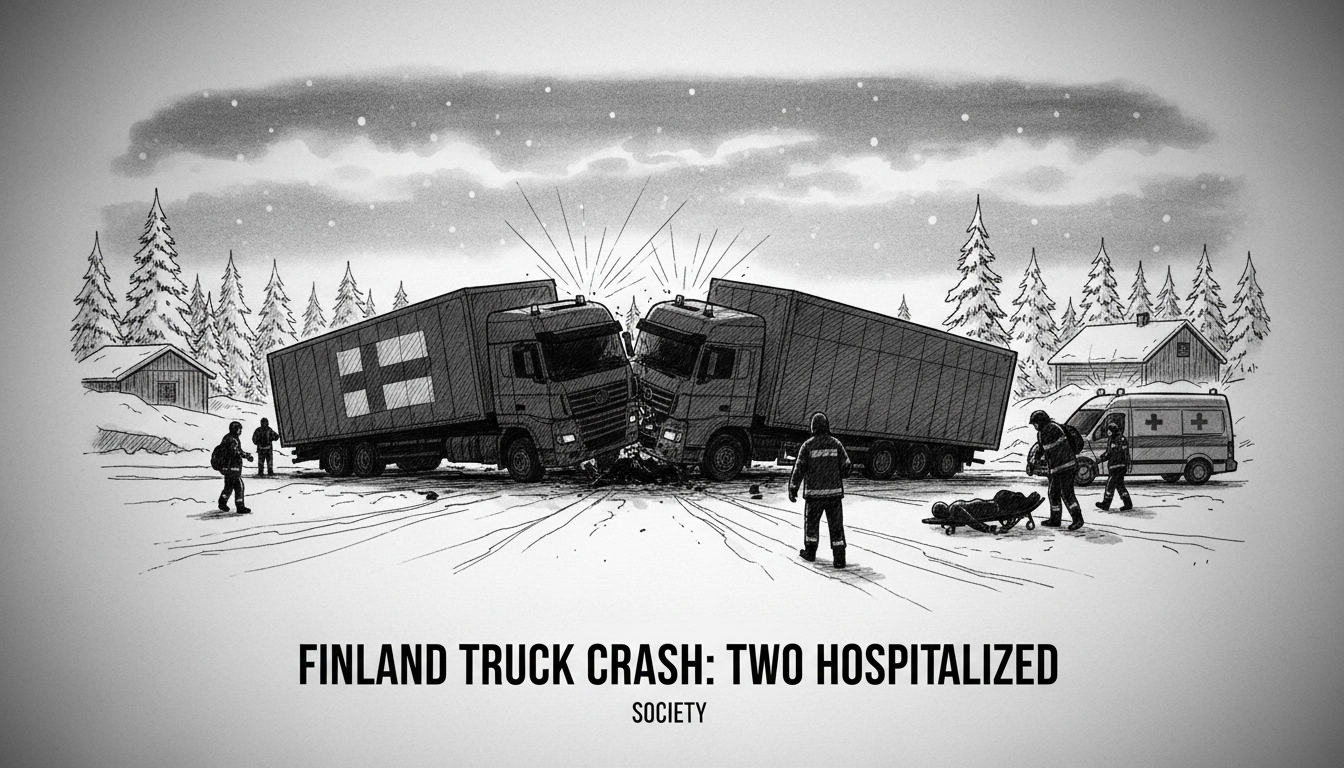
Finland's road safety record faced another test Tuesday evening with a truck collision in Kaustinen that sent two people to hospital. The crash, involving a turning passenger car struck by a truck on Toholammintie, saw five people involved and a car ending up on its side in a ditch. While Finland maintains some of Europe's safest roads, this incident highlights persistent risks at rural intersections where heavy goods vehicles and passenger cars meet.
A Rural Intersection Turned Crash Scene
Emergency services from Keski-Pohjanmaa responded to the Toholammintie intersection in Kaustinen after reports of a serious collision. Preliminary reports indicate a truck driver made an error, colliding with a passenger car that was in the process of turning. The force of the impact sent the smaller vehicle careening into the oncoming lane, where it made slight contact with another car before rolling onto its side in a roadside ditch. Two of the five individuals involved required transport to hospital for evaluation, though their conditions were not immediately life-threatening.
This specific accident type—a turning vehicle struck at an intersection—is a known risk scenario in traffic safety research. The dynamics are particularly dangerous when a large, heavy truck is involved. Finnish authorities typically deploy detailed technical inspections to determine the exact sequence of events, examining factors like vehicle speed, visibility, signage, and driver actions.
The National Context of Finnish Road Safety
Finland's overall traffic safety performance is strong by global standards, a point of pride for transport officials. The country's low population density, strict licensing laws, and significant winter driving culture contribute to a generally high level of driver competency. However, the statistics reveal areas for concern. In 2023, Finland recorded 222 fatal road accidents. While this number has trended downward over decades, each incident prompts renewed scrutiny.
More notably for this Kaustinen case, trucks were involved in 14% of all fatal accidents in Finland during 2023. This disproportionate involvement of heavy goods vehicles in the most serious crashes keeps them a focal point for the Finnish Transport Infrastructure Agency, known as Väylävirasto. The agency oversees road network safety through design, maintenance, and regulation.
“Every accident is one too many, and our goal remains Vision Zero—no fatalities or serious injuries on our roads,” said a senior advisor from Väylävirasto, referencing the ambitious long-term safety policy adopted from Swedish models. “Intersection safety, especially on regional roads where mixed traffic flows meet, requires continuous engineering and education efforts.”
Political and Infrastructure Responses
The accident in Kaustinen occurs amid ongoing political discussions in Helsinki about transport funding and infrastructure priorities. The Finnish government, led by Prime Minister Petteri Orpo, is negotiating a new long-term transport infrastructure plan. Regional MPs from areas like Central Ostrobothnia, where Kaustinen is located, often advocate for increased investment in road improvements outside the main Helsinki-Turku-Tampere triangle.
Transport Minister Lulu Ranne (Finns Party) has emphasized a “safe and functional network” as a key goal. Her ministry directs Väylävirasto’s work, balancing safety investments with budgetary constraints. Intersection improvements, such as converting standard crossroads into roundabouts or adding dedicated turning lanes and improved lighting, are proven safety measures but require significant capital.
“We analyze accident blackspots and prioritize measures based on risk,” explained a ministry official familiar with the road investment process. “A single incident like Kaustinen triggers a review of that location’s history. If a pattern exists, it accelerates plans for remedial action.” The official noted that EU cohesion funds sometimes co-finance safety projects on the TEN-T core network corridors, but local roads like Toholammintie rely more heavily on national and municipal budgets.
The Human Factor and Regulatory Environment
Expert analysis of such crashes typically points to a combination of factors: infrastructure, vehicle safety, and human behavior. Professor of Traffic Safety at Aalto University, Dr. Laura Hakamäki, who has studied intersection accidents, provided context. “The size and blind spots of trucks create specific vulnerabilities during turning maneuvers. Passenger car drivers also misjudge the speed and distance of approaching trucks. It’s a classic failure of perception and reaction time, often magnified by poor visibility or complex junction layouts.”
Finnish and EU regulations govern both driver hours and truck safety equipment. Finland implements the EU’s Mobility Package rules, which mandate strict rest periods for professional drivers to combat fatigue. Trucks are also increasingly fitted with advanced emergency braking systems (AEBS) and blind-spot detection, though retrofitting older fleets takes time. The EU’s General Safety Regulation mandates such systems for new vehicles, a policy area where Finland has been a supportive voice in Brussels.
“Technology helps, but it is not a silver bullet,” Dr. Hakamäki added. “The final layer is always the alert, trained, and compliant driver. This is why continuous professional training for truck drivers and sustained public awareness campaigns are so crucial.”
Looking Ahead: Safety as a Moving Target
The aftermath of the Kaustinen crash follows a standard protocol. Police will complete their investigation, potentially leading to charges if negligence is determined. Väylävirasto will review the intersection's design and accident history. Insurance companies will assess liabilities. For the two individuals hospitalized, the focus is on recovery.
On a policy level, the incident feeds into a larger, ongoing conversation in the Eduskunta and within the Ministry of Transport and Communications. How quickly can proven safety measures be deployed across Finland’s vast, expensive-to-maintain road network? With a public deeply committed to personal mobility and a thriving logistics sector dependent on trucks, the political challenge is to align resources with risks.
Finland’s road fatality rate of 22 deaths per million inhabitants in 2022 is among the lowest in the EU, a testament to decades of concerted effort. Yet, as Tuesday’s events in Central Ostrobothnia show, the safety margin can be thin at any single crossroads. The question for policymakers is whether future investments can shrink the map of these high-risk locations faster than traffic volume and aging infrastructure create new ones. For now, the focus in Kaustinen is on the facts of one crash, a stark reminder that safety statistics are built—and sometimes breached—one intersection at a time.