
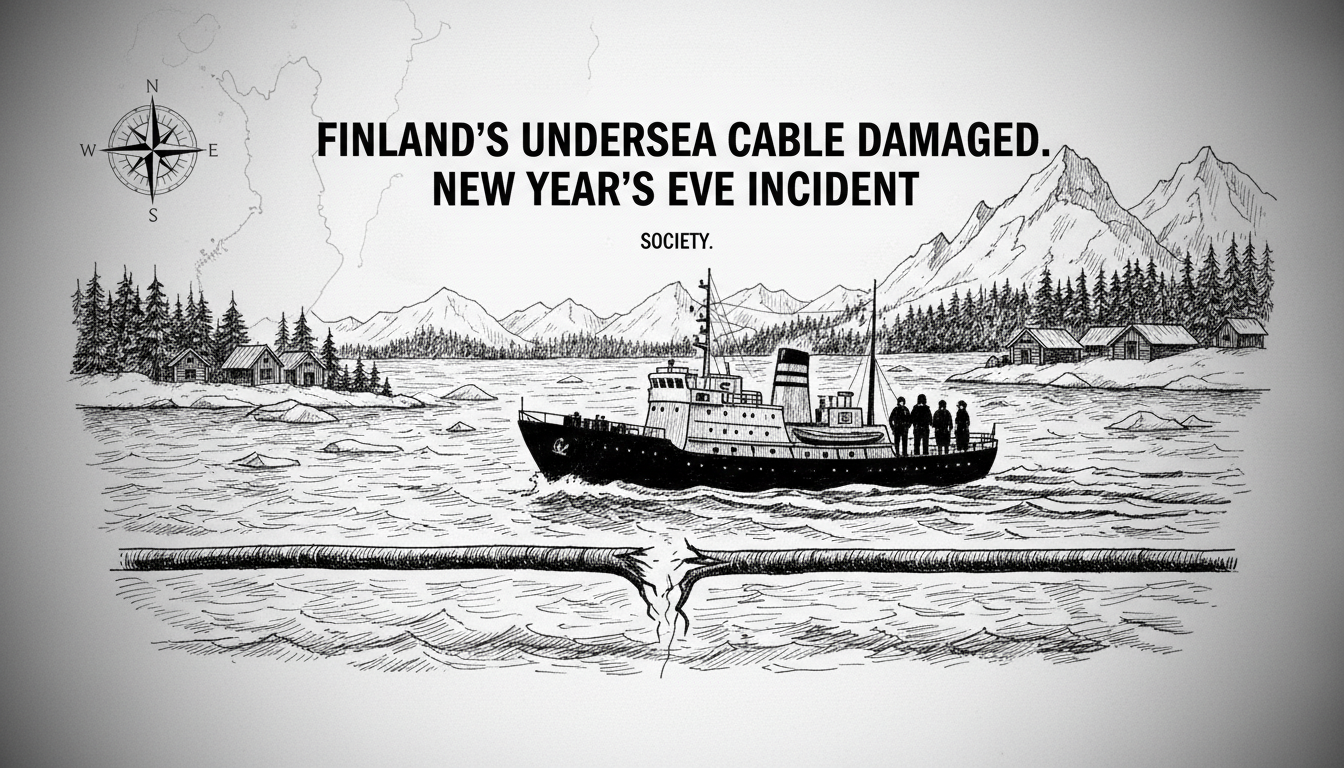
Finland's critical undersea infrastructure has been damaged in a New Year's Eve incident Prime Minister Petteri Orpo calls 'a special coincidence.' The disruption to a telecommunications cable owned by Finnish operator Elisa in the Gulf of Finland marks the second major cable incident in just over a year, raising urgent questions about the security of the Baltic Sea's vital seabed networks. Authorities have taken control of a vessel suspected of causing the damage, launching an immediate investigation with Estonian counterparts.
Prime Minister Orpo described the incident as serious in a statement. 'Of course it is a serious matter, if we start from the premise that our critical undersea infrastructure has been damaged,' Orpo said. 'It is clear that this has been taken very seriously.' The Prime Minister confirmed he was informed early on New Year's Day of disturbances on the Elisa cable and that Finnish authorities began acting immediately.
A Troubling Pattern Emerges
This event follows an almost identical incident on Christmas Day 2022, when the Estlink 2 power cable connecting Finland and Estonia was damaged by the oil tanker Eagle S. The temporal proximity of the two events—both occurring during major holidays—has sparked intense scrutiny. When asked about the pattern, Prime Minister Orpo offered a cautious but telling response. 'Your mind wants to draw conclusions, but I won't do that. We must now let the authorities do their work and see what this is about,' he stated, before adding, 'Let's say it's a special coincidence.'
The investigation will focus on determining whether the damage resulted from intentional action, poor seamanship, or environmental conditions. Orpo noted that the vessel in question has been cooperative and was brought under authorities' control within hours of the initial incident report. 'We have a tight connection with Estonia. I have spoken with the Estonian Prime Minister myself. The authorities are working together in good cooperation,' the Prime Minister said, emphasizing the cross-border nature of the response.
The Baltic Sea Chessboard
The Baltic Sea has transformed into a region of heightened strategic importance since Russia's full-scale invasion of Ukraine in February 2022. Finland's subsequent accession to NATO in April 2023 further altered the security landscape. The seafloor is a dense web of energy cables, like Estlink 1 and 2, and data cables that are the backbone of digital connectivity for the Nordic and Baltic nations. Protecting this infrastructure has become a paramount security concern for the alliance.
'These are not random pieces of string on the ocean floor. They are critical national security assets,' says Dr. Mira Kivistö, a senior researcher at the Finnish Institute of International Affairs specializing in hybrid threats. 'The pattern of incidents during holidays, when monitoring and response might be slower, is a red flag. It forces us to ask: is this testing our response times? Is it probing vulnerabilities? Or are we simply seeing a tragic increase in maritime accidents?'
Finnish authorities, including the Border Guard and the National Bureau of Investigation, are leading the probe. Their Estonian counterparts from the Estonian Police and Border Guard Board are collaborating closely. The Finnish government has stated that more information from the authorities is expected during the week, and repair operations will begin as soon as possible.
Infrastructure in the Crosshairs
The targeted cable belongs to Elisa, a major Finnish telecommunications company with 6.5 million subscriptions across its markets. While the full impact on data flow and connectivity is being assessed, the immediate operational response highlights hardened procedures developed over the past year. 'There is unfortunately already something of a routine in Finland for investigating such cases,' Prime Minister Orpo noted, underscoring how these events have shifted from theoretical risks to operational realities.
The incident underscores a broader, worrying trend across Northern Europe. In October 2023, a subsea gas pipeline and a telecommunications cable between Finland and Estonia were damaged, with the investigation pointing to external mechanical force. While no actor was formally blamed, the shadow of hybrid warfare—actions below the threshold of open conflict—loomed large. The Nordic countries have since significantly increased maritime patrols and underwater monitoring.
'What we are witnessing is the weaponization of infrastructure,' explains security analyst Lars Aho. 'You don't need to fire a shot. Cutting a cable or a pipeline can cause massive economic disruption, sow uncertainty, and force a costly response. It's asymmetric warfare that is very hard to attribute and equally hard to deter.'
The Path Forward: Resilience and Response
The immediate priority is the forensic investigation of the vessel and the damage site. Authorities must ascertain the cause through analysis of the ship's course, technical data, and the physical damage to the cable. Simultaneously, repair ships will be mobilized. Repairing a deep-sea cable is a complex, weather-dependent operation that can take weeks, requiring specialized vessels to locate the break and splice the cable.
Longer term, this event will intensify discussions on how to better protect undersea infrastructure. Proposals likely to gain traction include increased investment in seabed surveillance technology, stricter regulations for maritime traffic near known cable routes, and enhanced international cooperation for rapid response. NATO has already established a Critical Undersea Infrastructure Coordination Cell, and Finland's fresh membership means it is now integrated into these alliance-wide protection efforts.
For Finnish and Estonian businesses and citizens, the incident is a stark reminder of the physical fragility of the digital world. While redundancy in cable systems often prevents total blackouts, localized disruptions and increased latency can have real economic costs. The psychological impact—a sense of vulnerability in a tense geopolitical climate—may be equally significant.
Prime Minister Orpo concluded his remarks by urging patience and trust in the investigative process. 'Let the authorities do their work now, and in the good Finnish way, we investigate before drawing conclusions,' he said. Yet, with two major cable incidents in just over a year, the patience of the Finnish state is being matched by a rapid buildup of defensive capabilities. The investigation's findings will answer the immediate question of cause, but the broader question of how to secure the seafloor in an era of hybrid conflict remains wide open. As the Baltic Sea grows colder and darker this winter, the work to illuminate what happens beneath its waves has never been more critical.