
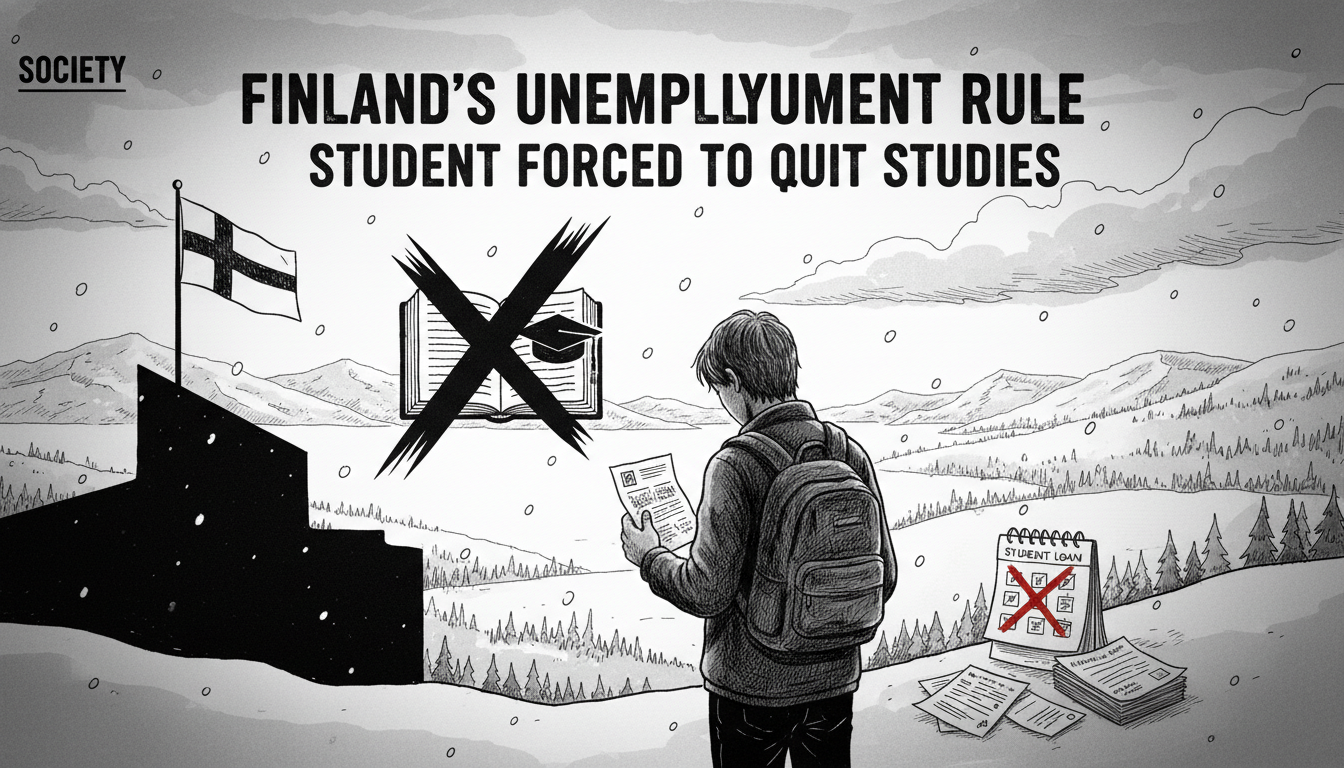
Finland's unemployment benefits system clashed with a student's right to study when Heidi Ruohola was told to abandon her education to receive financial support. The directive from the Public Employment and Business Services (TE Office) highlights a contentious rule within the Nordic welfare model, sparking debate over whether the system incentivizes job-seeking or inadvertently punishes self-improvement.
Heidi Ruohola, from Ulvila, was left in disbelief last November. After her fixed-term employment contract ended, she sought unemployment benefits while continuing her ongoing studies. The response from her local TE Office was blunt: to qualify for income support, she would have to terminate her studies immediately. "First came disbelief. As if it wasn't enough that the job ended, and then this on top of it," Ruohola recounted. The instruction felt like a punitive measure, forcing her to choose between immediate financial survival and long-term skill development.
A Clash Between Policy and Personal Ambition
The core issue lies in the eligibility criteria for Finland's earnings-related unemployment allowance. The system, administered by unemployment funds and monitored by TE Offices, requires recipients to be "fully available" for the labor market. Full-time studies are generally interpreted as conflicting with this requirement, as they can limit a person's ability to accept a job offer or attend job interviews at short notice. For Ruohola, this meant her pursuit of further qualifications was seen not as an asset but as a barrier to receiving the benefits her previous employment had funded.
This case exposes a potential rigidity within an otherwise admired social safety net. Finland's model is designed to provide security during unemployment while actively encouraging re-employment. However, experts point out that in a modern economy where continuous learning is crucial, the rule can create a perverse incentive. It may push individuals to remain in a state of pure job-seeking rather than allowing them to upskill, which could ultimately make them more competitive and secure in the long run. "The system's logic is from an industrial era," argued one social policy academic who requested anonymity. "It views availability as a binary state—studying or job-seeking—when in reality, strategic skill development is the best path to sustainable employment."
The Bureaucratic Hurdle and a Successful Appeal
Faced with the official demand, Ruohola decided to challenge the decision. Instead of dropping out, she filed a complaint. The appeals process, she discovered, was not as daunting as she feared. She gathered documentation about her study schedule, demonstrating its flexibility and her continued commitment to seeking work. She presented her case, arguing that her studies were complementary to her job search, not a replacement for it. Her persistence paid off. The initial decision was overturned, allowing her to continue her studies while receiving the unemployment benefits she was entitled to.
Ruohola's victory, however, is not a universal solution. Her success depended on her willingness to navigate a complex appeals system—a hurdle many may find intimidating or lack the resources to clear. The experience left her questioning the fairness of a rule that is applied automatically. "It feels like the first reaction of the system is to say 'no,'" she said. "The burden of proof is on the individual to show they are acting correctly, even when they are trying to improve their situation." Her story underscores a critical flaw: a rule intended to prevent abuse can instead punish proactive individuals.
Expert Analysis: A System in Need of Modernization?
Social security lawyers and employment policy researchers have long debated this specific tension. Professor Juha Hämäläinen, a specialist in social law at the University of Helsinki, notes the rule has historical roots. "The principle of full availability is central to the insurance-based logic of earnings-related benefits. It's a contract: society provides income replacement, and the individual commits to finding new work," Hämäläinen explained. "The challenge today is defining 'availability.' Does a weekly online course in a relevant field truly make someone unavailable? Often, the system's interpretation is too narrow."
There is growing discourse among Finnish policymakers about adapting these regulations. The rise of platform work, part-time studies, and modular micro-credentials demands a more nuanced approach. Some suggest implementing a hours-based threshold for studying, similar to rules for part-time work, rather than a blanket prohibition. Others propose caseworker discretion guided by clearer national guidelines that recognize the value of certain types of education. The Finnish Parliament's Social Affairs and Health Committee has periodically reviewed these issues, but legislative change has been slow, often caught between concerns over costs and the fundamental principles of the unemployment insurance system.
The Broader Context: Finland's Labor Market Paradox
Ruohola's situation occurs against a backdrop where Finnish governments consistently emphasize lifelong learning and digital skills development as national priorities. The Ministry of Economic Affairs and Employment runs campaigns encouraging adult education to meet labor market needs in technology and green industries. Yet, the unemployment benefits system can inadvertently work against this official strategy. This creates a paradox where the state, on one hand, funds adult education centers (kansalaisopistot) and study grants, while another arm of the state can penalize the unemployed for using them.
Comparisons with other Nordic nations reveal slightly different approaches. Sweden, for instance, allows for greater flexibility, permitting some studies while receiving benefits if they are deemed to increase employability and do not significantly hinder job search activities. Norway's system also incorporates more discretion for caseworkers. Finland's relatively stricter interpretation places it in a more conservative position within the Nordic framework, despite shared welfare state values.
A Personal Victory with Systemic Implications
Heidi Ruohola's case ended successfully for her, but it serves as a cautionary tale for thousands of Finns who might find themselves at a similar crossroads. It highlights the importance of knowing one's rights and being prepared to appeal bureaucratic decisions. For every Ruohola who successfully challenges the system, there may be many who reluctantly abandon their studies, potentially harming their future career prospects and the nation's collective skill base.
The incident raises a fundamental question for Finnish society: does its social security system trust its citizens to make responsible decisions about their own employability? As the nature of work continues to evolve, the rules governing unemployment must also adapt. The goal should be a system that provides a secure foundation not just for searching for the next job, but for building a better one. Ruohola's experience suggests that currently, the welfare state sometimes sees education as the enemy of employment, rather than its essential partner. The path to reforming this view runs through the Eduskunta, where the balance between control and empowerment will continue to be debated.