
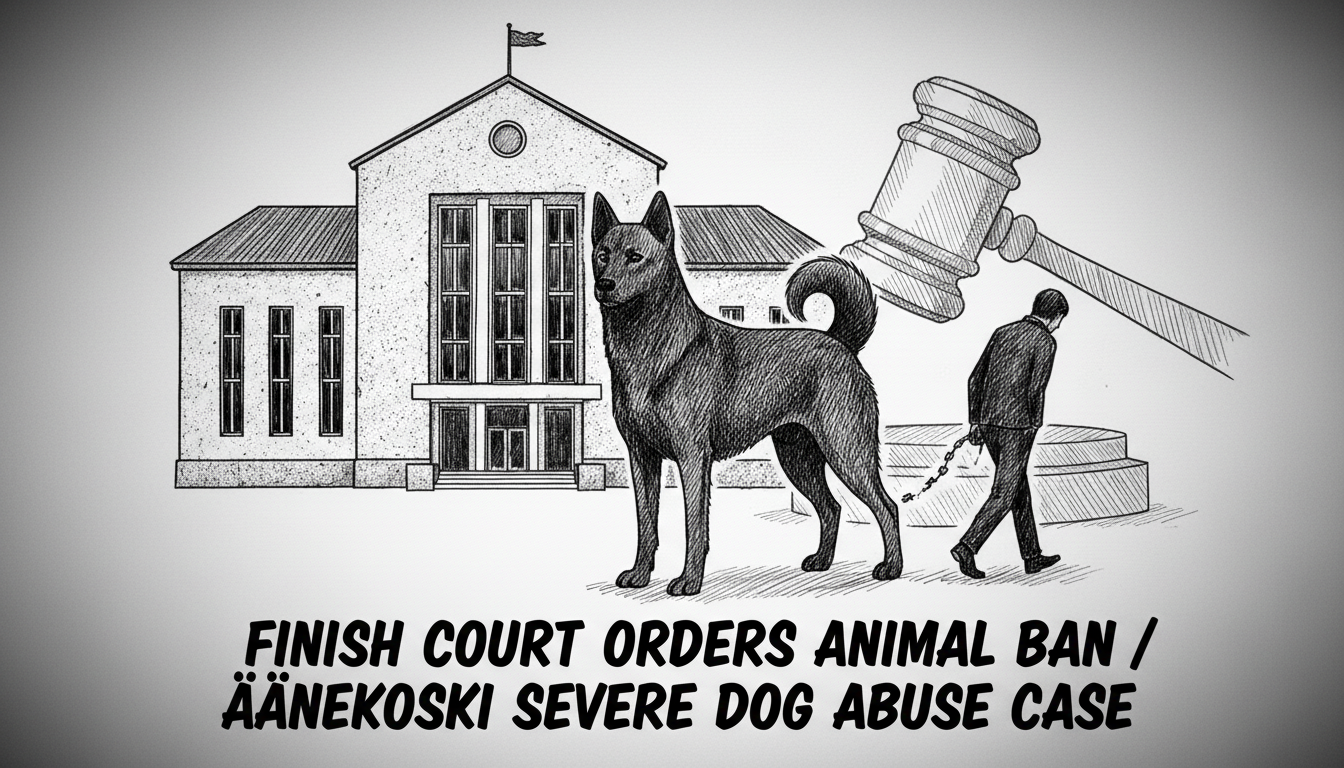
A Central Finland district court has delivered a decisive verdict in a severe animal welfare case, permanently removing a dog from its owner and imposing a comprehensive animal ownership ban. The court in Äänekoski found a 54-year-old man guilty of animal protection crimes for violently beating and kicking his dog on multiple occasions. This ruling underscores Finland's stringent legal framework for animal welfare and the serious consequences for violations.
The case, heard at the Keski-Suomen käräjäoikeus, detailed disturbing acts of cruelty. Evidence presented showed the man struck his dog with a fist and an open palm between four and nine times. He also kicked the animal in its side. The court deemed this treatment as cruel abuse, warranting the strongest penalties available under Finnish law. The primary outcome was the forfeiture of the dog to the state, effectively severing the owner's rights permanently. Furthermore, the court issued a formal ban preventing the individual from owning or keeping any animals for a substantial period, a measure designed to protect other creatures from potential harm.
This judgment aligns with Finland's robust Animal Welfare Act, which mandates proper care and prohibits all forms of mistreatment. Finnish society places high value on animal rights, with legislation that is considered among the most comprehensive in the European Union. The case occurred in Äänekoski, a town in the Central Finland region, demonstrating that enforcement is consistent across both urban and rural municipalities. Local authorities and animal protection organizations actively monitor and investigate reports of abuse.
For international observers and residents, this case highlights several key aspects of Finnish governance. The legal system operates with clear authority in welfare matters, and courts do not hesitate to impose lifetime bans on ownership for severe offenses. The forfeiture of the animal to the state ensures it can be relocated to a safe environment, typically through cooperation with reputable rescue organizations. This approach reflects a societal consensus that animals are sentient beings deserving of legal protection, not merely property.
The ruling sends a clear message about the boundaries of acceptable conduct. While details of the dog's current condition and future placement were not fully disclosed in the court summary, standard procedure involves veterinary care and rehabilitation. The case also serves as a reminder of the legal obligations for all pet owners in Finland, where negligence and active cruelty carry serious legal and financial repercussions. The straightforward application of the law in this instance, without prolonged appeals, shows the system's efficiency in addressing clear-cut violations.
What does this mean for the broader Nordic context? Finland's approach is consistent with its Scandinavian neighbors, where animal welfare standards are uniformly high. Similar cases in Sweden or Norway would likely yield comparable results, including ownership bans. The case is not an isolated incident but part of a continuous effort to uphold ethical standards. It answers the natural question of what happens when those standards are breached. The answer is a definitive loss of privileges and state intervention, a policy that enjoys broad public support and reflects the region's progressive values.