
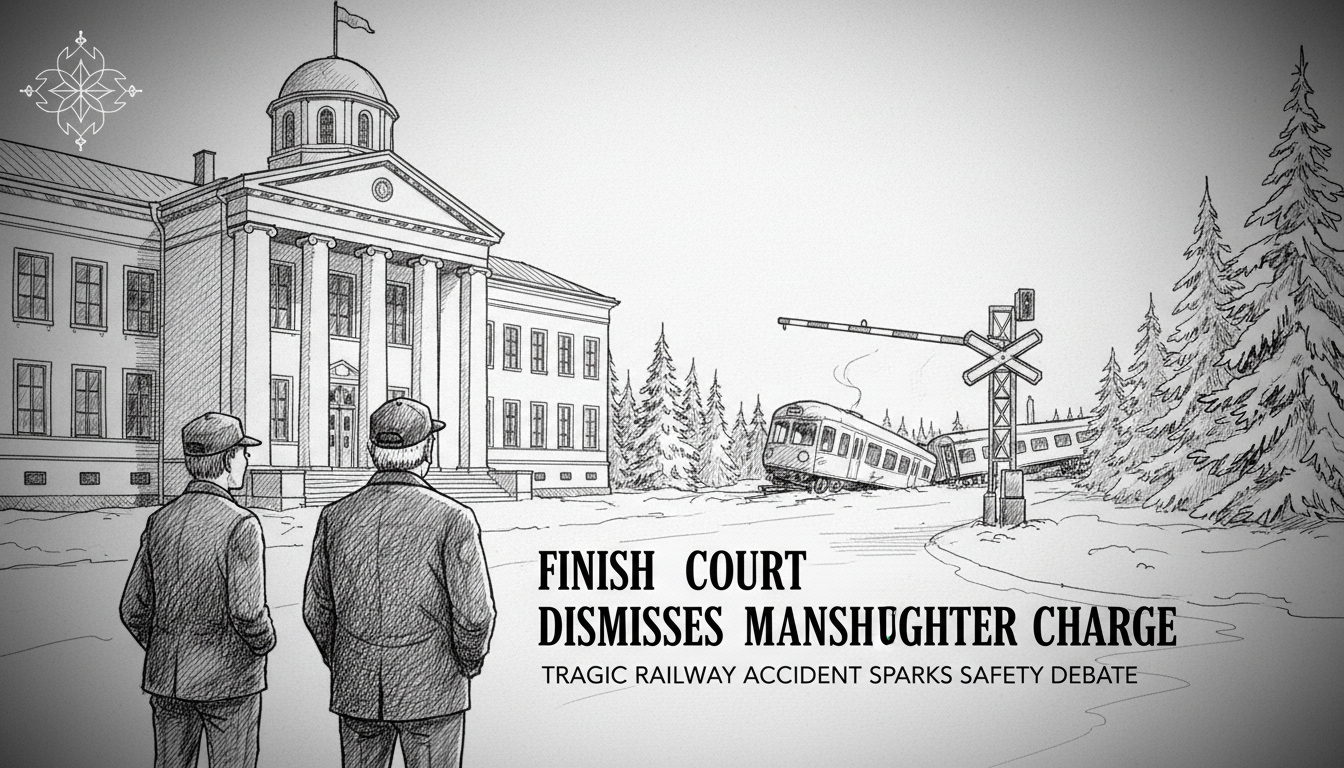
A Finnish district court has dismissed a manslaughter charge against a student driver involved in a fatal railway crossing accident in Kuopio. The court ruled the death of a railway maintenance worker was an accident, not a result of criminal negligence. This decision highlights critical questions about safety protocols, training responsibilities, and shared risk management in Finland's industrial and transport sectors.
The incident occurred at an unguarded level crossing within a timber loading area in Kuopio. A timber train collided with a lorry that had entered the tracks. The railway worker became trapped between the lorry's wheels and died. The lorry driver was a logistics student from the Savo Vocational College, practicing independently on the loading area for the first time as part of his studies.
The prosecution sought a conditional prison sentence for manslaughter. They argued the student driver neglected a duty of special care when approaching the crossing and proceeded despite an oncoming train. The North Savo District Court agreed the driver was guilty of endangering traffic safety. The court imposed 45 day-fines, totaling 270 euros based on his income. It rejected the more serious manslaughter charge.
The court found several mitigating factors. It noted the student's visibility was hampered by a snowbank and glaring sunlight. The deceased railway worker did not attempt to alert the driver to the train's approach. Crucially, the court stated it remained unclear what specific safety instructions the student had received from his educational institution regarding the loading area.
An official accident investigation report cited a broader systemic issue. It found operators in the area had minimal knowledge of each other's activities and shared safety procedures. The court concluded it could not demand that a student driver fully comprehend the operational risks or independently investigate them. This places significant responsibility on training institutions and site operators.
This case touches on core aspects of Finnish societal and legal principles. Finland's legal system emphasizes proportionality and intent in criminal liability. The distinction between 'tapaturma' (accident) and 'huolimattomuus' (negligence) is legally significant. The ruling suggests the system viewed the student's actions as a tragic error within a flawed environment, not a conscious disregard for safety.
For international observers, this illustrates Finland's nuanced approach to justice, balancing accountability with circumstance. It also raises immediate questions for vocational education and industrial zoning regulations. Who bears the ultimate responsibility for student safety in high-risk training environments? How are shared workspaces between different companies and trainees legally defined and managed?
The Finnish Transport and Communications Agency likely will review guidelines for level crossings in industrial areas. The Ministry of Education and Culture may also scrutinize practical training agreements for vocational students. This accident serves as a stark reminder that even in a nation renowned for safety and order, complex, shared spaces require explicit, communicated, and enforced protocols to prevent tragedy.