
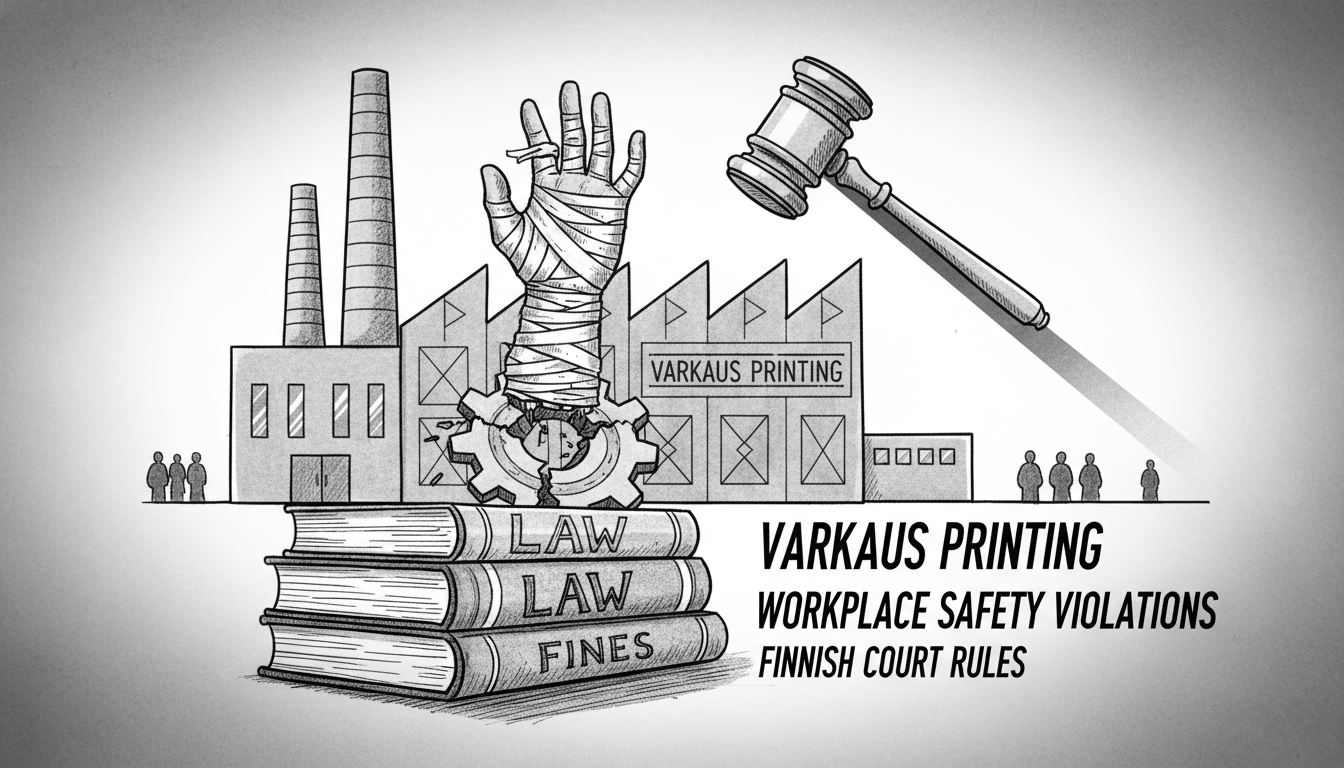
A district court in Northern Savonia has imposed a significant corporate fine on a printing company for workplace safety violations that led to a serious finger injury. The court ordered Lehtisepät Oy to pay a 10,000 euro corporate fine. The company's CEO and production manager also received personal fines for safety offenses and causing injury through negligence.
The incident occurred at the Savon Paino printing facility in Varkaus. A worker's glove became caught between two rollers of a lamella conveyor transporting newspaper bundles. The conveyor pulled the glove and the worker's fingers into the mechanism. This resulted in a crushing injury to the finger, causing skin necrosis, nerve damage, and permanent numbness.
In its ruling, the court determined the company failed to properly assess the risks associated with the conveyor. The judges noted that a different type of conveyor in another part of the same facility had been identified as a pinch-point hazard. Therefore, similar risks should have been recognized and mitigated on the machine involved in the accident. The court found this oversight constituted a clear breach of Finland's stringent occupational safety legislation.
This case highlights the rigorous enforcement of Finland's Occupational Safety and Health Act. Finnish authorities treat workplace safety violations with extreme seriousness, especially when they result in physical harm. The dual penalty structure—fining both the corporation and its responsible managers—is designed to create accountability at multiple levels. It sends a clear message that cost-cutting or negligence in safety protocols carries substantial financial and legal consequences.
For international businesses operating in Finland, this ruling serves as a critical reminder. The Finnish model prioritizes worker protection through proactive risk assessment. The legal expectation is that companies will systematically identify potential hazards before accidents occur, not merely react afterwards. The fact that a similar machine had a recognized risk made the company's failure to apply that knowledge elsewhere particularly damning in court.
What happens next for the company? Beyond the financial penalty, the ruling will trigger increased scrutiny from occupational safety inspectors. The company must now demonstrate comprehensive corrective actions across all its operations. For the injured worker, the court's finding strengthens any subsequent civil claim for compensation related to permanent disability or lost earning capacity. This case is not an isolated event but part of a consistent pattern in Nordic jurisdictions where courts impose meaningful penalties for safety failures, reflecting the region's deep-seated cultural commitment to workplace welfare.