
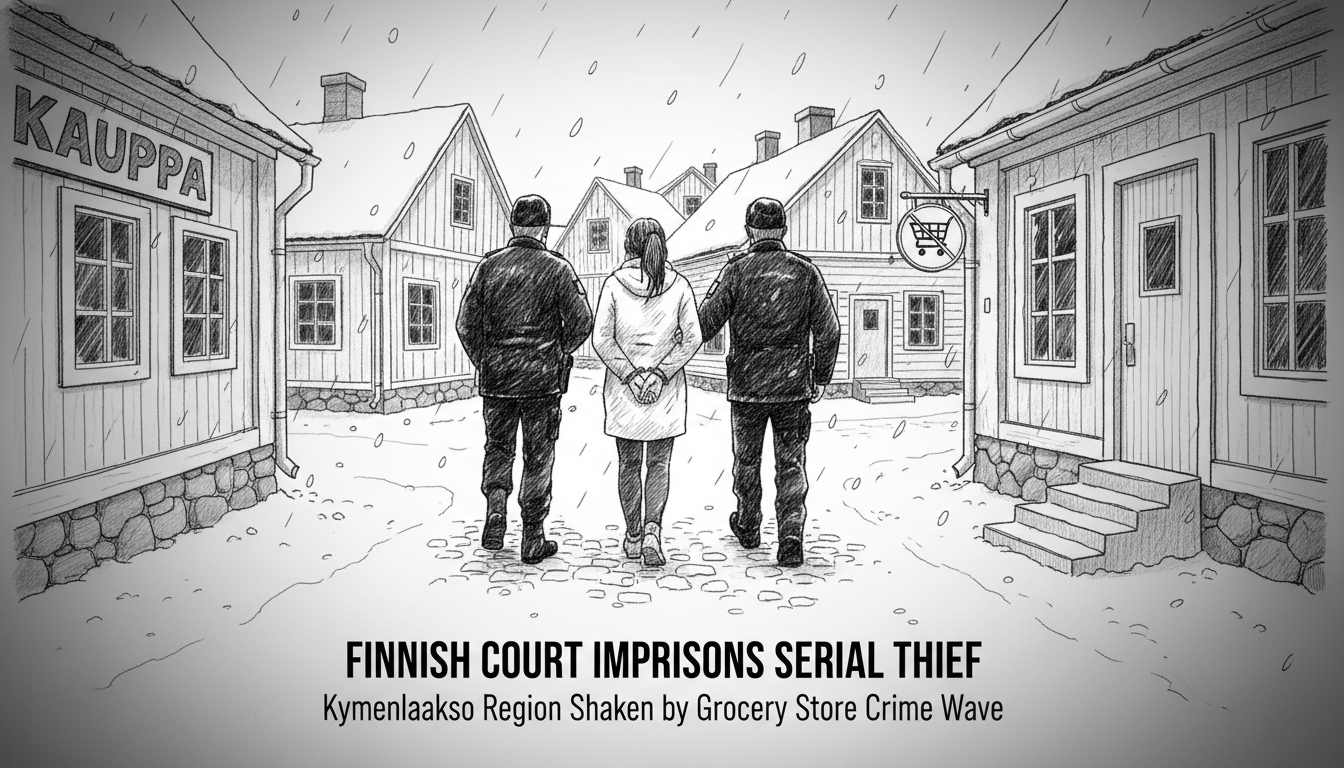
A district court in Finland's Kymenlaakso region has handed down an unconditional prison sentence to a woman for dozens of thefts and other crimes. The convicted individual, a woman born in 1983 from Kouvola, committed the offenses across multiple districts in the city. Her crimes included shoplifting from grocery stores in central Kouvola and the neighborhoods of Eskolanmäki, Tornionmäki, Lehtomäki, Myllykoski, and Kuusankoski. In several instances, she acted alongside a man born in 1986. The court considered the pattern of criminal activity across these locations when determining the sentence.
This case highlights the operational focus of Finnish district courts, known as käräjäoikeudet, on processing localized crime. The sentencing reflects standard judicial practice for repeated property offenses. Finnish law typically imposes unconditional prison terms for serial theft, especially when it involves multiple locations and a sustained pattern of behavior. The police investigation covered several months and linked the individual to thefts from commercial establishments.
Beyond the specific verdict, this prosecution connects to broader discussions in Finnish society about social support systems and recidivism. Finland maintains one of the lowest incarceration rates in the European Union, yet courts do not hesitate to impose custodial sentences for persistent criminality. The case originated from reports filed by local grocery stores, which are common targets for theft. Store security and local police cooperation led to the identification and arrest of the suspects.
The legal process involved standard procedures, including remand hearings and evidence collection from the various crime scenes. After her arrest, the woman spent a night in a hotel by taking a key from the reception. She also damaged a mattress while in police detention. These acts were included in the court's consideration of her conduct. The final sentence was based on the totality of the crimes, not just the individual thefts.
For international observers, this case offers a window into the Finnish judicial system's approach to non-violent, repetitive crime. The system emphasizes procedural fairness but applies clear consequences. The outcome is typical for similar patterns of offending in Finland, where the penal code allows for cumulative sentencing across multiple charges. The court's decision is now legally binding, though subject to standard appeal processes within the Finnish judicial hierarchy.
Local residents in Kouvola often express concern about petty crime affecting neighborhood businesses. This sentencing may provide some sense of judicial resolution for the affected store owners. The case also underscores the day-to-day work of the Kymenlaakso police district in responding to community crime reports. The collaboration between private security and public law enforcement remains a standard model for addressing property crime in Finnish cities and towns.