
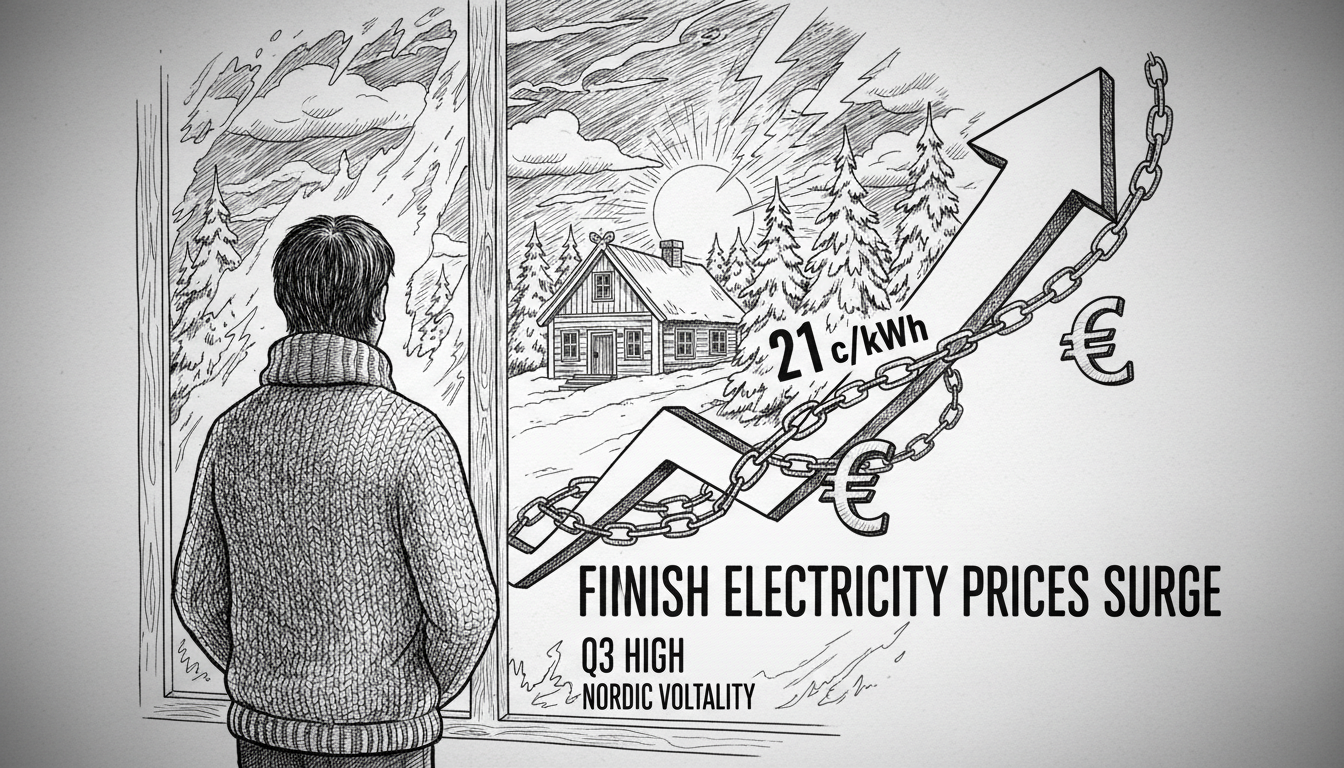
Finnish consumers face a sharp spike in electricity costs as spot market prices are set to reach an unusually high level. The average hourly price for consumer electricity, including value-added tax, will climb to a peak of 21.6 cents per kilowatt-hour on Friday morning. This price point is exceptionally rare, occurring during only about seven percent of all hours historically. The peak represents a multiple of the typical price of around four cents per kilowatt-hour. The price surge follows a consistently high price level observed throughout Thursday, which remained above 17 cents per kilowatt-hour during afternoon hours but stayed notably lower than Friday's expected peak. The reported prices are averages calculated from four separate 15-minute pricing intervals within each hour, reflecting a recent shift by the Nordic power exchange Nord Pool to 15-minute pricing intervals which began in early October. This pricing mechanism change can contribute to greater volatility and more pronounced price peaks during periods of high demand or constrained supply.
This sudden price increase carries significant implications for household budgets and the broader Finnish economy. The government in Helsinki, led by Prime Minister Petteri Orpo's coalition, has made energy affordability a central policy plank. Ministers from the National Coalition Party and the Finns Party have repeatedly pledged to stabilize energy costs. Such price spikes test those promises directly and put pressure on the government to consider immediate consumer support measures or longer-term market interventions. The issue is likely to prompt urgent questions in the Eduskunta, Finland's parliament, with opposition parties from the Social Democrats and the Left Alliance expected to criticize the government's energy strategy. The situation underscores the ongoing challenge of managing a market-based electricity system while protecting consumers from extreme price fluctuations, a tension at the heart of current political debates in Helsinki's government district.
The price surge also has clear European Union dimensions. Finland's integrated electricity market with its Nordic and Baltic neighbors means domestic prices are heavily influenced by regional supply, demand, and transmission capacity. Broader EU energy policy directives aimed at decarbonization and market integration shape the fundamental structure of this market. Analysts point to a combination of factors behind the spike, including lower-than-expected wind power generation in the region, scheduled maintenance at some nuclear or thermal power plants, and colder autumn temperatures driving up heating demand. Historical comparisons using data from November through May show that prices above 20 cents, while rare, are not unprecedented, but their frequency and impact remain a sensitive political issue. For international observers and expatriates in Finland, this event highlights the tangible effects of the Nordic energy market's design, where consumers are exposed to wholesale price signals that can change dramatically within hours.
The government's response will be closely watched. Will it hold firm to its market-liberal principles, or will it expedite planned support mechanisms? The Ministry of Economic Affairs has previously outlined tools for crisis situations, but deploying them requires political will. This price event, while acute, is a symptom of the larger transition facing Europe's energy systems. Finland's heavy reliance on its own nuclear base load and increasing renewable capacity provides some insulation, but not complete protection from these regional price dynamics. The coming days will reveal whether this is a brief anomaly or the start of a more sustained period of high costs, testing both household resilience and political resolve in equal measure.