
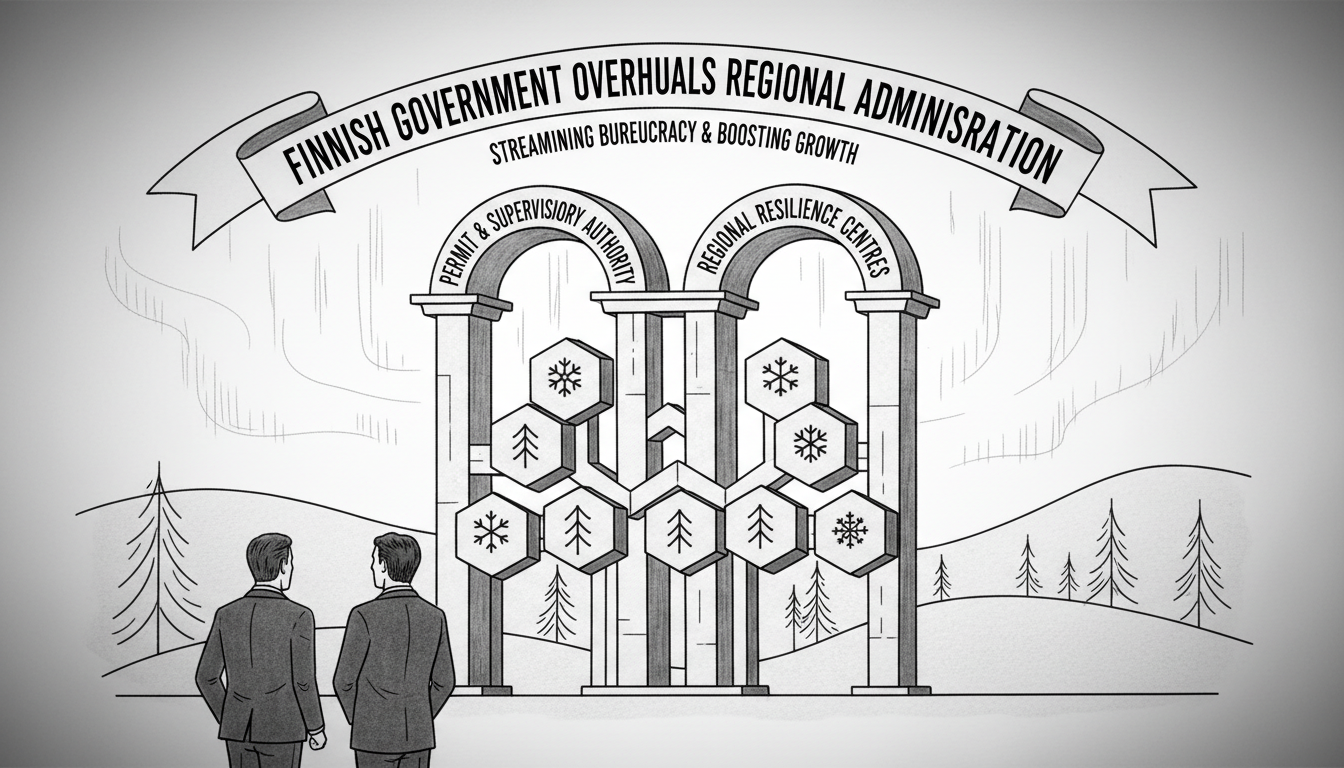
The Finnish government is dismantling its long-standing regional administrative bodies in a major structural reform. The fifteen-year-old Regional State Administrative Agencies, known as AVIs, and the Centres for Economic Development, Transport and the Environment, the ELY Centres, will cease to exist at the turn of the year. They will be replaced by two new super-agencies: a Permit and Supervisory Authority and ten Regional Resilience Centres. This move represents the most significant shake-up of Finland's state provincial administration in decades and is being launched under intense pressure to cut public spending.
The new Permit and Supervisory Authority will be headquartered in Tampere with 18 offices nationwide. The ten Regional Resilience Centres will cover the entire country. Each new agency will start with approximately 2,000 employees. Minister of Economic Affairs Sakari Puisto of the Finns Party stated the government aims to provide the Resilience Centres with new tools and funding to accelerate regional growth and investment. The government appointed directors for the Resilience Centres last week, but the top leadership position for the Permit Authority remains vacant.
The core mission of the Regional Resilience Centres is broadly defined as strengthening regional vitality. They will continue much of the ELY Centres' work on economic and business development under the Ministry of Economic Affairs and Employment. They will also receive guidance from other ministries, including the Ministry of the Environment and the Ministry of Agriculture and Forestry. The most substantial operational shift involves environmental permitting and supervision. The majority of personnel handling environmental tasks from the old ELY Centres will transfer to the new Permit and Supervisory Authority. Public transport-related duties will move to the Finnish Transport and Communications Agency, Traficom.
The new Permit and Supervisory Authority will consolidate a vast range of oversight functions. It will absorb the environmental permitting tasks from the AVIs and ELY Centres. It will also take over all the supervisory duties of the National Supervisory Authority for Welfare and Health, Valvira. A primary stated goal is to streamline and speed up the nation's licensing processes, which businesses have long criticized for being slow and fragmented.
This administrative overhaul occurs against a stark fiscal backdrop. The government has mandated substantial savings across the public sector. Project Manager Päivi Blinnikka for the Resilience Centre reform confirmed that specific savings targets have not yet been allocated to each centre. She noted that discussions on achieving these targets will begin immediately in the new year. The options include improving efficiency and streamlining operations, but Blinnikka acknowledged that other measures may be necessary later. The Permit and Supervisory Authority also has an immediate target to reduce its operational costs.
From a political perspective, this reform aligns with the current government's focus on centralization, cost-cutting, and simplifying bureaucratic processes for businesses. The consolidation into two main agencies aims to reduce overlap and clarify lines of responsibility. However, the immediate imposition of savings targets raises questions about the agencies' capacity to fulfill their new, broad mandates from the start. The success of the reform will likely be judged on two fronts: whether it genuinely improves service speed for citizens and companies, and whether it can stimulate regional economic growth as intended, all while operating with potentially fewer resources.
The changes will be closely monitored by municipalities, businesses, and EU authorities, as the new structures will be responsible for implementing a significant portion of EU regional development and environmental legislation within Finland. The coming year will serve as a critical test for this ambitious administrative restructuring.