
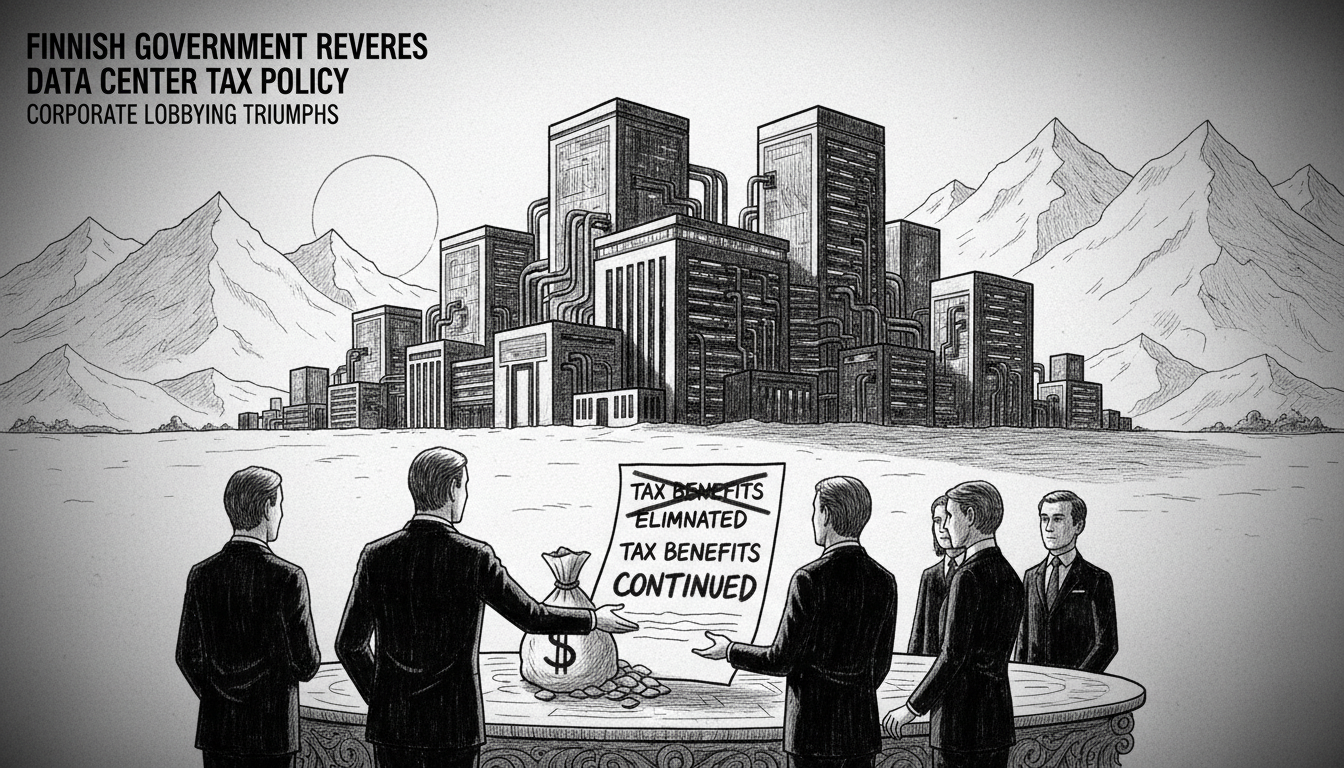
The Finnish government reversed its decision to eliminate tax benefits for data centers following intensive lobbying efforts from major technology corporations. Internal correspondence obtained through public records requests reveals how corporate lobbyists successfully influenced government ministers to maintain financial incentives for data center operations. Google emerged as the most active lobbyist during the first half of the year, specifically targeting advisors to ministers from the National Coalition Party.
Prime Minister Petteri Orpo became the primary focus of lobbying efforts according to the documents. The government had previously decided to remove corporate subsidies specifically designed for data centers, which traditionally included reduced electricity taxes among other financial benefits. Finance Minister Riikka Purra announced earlier this spring that the government intended to phase out these specialized tax arrangements for data center operations.
Corporate lobbyists immediately began warning policymakers that eliminating the tax benefit could drive away investors and associated tax revenues. Industry organizations painted dramatic scenarios of cancelled investments worth billions of euros. Google publicly suggested that its planned investments remained frozen due to electricity tax concerns. The lobbying campaign included direct email appeals to decision-makers and high-level meetings between Google executives and Prime Minister Orpo.
When the government refused to abandon electricity tax increases, discussions shifted toward developing an alternative support model. The data center subsidies have created divisions within the coalition government. The National Coalition Party expressed concerns that removing tax benefits would prevent Google's planned data center investments in Muhos and Kajaani. The Finns Party has maintained a more cautious approach toward data center subsidies.
Finance Minister Purra articulated the government's position in early November, questioning whether the world's wealthiest corporations truly need financial support from Finnish taxpayers. She noted that while data center investments could complement Finland's economic structure, they hardly constitute the backbone of the national economy. The government decided in April to replace the tax benefit with a compensation model that would reimburse companies for costs resulting from tax category increases.
Following the lobbying campaign, the government abandoned tax reductions but prepared a new support mechanism for data centers. Minister Purra confirmed in early November that a new support model for data centers remains under development. This policy reversal demonstrates the substantial influence corporate lobbying wields over Finnish decision-making processes, particularly concerning technology infrastructure investments.
The situation highlights ongoing tensions within the coalition government regarding industrial policy and foreign investment. The National Coalition Party typically advocates for business-friendly policies to attract international companies, while the Finns Party often questions subsidies for large multinational corporations. This philosophical divide becomes particularly evident when dealing with technology giants seeking special treatment within the Finnish market.
Data centers represent a complex policy challenge for the Finnish government. They bring substantial investments and potential job creation to regions like Muhos and Kajaani, but they also consume enormous amounts of electricity in a country where energy costs remain a sensitive political issue. The government must balance competing priorities between attracting foreign investment and maintaining fair taxation policies that don't disproportionately benefit massive corporations.
The outcome suggests that well-resourced lobbying campaigns can effectively shape Finnish policy decisions, even when those decisions involve substantial public financial commitments. The case raises important questions about transparency in government-corporate relations and whether Finnish taxpayers are getting adequate value from these specialized support arrangements.