
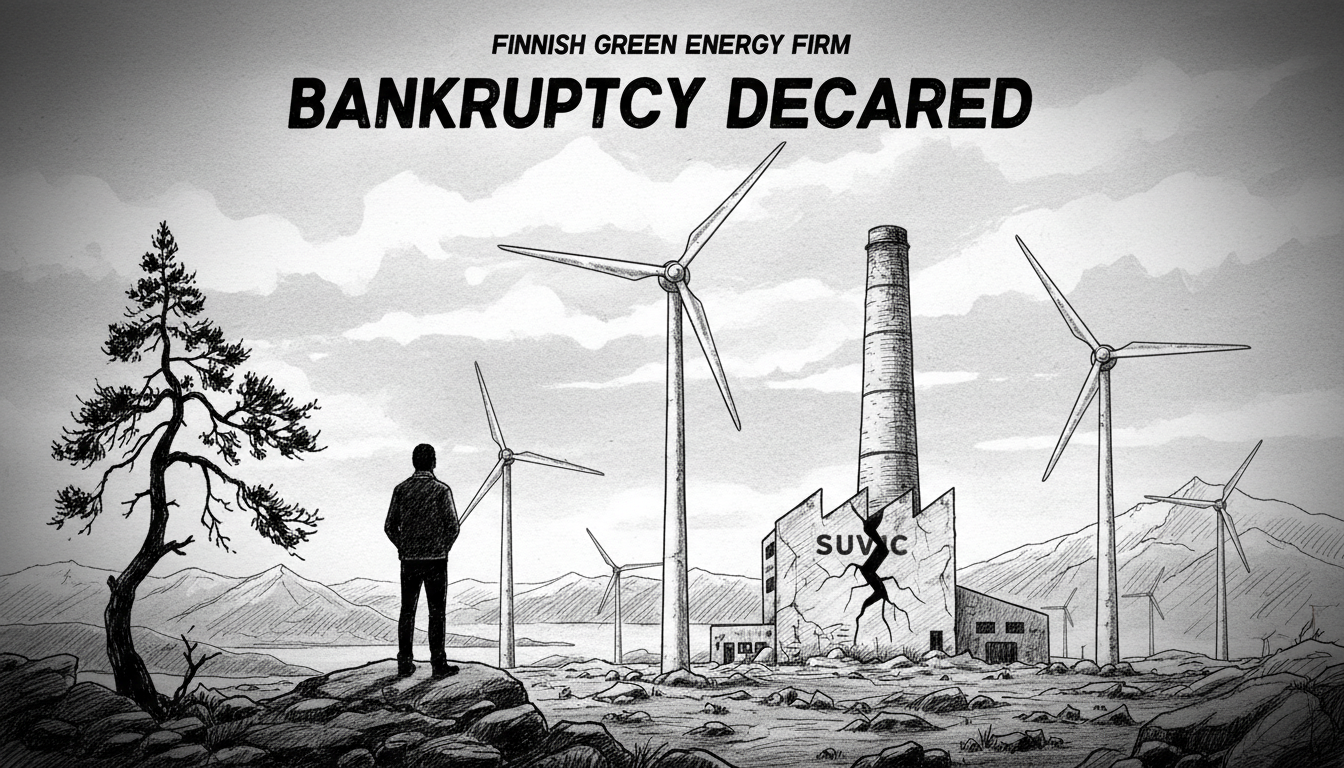
Finland's renewable energy sector faces a sudden shock as Oulu-based wind and solar constructor Suvic Oy files for bankruptcy. The Oulu District Court declared the company bankrupt on Wednesday, a move initiated by the firm's own board citing imminent insolvency. The collapse of a prominent builder in a state-prioritized industry sends immediate ripples through Finland's ambitious climate transition plans.
Suvic's Swedish subsidiary, Suvic AB, has simultaneously been petitioned into bankruptcy in the Stockholm District Court. Company CEO Markku Taskinen confirmed the decision was made by the board, which determined the company was threatened by insolvency. The rapid dual-country failure points to systemic financial pressures beyond a single project's troubles.
This bankruptcy strikes at the heart of Finland's northern technology hub. Oulu has cultivated a reputation as a center for clean-tech innovation, making Suvic's fall a significant local economic event. The case moves to bankruptcy trustee Lassi Nyyssönen of the law firm Fenno, who will now oversee the liquidation of assets.
A Strategic Hub Goes Silent
Suvic's headquarters in Oulu placed it within a critical ecosystem for Finnish engineering and technology. The city, known for its university and tech research, has been actively promoted by successive governments as a growth pole for green industry. The loss of a specialized contractor like Suvic removes a key node from this network, potentially slowing project execution across the region.
The company's core business involved the construction and development of wind farms and solar parks. This work is central to the Finnish government's legally binding goal of achieving carbon neutrality by 2035—one of the most ambitious in Europe. Each stalled or cancelled project directly impacts the national roadmap for phasing out fossil fuels.
Industry experts point to a confluence of pressures. "While the demand for renewable energy is higher than ever, the construction side is squeezed from multiple angles," notes a Helsinki-based energy analyst who requested anonymity due to client relationships. "Global supply chain issues have driven up the cost of turbines, solar panels, and specialty steel. Simultaneously, fierce competition for skilled labor and project delays due to permitting can cripple a company's cash flow."
Examining the Financial Fracture Lines
Suvic's decision to petition for bankruptcy itself suggests directors saw no viable path for restructuring or rescue financing. In Finland's creditor-friendly insolvency system, this preemptive move can provide a more orderly process. It indicates the board believed the company's financial position was beyond short-term repair, despite the booming sector.
The parallel bankruptcy in Sweden reveals the company's troubles were cross-border. Suvic AB likely handled projects in the Swedish market, which is also experiencing a massive wind power expansion. This suggests the problems may relate to corporate-level finances, management, or bidding strategies, rather than a single failed contract in Finland.
Rising interest rates present a major headwind for capital-intensive green energy projects. Financing for new wind and solar farms has become markedly more expensive over the past two years. Developers may delay final investment decisions, causing a pipeline bottleneck for construction firms like Suvic that relied on a steady stream of new projects.
"The sector is growing, but it is not immune to economic cycles and cost inflation," says Professor Laura Mäkinen, who studies energy transitions at the University of Turku. "Contractors operate on thin margins and long project timelines. A delay in one major project, or a miscalculation in a fixed-price bid, can be enough to threaten the whole enterprise. The government's targets create demand, but they don't guarantee the profitability of every private actor in the chain."
Implications for Finland's Climate Agenda
The bankruptcy poses direct questions for policymakers in Helsinki. The Finnish Ministry of Economic Affairs and Employment has consistently highlighted the green transition as a source of jobs and economic growth. The failure of a domestic builder implies potential vulnerabilities in this strategic national project.
Will Suvic's exit slow down the physical construction of promised renewable capacity? Competitors may absorb the workforce and projects, but the immediate disruption is real. The government faces a balancing act between setting ambitious goals and ensuring the industrial ecosystem can deliver them sustainably.
This event may trigger closer scrutiny of the financial health of other small-to-medium enterprises in the green construction sector. Parliament's Commerce Committee could potentially call for reviews to assess systemic risks. The state-owned investment fund, Suomen Malmijalostus, which is tasked with bolstering strategic industries, may also review its portfolio.
From a European Union perspective, Finland's progress is closely monitored. The country's National Energy and Climate Plan is part of the broader EU framework to achieve net-zero emissions. Any signal that key implementation partners are struggling could affect investor confidence in the region's transition timeline.
The Human and Industrial Aftermath
Beyond the balance sheets, the bankruptcy affects employees, subcontractors, and municipalities awaiting new projects. Skilled engineers and technicians in Oulu may find new positions quickly given the sector's demand, but the disruption is personal and financial. Local subcontractors who provided services to Suvic now face unpaid invoices, a typical cascading effect of corporate insolvency.
The trustee's primary duty is to liquidate Suvic's assets to pay creditors. This may include selling off project rights, equipment, and intellectual property. Larger Scandinavian or European energy contractors could see an opportunity to acquire valuable Finnish market knowledge and project pipelines at a discount.
For Oulu's city officials, the event is a setback. They have actively marketed the region's expertise in harsh-condition engineering, perfect for Arctic wind farm development. The city may need to reinforce support for its remaining clean-tech cluster to maintain investor confidence.
A Look at the Road Ahead
Suvic's collapse is unlikely to derail Finland's renewable energy ambitions, but it serves as a stark warning. It highlights that the transition to a green economy, while essential, is a complex industrial undertaking fraught with commercial risks. The market is consolidating, and scale is becoming increasingly important to withstand volatility in material costs and financing.
The Finnish government may examine whether its support mechanisms adequately reach the construction and contracting tier of the supply chain, not just the project developers and technology manufacturers. Policy tools may need refinement to ensure a resilient and competitive contractor base.
In the coming weeks, the bankruptcy proceedings will reveal more about the specific causes of Suvic's failure. The key question for industry observers is whether this is an isolated case or the first sign of sector-wide stress. One company's insolvency is a tragedy for its stakeholders; a pattern of them would constitute a crisis for Finland's climate strategy.
The ultimate test will be whether Finland's renewable project pipeline continues to move forward without delay. The success of the energy transition depends not on targets written in Helsinki, but on steel erected in the fields of Ostrobothnia and turbines turning in the winds of the Bothnian Bay.