
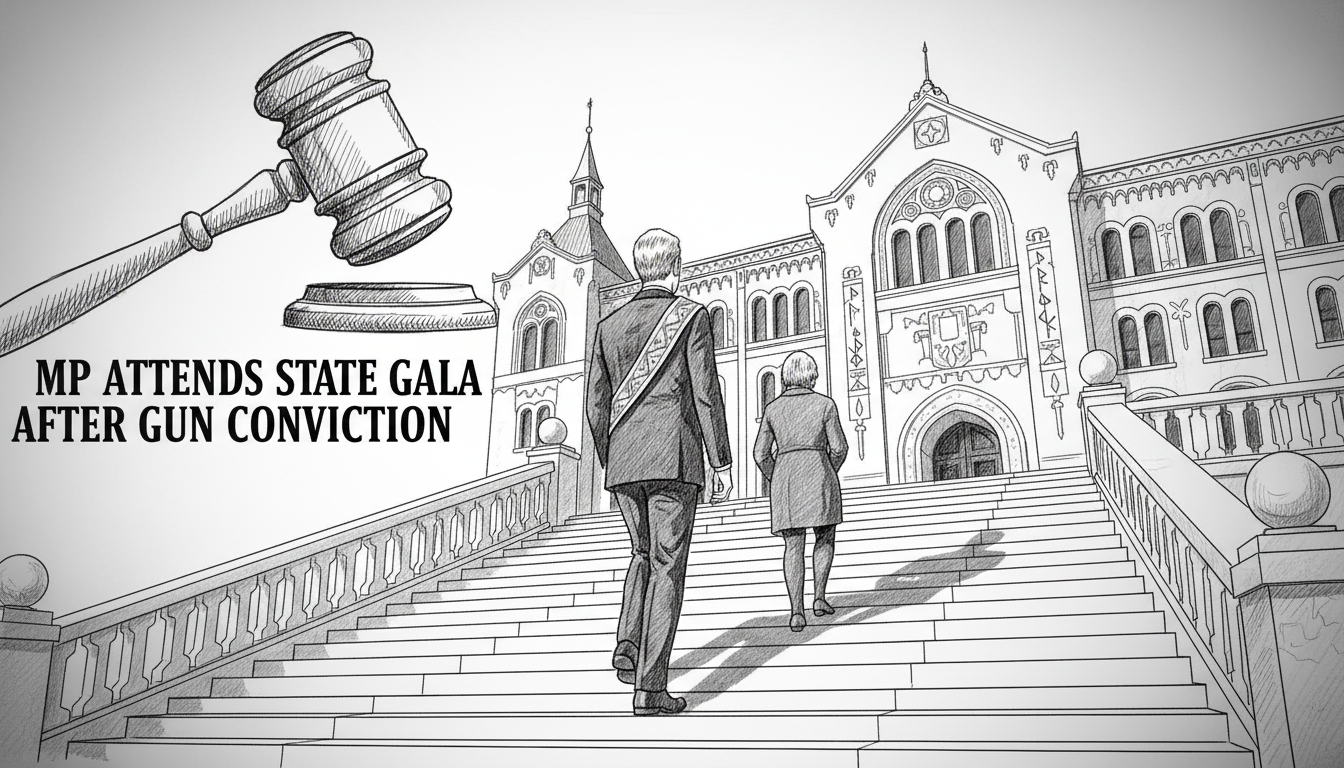
Finnish MP Timo Vornanen arrived at the Presidential Independence Day Gala on Friday evening, just hours after receiving an eight-month suspended prison sentence for a gun-related incident. The Member of Parliament for the Finns Party was convicted of assault, illegal threats, and firearms offenses for firing a warning shot while intoxicated outside a Helsinki bar in April 2024. His attendance at the prestigious Linnan juhlat, a celebration of Finland's 107th year of independence, immediately sparked a national debate about political accountability and the standards expected of elected officials.
Vornanen approached the red carpet outside the Presidential Palace with a relaxed demeanor. When asked by journalists if he planned to enjoy the event's famous glögg, a traditional mulled wine, he replied, "Let's see what's on offer. I might have a mug of it." The MP laughed off further questions about his evening plans, confirming he would not be heading to any after-parties or, pointedly, to Bar Ihku—the location of his criminal offense. His presence at the gala, accompanied by his wife, presented a stark visual contrast to the serious legal judgment handed down that morning in Helsinki District Court.
A Conviction and a Celebration
The Helsinki District Court found Timo Vornanen guilty on multiple counts stemming from the April incident. The charges included assault, two counts of making illegal threats, reckless handling of a firearm, a firearms offense, and a firearms violation. The court heard that Vornanen, while under the influence of alcohol, discharged his handgun in a public space, leading to the eight-month suspended prison sentence. Finnish law typically mandates the revocation of a firearms license following such a conviction, a process now underway. Vornanen stated his intention to appeal the verdict to the Helsinki Court of Appeal, a move that will prolong the legal process and keep the sentence from becoming final for months or even years.
This legal timeline is crucial for Vornanen's political future. Speaking to reporters at the palace gates, he directly linked his parliamentary career to the final court ruling. "If the prison sentence becomes final, then I will consider resigning," Vornanen stated. Given that the current parliamentary term does not end until 2027, a final, binding verdict may not arrive before the next national election. This allows Vornanen to potentially complete his term while his appeal is processed, a fact that has frustrated critics who argue an MP convicted of a violent crime should step aside immediately.
Political Repercussions and Coalition Tensions
The case places immediate pressure on the ruling coalition government, where Vornanen's Finns Party is a key partner. Prime Minister Petteri Orpo's coalition includes the National Coalition Party, the Finns Party, the Swedish People's Party, and the Christian Democrats. Senior figures from the National Coalition Party have been notably silent, while members of the opposition have been vocal. Social Democratic Party chairperson Antti Lindtman stated that a convicted MP has no place in the Eduskunta, Finland's parliament. The Green League and the Left Alliance have echoed calls for Vornanen to resign his seat voluntarily, irrespective of the ongoing appeal.
Within the Finns Party itself, reactions have been mixed. Party chairperson Riikka Purra has emphasized the principle of innocence until a verdict is final, supporting Vornanen's right to appeal. However, some party members privately express concern over the reputational damage. The incident fuels an ongoing narrative about the Finns Party and its approach to law and order, a central pillar of its platform. Political analyst Dr. Jenni Karimäki from the University of Helsinki notes, "This creates a significant tension. The party campaigns on strict justice and security, yet here is a sitting MP from their ranks convicted of a serious security offense. The cognitive dissonance for voters is substantial."
The Weight of Linnan Juhlat
The symbolism of Vornanen's gala attendance cannot be overstated. Linnan juhlat is the most exclusive social event of the Finnish calendar, broadcast live on national television and dissected in the media for days. An invitation is a mark of status and respect. The guest list, curated by President Alexander Stubb and his wife, includes individuals who have contributed significantly to Finnish society. For many citizens, seeing a politician convicted of a violent crime that same day walk the palace halls was jarring. It raised a fundamental question: what message does it send about the consequences for powerful figures?
Professor of Political Ethics, Marko Junkkari, argues the event itself became a platform for the controversy. "The Independence Day reception is a celebration of the nation and its institutions, including the rule of law," Junkkari explains. "An MP attending hours after being sentenced for breaking that very law creates a profound contradiction. It shifts the public discussion from the legal outcome to one of political arrogance and privilege." The image of Vornanen laughing on the red carpet has become the defining snapshot of the 2024 celebrations for many, overshadowing other honorees.
Legal Process Versus Political Accountability
The core of the debate now hinges on the distinction between legal process and political accountability. Vornanen and his supporters correctly point out that he has the legal right to appeal and is presumed innocent until that process is exhausted. His sentence is not yet final, and he retains his civil rights, including the right to serve as an MP. From a purely procedural standpoint, his attendance at the gala was not illegal.
However, critics, including ethics experts and opposition politicians, argue that political office demands a higher standard. They contend that the District Court's ruling, even if appealed, represents a serious finding of fact that undermines Vornanen's ability to perform his duties. As a legislator, he participates in making the laws he was found to have broken. "There is an expectation of moral authority," says Dr. Karimäki. "The court has established he committed a reckless, dangerous act. The question for his constituents and colleagues is whether someone who demonstrates such poor judgment can effectively represent the public interest and craft sensible security policy."
The appeal to the Helsinki Court of Appeal will likely focus on procedural elements and the interpretation of intent. Vornanen's defense may argue the warning shot did not constitute a direct threat or assault under strict legal definition. The court will review the evidence and the lower court's reasoning, a process that could take over a year. During this time, Vornanen will continue to draw his parliamentary salary, serve on committees, and vote on legislation.
A Test for Finland's Political Culture
This episode serves as a stress test for Finland's consensus-oriented political culture. The country generally enjoys high public trust in institutions, but scandals involving MPs can erode that foundation. The case forces all parties to clarify their stance on acceptable conduct for elected officials. For the coalition government, it is a delicate balancing act between respecting judicial process and maintaining public confidence. Pressure will mount on Prime Minister Orpo to address the issue, even if just to reaffirm his government's commitment to the rule of law.
The Finns Party now faces an internal test of its own discipline and priorities. Will it continue to shield Vornanen throughout the appeal, risking longer-term electoral fallout? Or will it eventually encourage him to step down to protect the party's brand? The decision will signal how the party weighs loyalty against broader electoral strategy. Meanwhile, the opposition sees a clear opportunity to frame the government as tolerant of ethical lapses, a line of attack they will likely pursue in upcoming budget debates and policy discussions.
As the commentary on the gala outfits fades, the substantive debate Timo Vornanen triggered is just beginning. His case sits at the intersection of law, politics, and public morality. Finland must now decide where the line is for its parliamentarians and what consequences should follow when that line is crossed, even before the final gavel falls in the highest court. The appeal will determine his legal fate, but the court of public opinion has already convened, and its judgment may prove equally consequential for the future of Finnish political norms.