
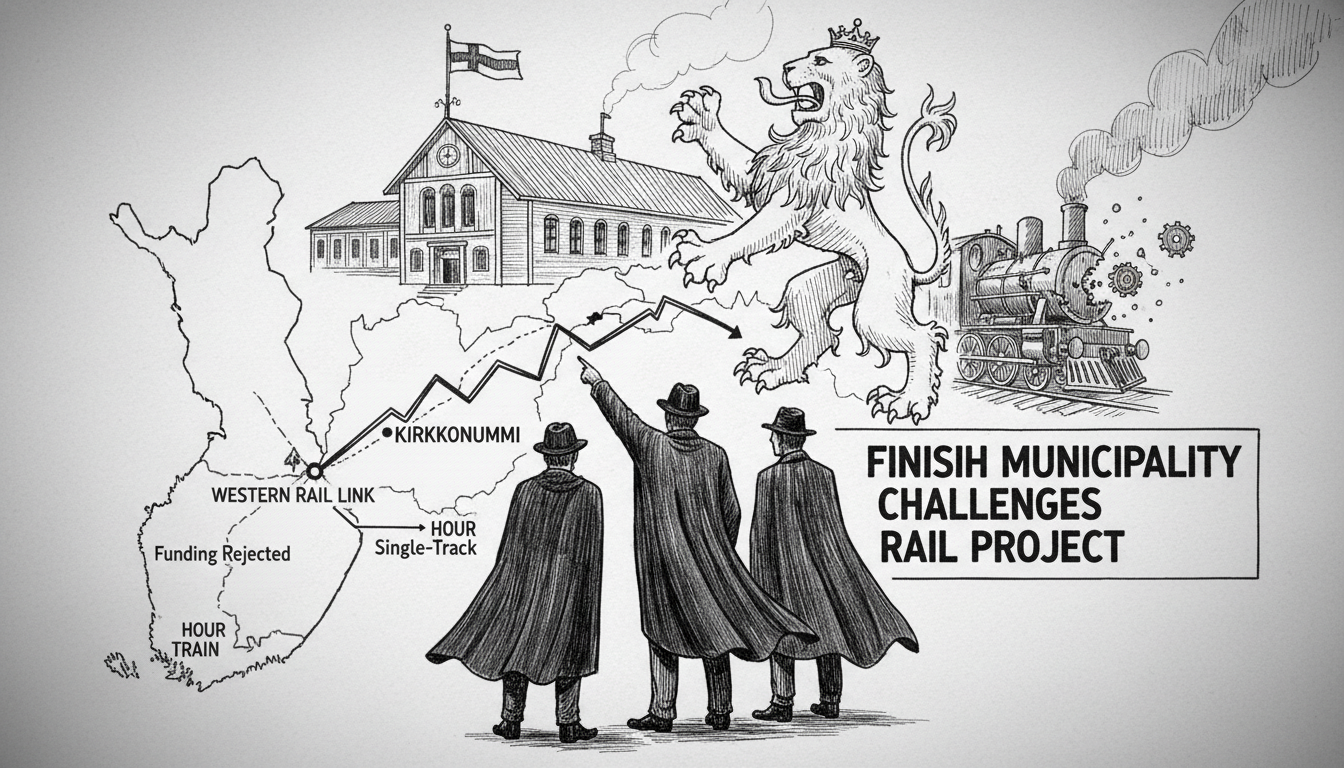
The municipal government of Kirkkonummi has voted to recommend rejecting a crucial funding agreement for Finland's Western Rail Link project, casting fresh doubt on the long-planned Helsinki-Turku high-speed connection. The council board decided by a vote of 8-5 on Monday to advise the full municipal council against approving the shareholder agreement and related financial commitments with the state-owned Länsirata Oy company. This decision directly challenges a core financing pillar for the first construction phase of the rail corridor intended to connect the capital region with southwestern Finland. Kirkkonummi's proposed commitment under the agreement would involve financing up to 15 million euros for the initial phase and being liable for up to 1.24 percent of the costs for a 520-million-euro loan arranged by the state. The final decision rests with Kirkkonummi's full municipal council, which will vote on the matter in early December.
The vote represents a significant political obstacle for a project already burdened by scaled-back ambitions and rising public skepticism. Kirkkonummi joins a growing list of municipalities expressing reservations, though others have moved forward. The neighboring municipalities of Turku, Espoo, Lohja, and Vihti have already voted in favor of the project. On the same day as Kirkkonummi's board vote, Vihti's municipal council approved the first-phase shareholder agreement by a decisive 33-9 margin. A separate survey of councilors in Salo suggests a majority there also intend to support the rail link. This patchwork of local support highlights the complex municipal politics surrounding major national infrastructure projects in Finland, where individual towns bear direct financial responsibility.
The Western Rail Link's journey from vision to reality has been marked by continual downgrades and cost-cutting measures that have eroded its original promise. Initial plans for a true high-speed, double-track railway have been substantially diluted. Over 60 kilometers of the planned route will now be single-track, a design choice that severely limits capacity and future expansion potential. The most symbolic casualty is the project's namesake goal: the 'Hour Train' between Turku and Helsinki. Current estimates now suggest the journey will take approximately 78 minutes, not the promised 60. These compromises stem from a brutal financial reassessment conducted a few years ago, which concluded the original four-billion-euro double-track design could never be economically viable. Subsequent redesigns managed to lower cost estimates to around three billion euros.
Financing for the first construction phase is now estimated at 1.32 billion euros, to be shared equally between the participating municipalities and the Finnish state. The municipal consortium's share is set at 400 million euros, matched by the state, with Länsirata Oy expected to secure a 520-million-euro loan backed by a state guarantee. This complex financial structure places direct burden on local taxpayers in the participating municipalities, explaining the cautious political calculus in council chambers. The project's construction is tentatively scheduled to begin in 2027, with the Lohja-Helsinki section projected to be operational by 2032, though these timelines are now increasingly uncertain.
This local resistance in Kirkkonummi reflects a broader tension in Finnish regional development policy. Major rail projects are championed as engines for economic growth and carbon reduction, yet their execution depends on the consent and coffers of individual municipalities. The decision pits long-term national transport strategy against immediate local budgetary concerns. For international observers, it showcases the decentralized nature of Finnish governance, where even state-backed megaprojects cannot proceed without convincing local stakeholders. The coming council vote in Kirkkonummi will serve as a critical test of whether the political will exists to fund a diminished version of a once-ambitious rail vision.