
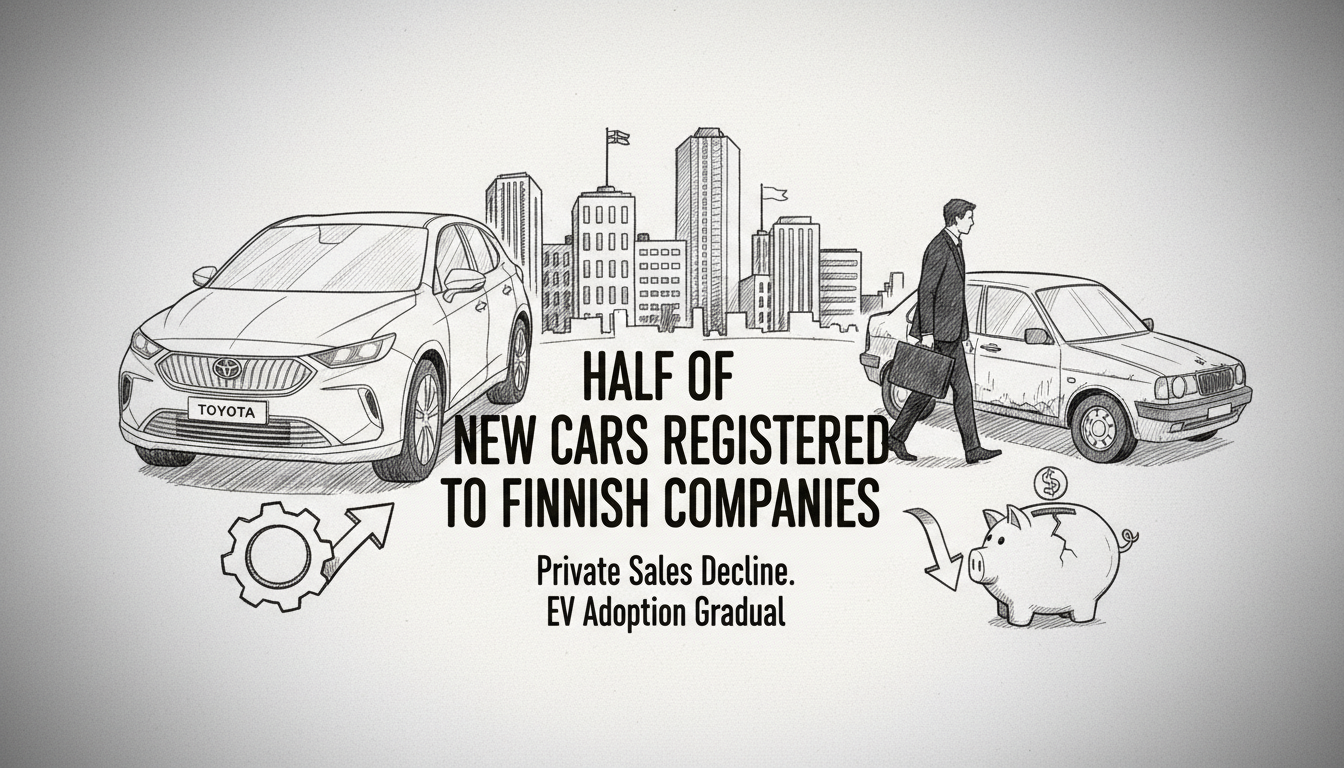
New car registrations in Finland fell again in November, continuing a year-long trend of declining private vehicle purchases. Official data shows 6,175 new passenger cars were registered last month, a 2.6 percent decrease compared to the same period last year. The total for the year to date stands at 66,342 vehicles, representing a 2.1 percent overall decline. This persistent downward movement in private registrations highlights shifting consumer behavior amid economic pressures and evolving transportation preferences in Finnish society.
A striking pattern emerges from the registration statistics, with corporate entities now accounting for approximately half of all new car acquisitions. This corporate dominance reflects broader economic structures and tax policies that favor business purchases over private ownership. Company car benefits, including tax deductions and value-added tax advantages, create powerful incentives within the Finnish system. The trend suggests private consumers are increasingly opting out of new car markets, possibly turning to used vehicles, public transport, or car-sharing services instead.
Toyota maintained its market leadership in November with 1,264 new registrations, followed by Skoda (821), Volkswagen (566), Volvo (448), Mercedes-Benz (350), and Kia (303). The year-to-date rankings show Toyota (10,756), Volkswagen (7,350), Skoda (6,535), Volvo (5,425), and Kia (5,260) as the top five brands. These figures reveal the continued strength of reliable, practical vehicles in the Finnish market, with Toyota's models consistently outperforming luxury competitors.
Model-specific data shows Toyota's Yaris Cross leading with 457 November registrations and 2,695 year-to-date, followed by the Corolla (237/1,965), RAV4 (227/1,833), and Yaris (206/2,250). The Skoda Enyaq electric vehicle achieved 206 registrations in November, reaching sixth place overall with 1,614 year-to-date registrations. The Volvo XC60 holds fifth position with 1,641 registrations. The presence of the Enyaq in the top rankings indicates growing, though still modest, electric vehicle adoption in Finland's challenging climate and infrastructure context.
This registration data carries implications for Finland's climate goals and automotive industry. The government has set ambitious targets for reducing transport emissions, but the slow uptake of fully electric vehicles presents challenges. While corporate fleets often transition faster to newer, cleaner technologies, the overall decline in new car registrations might actually reduce emissions if it reflects reduced total vehicle miles traveled. The data raises questions about whether current policies adequately address both climate objectives and equitable access to transportation.
Finland's automotive market operates within unique Nordic conditions, including harsh winters, long distances between population centers, and high vehicle taxes. These factors traditionally favored robust, reliable vehicles suited to challenging conditions. The current shift toward corporate ownership may accelerate technological adoption as companies seek fuel efficiency and lower operating costs. However, it also risks creating a two-tier system where newer, cleaner vehicles are primarily accessible through employment benefits rather than direct consumer choice.
The registration trends likely reflect multiple overlapping factors, including economic uncertainty, high inflation affecting disposable income, and changing attitudes toward car ownership among younger urban residents. Helsinki's growing public transport network and cycling infrastructure provide alternatives that simply don't exist in more rural areas. This urban-rural divide in transportation options may explain some of the registration patterns, though the data doesn't provide regional breakdowns.
Looking forward, these trends will influence policy discussions in the Eduskunta regarding transportation taxation, infrastructure investment, and climate strategy. The European Union's upcoming Euro 7 emissions standards and electric vehicle mandates will further shape the Finnish market. As corporate fleets increasingly dominate new car sales, policymakers must consider how to ensure transportation remains accessible to all citizens while meeting environmental targets. The data suggests Finland's relationship with the private automobile continues to evolve in fundamental ways.