
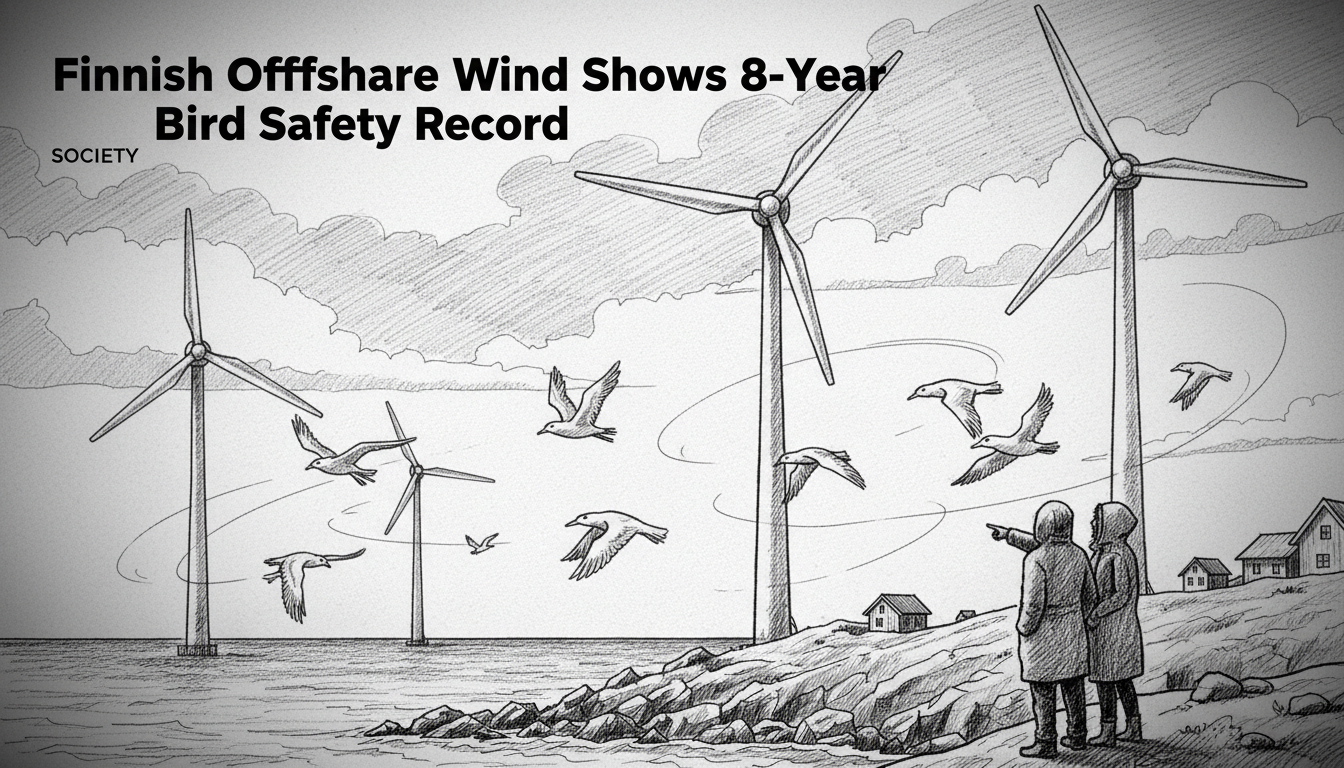
Finland's only offshore wind farm has operated for eight years without harming local bird populations, a landmark new study reveals. The findings from the Tahkoluoto project in Pori offer significant evidence for balancing green energy expansion with wildlife conservation.
An extensive, near-continuous bird monitoring report commissioned by Suomen Hyötytuuli concludes the eleven-turbine farm has shown no measurable effect on the size of bird colonies or their breeding success. This data comes as Finland aggressively pursues wind power to meet its climate neutrality goals, making environmental impact assessments critical for future projects.
A Long-Term Study in a Sensitive Archipelago
The Tahkoluoto offshore wind farm was completed in 2017 off the coast of Pori in the Bothnian Sea. Its location is significant; it sits near the valuable bird islands of Kaija, Kumpeli, Hylki, and Silakkariutta. This proximity raised initial concerns from conservationists about potential disruptions to nesting and feeding patterns for species like various sea ducks, terns, and gulls.
The strength of the new findings lies in the study's duration and methodology. Researchers have tracked breeding birdlife at the site for almost eight consecutive years. They used the nearby Preiviikinlahti archipelago area as a control zone. This comparison allowed scientists to isolate the effects of the wind turbines from other variables affecting bird populations, such as broader environmental changes or predation.
"Long-term monitoring like this is non-negotiable for credible impact assessment," said a senior ecologist involved with the study. "One or two years of data can be skewed by natural population fluctuations. Eight years provides a much clearer, more reliable picture of true trends."
Implications for Finland's Green Energy Surge
Finland's technology sector, known for Nokia and a thriving startup scene in Helsinki and Espoo, is also a leader in clean tech innovation. The nation aims to be carbon neutral by 2035, a goal that demands a rapid scale-up of renewable energy. Wind power is central to this strategy, with both onshore and offshore development accelerating.
However, project approvals often face scrutiny regarding environmental impact. The positive results from Tahkoluoto provide a powerful case study for developers and regulators. It demonstrates that with careful site selection and ongoing monitoring, offshore wind can coexist with important bird habitats. This is crucial for planning future large-scale projects in the Archipelago Sea and the Gulf of Bothnia.
"This isn't a blanket green light for any offshore location," cautioned a project manager from Suomen Hyötytuuli. "Tahkoluoto's specific conditions and the pre-construction studies that guided its placement were key. The lesson is that exhaustive preliminary research and committed long-term monitoring are essential components of responsible development."
The Finnish Wind Power Association has highlighted the study as important for the industry's social license to operate. Public support for wind energy remains high in Finland, but transparent environmental stewardship is vital for maintaining that trust, especially in ecologically sensitive coastal communities.
The Nordic Context and Technological Mitigation
The Nordic region is a global leader in wind energy penetration. Denmark and Sweden have extensive experience, and Norway is now advancing major offshore projects. The question of avian impact is a shared concern across the Baltic and North Seas.
Finland's eight-year dataset contributes valuable northern European evidence to an international body of research. Outcomes vary globally, depending on species, migration routes, and turbine technology. The Tahkoluoto findings suggest that in certain Baltic Sea conditions, risks can be effectively managed.
Technology plays an increasing role in mitigation. While not explicitly mentioned in the Tahkoluoto study, the broader Finnish tech industry is developing solutions used in wind farms. These include radar and camera-based monitoring systems that can detect large flocks of birds and potentially trigger temporary turbine shutdowns during high-risk periods. Helsinki-based startups in the Espoo innovation hub are working on AI-driven monitoring software, marrying the country's strength in gaming AI with its green energy needs.
Looking Beyond the First Eight Years
While the report is positive, experts emphasize that monitoring must continue. The lifecycle of a wind farm is 25-30 years. Understanding long-term, cumulative effects, especially as more turbines are added to nearby areas, requires persistent observation.
The next phase for Finnish offshore wind is markedly larger. Projects currently in planning stages envision turbines with much greater capacity and height than those at Tahkoluoto. The environmental assessment for these will be even more complex. The successful coexistence model at Tahkoluoto provides a foundation, but each new site will present unique challenges requiring its own detailed analysis.
The Finnish government's commitment to streamlining permitting for renewable energy must be matched by a commitment to funding and enforcing high-quality environmental research. The Tahkoluoto study shows this investment pays off in credible data that can unblock future projects.
For the Nordic energy sector, the message is one of cautious optimism. Finland's pioneering offshore project has delivered not just clean electricity but also eight years of evidence that economic and environmental goals can align. As the race to decarbonize intensifies, such hard data is more valuable than any speculative promise. The true test will be scaling this success responsibly, ensuring Finland's green energy future does not come at the cost of its natural heritage.