
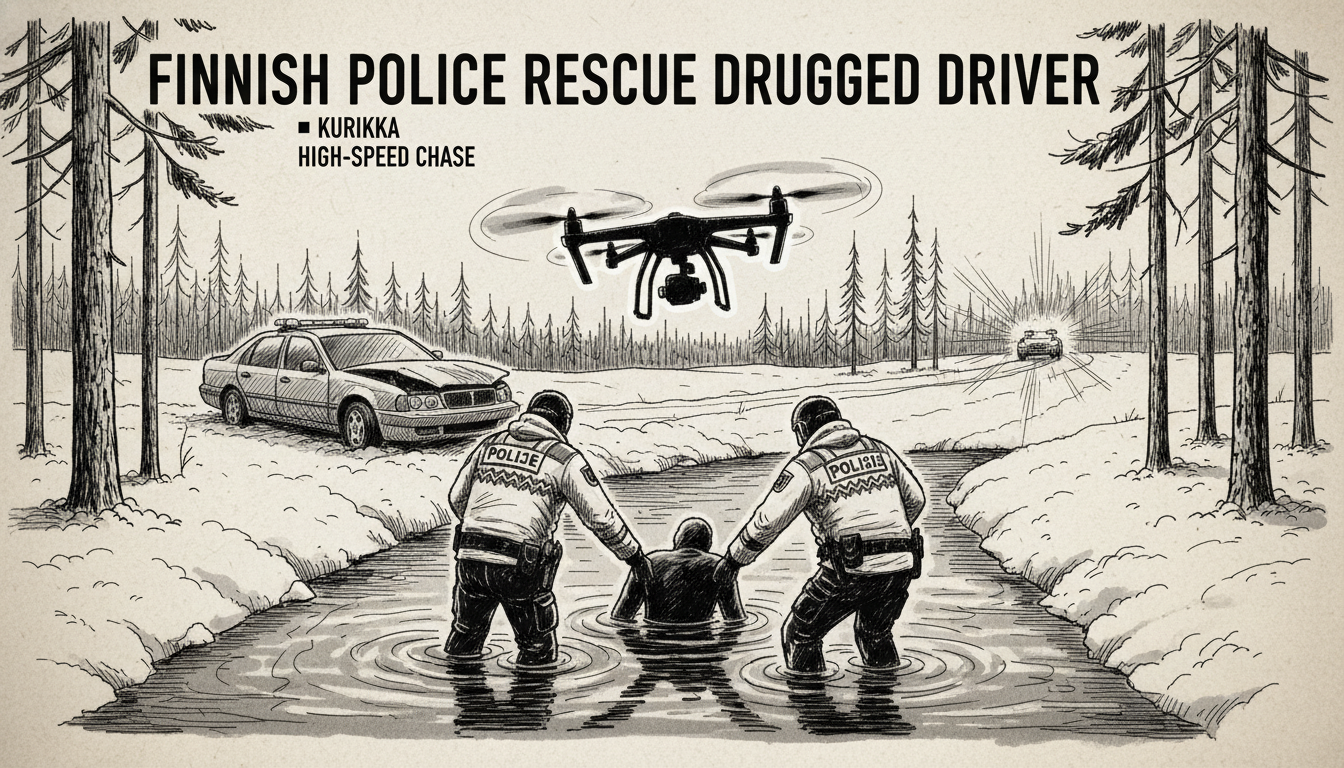
Finnish police rescued a disoriented man from a muddy ditch in Kurikka, South Ostrobothnia, on Wednesday evening. The man was suspected of driving under the influence of drugs, capping a dangerous high-speed chase that began in the neighboring municipality of Ilmajoki. The incident highlights ongoing challenges with impaired driving and police response in rural Finland.
Multiple calls to emergency services reported a car driving erratically and on the wrong side of the road in Ilmajoki's Ahonkylä village. The driver then collided with another vehicle before fleeing the scene at high speed, overtaking other cars. The chase continued toward Kurikka, with more calls coming in to police, who were attempting to locate the vehicle using its license plate number.
Approximately one hour later, police found the car in a ditch along Varpahaiskyläntie road in Kurikka. The hazard lights were on and the airbags had deployed. The driver was missing. Officers discovered footprints in the mud and launched a search using a drone equipped with a thermal camera. The drone located the unconscious man lying in a deep water-filled ditch. He was revived but was in an extremely confused state. Subsequent testing confirmed he was under the influence of narcotics. An ambulance transported him to a hospital for examination.
Police suspect the man of aggravated endangerment of traffic safety and aggravated drunk driving, a charge that in Finnish law also covers drug impairment. The driver of the other vehicle involved in the initial collision in Ilmajoki has not yet been contacted. Police have asked this individual to contact the Ostrobothnia Police Department via email.
This case is not an isolated event in Finland. Traffic safety officials consistently warn about the severe risks of driving under the influence of drugs or alcohol. Finland has strict laws, but enforcement in vast rural areas like South Ostrobothnia presents logistical difficulties. The successful use of a thermal drone in this search demonstrates how technology is becoming a critical tool for police in these regions, especially during nighttime or in difficult terrain.
The broader context involves Finland's continuous struggle to reduce traffic fatalities linked to substance abuse. While overall numbers have declined, incidents involving drugs are a persistent concern for authorities. The legal process following such an arrest is typically lengthy, involving blood tests, formal charges from the prosecutor, and a court hearing. Convictions for aggravated offenses often result in substantial fines and lengthy, unconditional driving bans. For international readers, it is important to understand that Finnish traffic law treats drug impairment with the same severity as alcohol intoxication, with low legal tolerance thresholds.
What happens next? The suspect will receive medical care while under police supervision. The investigation will focus on confirming the exact substances in his system and reconstructing the entire route of the chase. The other motorist involved needs to be found to complete the report on the initial collision. This incident will likely be cited in ongoing discussions about resource allocation for rural police districts and the need for continued public awareness campaigns against impaired driving, a year-round issue not limited to specific holiday seasons.