
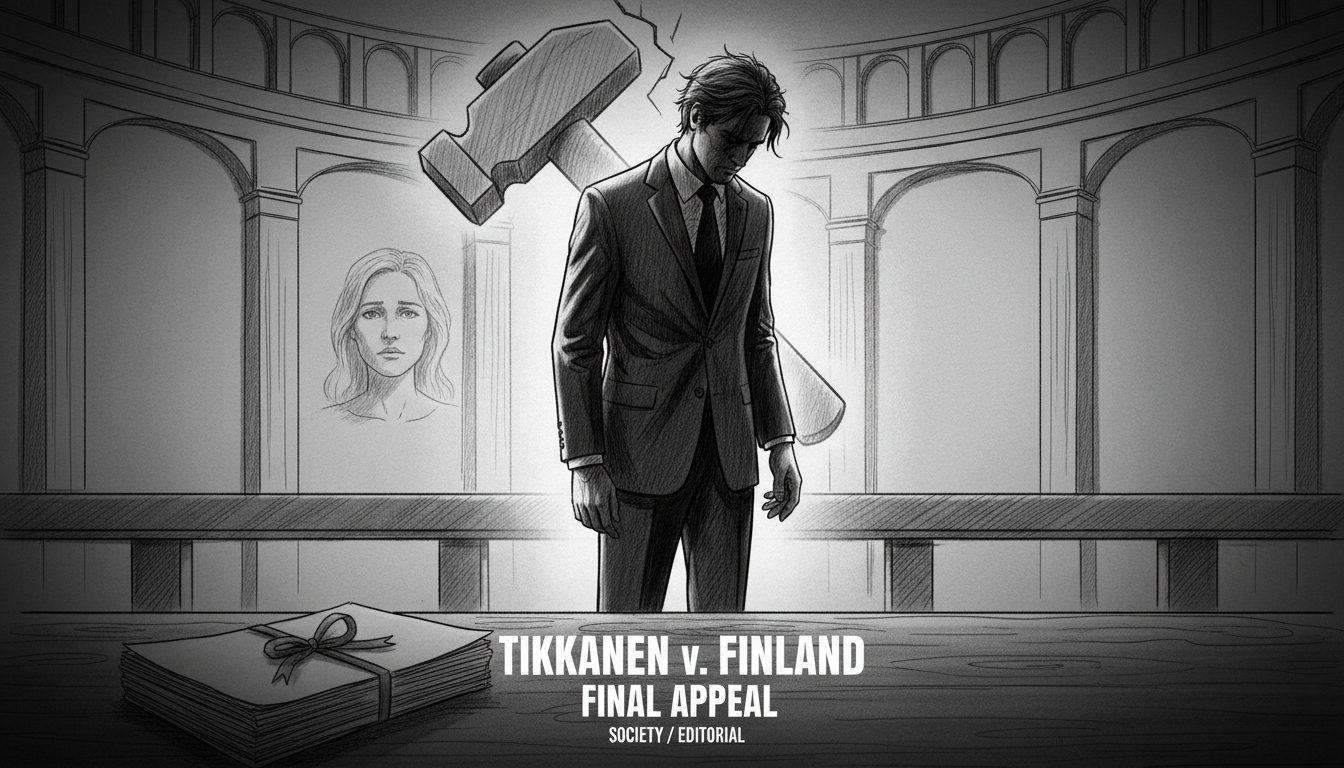
Roope Tikkanen, a 51-year-old former psychiatrist convicted of murdering his wife, is considering a final appeal to Finland's Supreme Court. His defense lawyer confirmed the potential appeal after reviewing the recent appellate court decision. The Helsinki Court of Appeal largely upheld the life sentence imposed by the district court earlier this year. This high-profile case has gripped the nation and raises complex questions about mental health defenses within the Finnish legal system.
The appellate court delivered its verdict in early December, making only minor adjustments to the original sentence. Judges affirmed the life imprisonment for what they described as a particularly brutal and cruel killing. They diverged from the prosecution on one key point by not classifying the act as premeditated. The court also rejected Tikkanen's request for a new psychiatric evaluation, upholding the assessment by the Finnish Institute for Health and Welfare that found him legally competent at the time of the crime.
Tikkanen, who worked as a psychiatry specialist, maintained throughout the trial that he was experiencing psychosis during the incident. He argued for a conviction of manslaughter rather than murder, which would have carried a conditional prison sentence. Both courts thoroughly dismissed this defense after examining extensive medical evidence and expert testimony. The legal standard for insanity defenses in Finland requires proving complete lack of criminal responsibility due to severe mental disorder.
The case highlights Finland's strict approach to homicide convictions and the high threshold for successful mental health defenses. Finnish courts rarely grant appeals to the Supreme Court, particularly for violent crimes. The Supreme Court accepts cases only when they involve important legal principles or contain procedural errors requiring clarification. The deadline for filing the appeal application is early February.
Beyond the prison sentence, the courts addressed substantial compensation for the victims' family. The district court had ordered record-high suffering compensation payments of 30,000 euros to each of the couple's two children. The appellate court reduced these amounts to 25,000 euros per child while maintaining the compensation order itself. These sums represent some of the largest ever awarded in Finnish criminal cases for non-material damages.
The legal proceedings have unfolded in Helsinki's government district courtrooms, drawing attention to Finland's judicial processes. The case's progression through multiple court levels demonstrates the thoroughness of the Finnish legal system but also its finality once appeals are exhausted. Legal experts note that Supreme Court appeals in murder cases succeed only in exceptional circumstances involving novel legal questions.
What makes this case particularly notable is the defendant's professional background. As a trained psychiatrist, Tikkanen's mental health defense faced intense scrutiny from medical and legal professionals alike. The courts relied heavily on independent psychiatric evaluations rather than accepting the defendant's self-assessment. This approach reflects Finland's evidence-based legal culture where expert testimony carries substantial weight.
The coming weeks will determine whether Finland's highest court will review this already extensively examined case. If the appeal proceeds, it would focus narrowly on legal procedure rather than re-examining factual evidence. For now, the life sentence stands as a definitive judgment in one of Finland's most closely watched criminal cases in recent memory.