
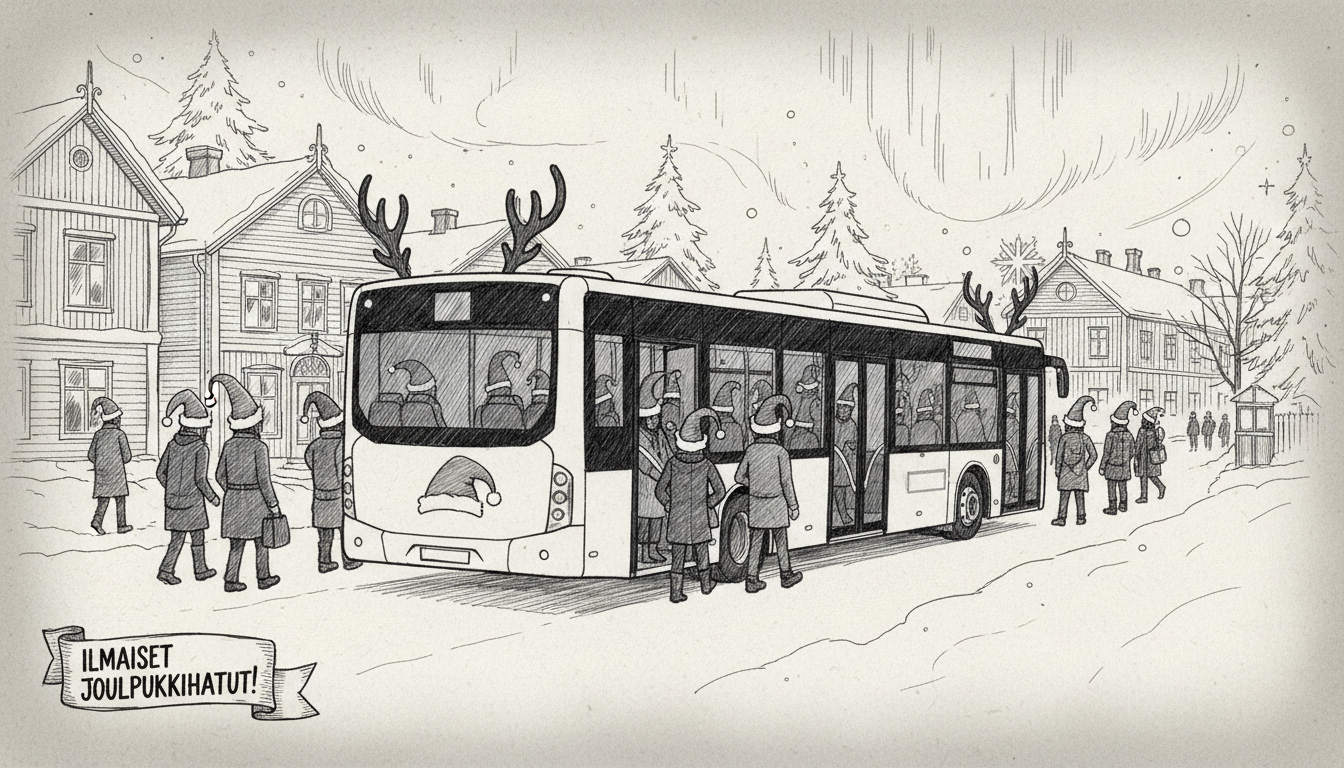
The Linkki public transport network in Central Finland will offer free travel to all passengers wearing a Christmas elf hat next Saturday. This annual tradition transforms regular bus routes into festive journeys across seven municipalities. The promotion applies to all Linkki buses in Jyväskylä, Laukaa, Muurame, Äänekoski, Hankasalmi, Toivakka, and Petäjävesi from early morning until midnight. Specific lines include S1 through S6, routes 3 to 46, and lines 140, 141, and 143. The free fare also extends to certain Matka Mäkelä coach services between Petäjävesi and Jyväskylä and regional line 113 towards Korpilahti and Jämsä. Organizers emphasize that the hat must be visibly worn. Without it, normal ticket rules apply.
This initiative represents a unique blend of Finnish cultural tradition and municipal public service. The 'tonttulakki' or elf hat promotion leverages seasonal goodwill to encourage public transport use during the busy pre-Christmas period. It is a concrete example of how local governments in Finland often employ light-hearted, community-focused campaigns to engage citizens. The policy effectively subsidizes mobility for participants while fostering a shared festive spirit. Similar regional promotions exist across the Nordic countries, often tied to specific cultural events or national days. These campaigns are typically funded through municipal marketing budgets or transport authority partnerships. They aim to increase off-peak ridership and build positive public association with transit systems.
From a policy perspective, the event functions as a temporary, targeted subsidy. It reduces the effective cost of transportation to zero for compliant users within a defined geographical and temporal window. This can have minor economic effects by increasing consumer spending power in town centers. The requirement of the hat acts as a simple but effective verification mechanism. It prevents system abuse while ensuring the promotional cost remains predictable. For international observers, such events highlight the Finnish propensity for practical, rule-based systems that still accommodate whimsy and community tradition. The campaign's success relies on widespread cultural recognition of the elf hat as a symbol of the season.
What does this mean for residents and visitors? The offer provides a cost-effective way to complete Christmas shopping or visit friends across the region. It reduces traffic congestion and parking demands in urban centers like Jyväskylä on a busy Saturday. The promotion also subtly reinforces the use of public transit as a social norm. For families, it offers an affordable day out. The explicit requirement for good Christmas spirit and patience, as noted in local reports, acknowledges that buses may be busier than usual. This is a characteristically Finnish note of pragmatic realism within a festive framework. The event is a scheduled annual occurrence, not an ad-hoc decision, reflecting stable municipal planning.
Looking forward, the continuation of this tradition depends on its perceived value for money by the governing councils of the Central Finland Transport service. Similar cultural promotions face scrutiny if public finances tighten. Yet their relatively low cost and high goodwill often secure their place in the budget. The model could inspire other regions to develop localized versions tied to different festivals. In an era of climate goals, encouraging public transport use through positive incentives aligns with broader national strategies. This small Saturday event, therefore, connects to larger themes of sustainable mobility, cultural identity, and community cohesion in Finnish society. It is policy through celebration, a distinctly Nordic approach to civic engagement.