
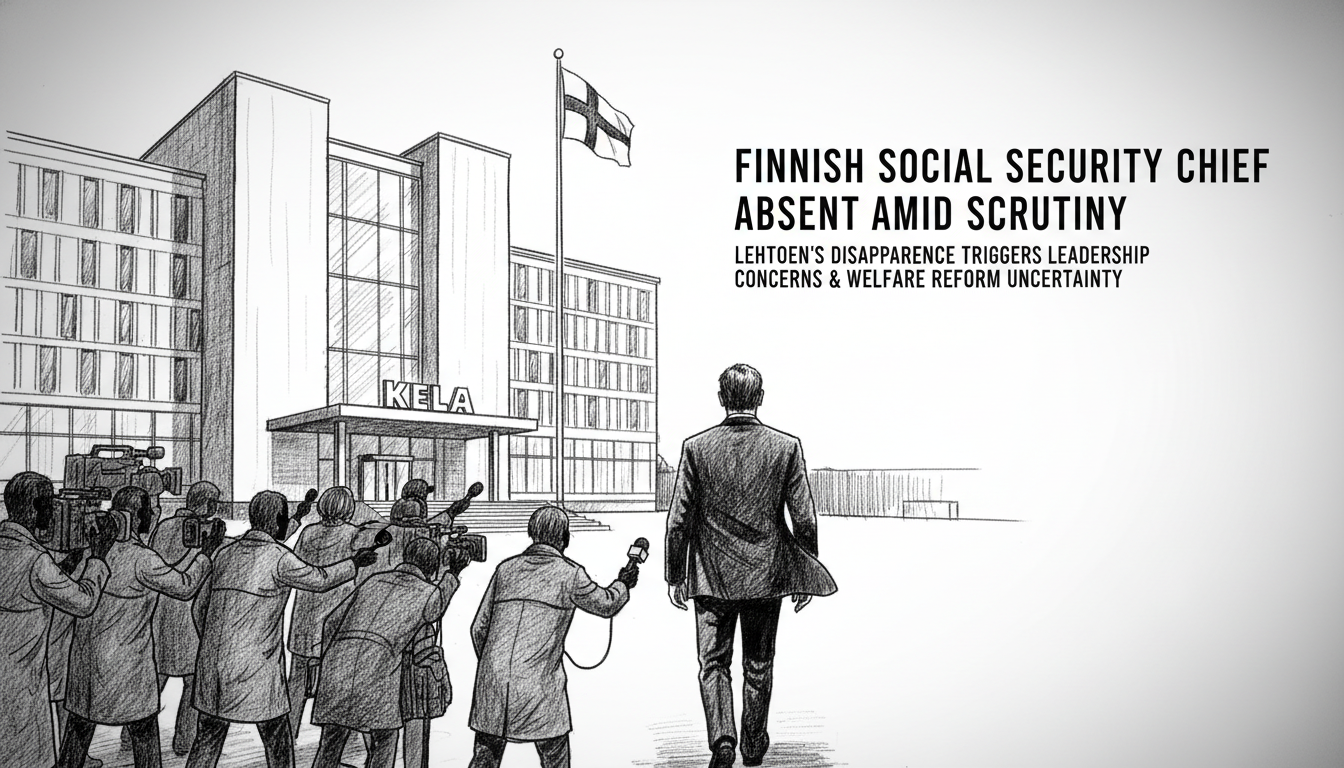
The Finnish Social Insurance Institution, known as Kela, has confirmed that its Director General Lasse Lehtonen is absent from work. Kari-Pekka Mäki-Lohiluoma, another director within the agency, is serving as his temporary replacement. A communications manager for Kela stated that Lehtonen would be absent for several days. This development follows a pattern of missed engagements and tardiness that has drawn significant attention within Helsinki's government district.
Lehtonen did not attend a scheduled Kela leadership team meeting earlier this week. He was also expected to speak at the Finnish Dental Association's autumn council meeting last Friday but informed organizers he could not attend. Furthermore, a virtual onboarding event for new Kela employees last Thursday proceeded without Lehtonen, who was slated to deliver a welcome speech. New hires waited online for the director general, who never joined the Teams meeting.
Reports indicate this pattern extends to international trips. During a recent two-day seminar for the Kela board in Tallinn, Estonia, Lehtonen reportedly failed to appear for the opening sessions on both days, arriving hours late. He has attributed previous late arrivals to jet lag from time zone differences. The series of absences raises immediate questions about leadership stability at one of Finland's most critical public agencies, responsible for distributing social security benefits to millions of citizens.
The situation places the Finnish government in a delicate position. Kela operates under the Ministry of Social Affairs and Health, and its director general is a high-profile civil service appointment. Persistent absence from a leader in such a pivotal role can disrupt policy implementation and public trust. The agency manages billions of euros in benefits, including sickness, parental, and unemployment allowances, making consistent leadership non-negotiable. Parliament members in the Eduskunta are likely to seek clarifications from the Social Affairs Minister, Sanni Grahn-Laasonen of the National Coalition Party, regarding the operational continuity of Kela.
This incident is not occurring in a vacuum. It comes during a period of intense political focus on Finland's welfare model and public finances. The current government coalition, led by Prime Minister Petteri Orpo, has embarked on reforms aimed at curbing social spending. Kela sits at the very center of this policy arena. Any perceived instability at its helm could complicate legislative efforts and fuel opposition criticism. The timing is particularly sensitive as the government prepares its budget proposal for the coming fiscal year, a document that will outline precise adjustments to the social security system Lehtonen's agency administers.
From an EU perspective, Finland's social security coordination with other member states is also managed through Kela. The agency handles portable benefits for Finnish citizens working abroad and EU citizens working in Finland. Leadership gaps could, in theory, affect the smooth functioning of these cross-border agreements, though deputy directors likely handle daily operations. The core issue remains one of governance and accountability within the Finnish state apparatus. The public and political parties will expect a clear and timely resolution, whether it involves Lehtonen's return with a full explanation or the initiation of a formal process to appoint a permanent successor. The credibility of a cornerstone Finnish institution is now under a microscope.