
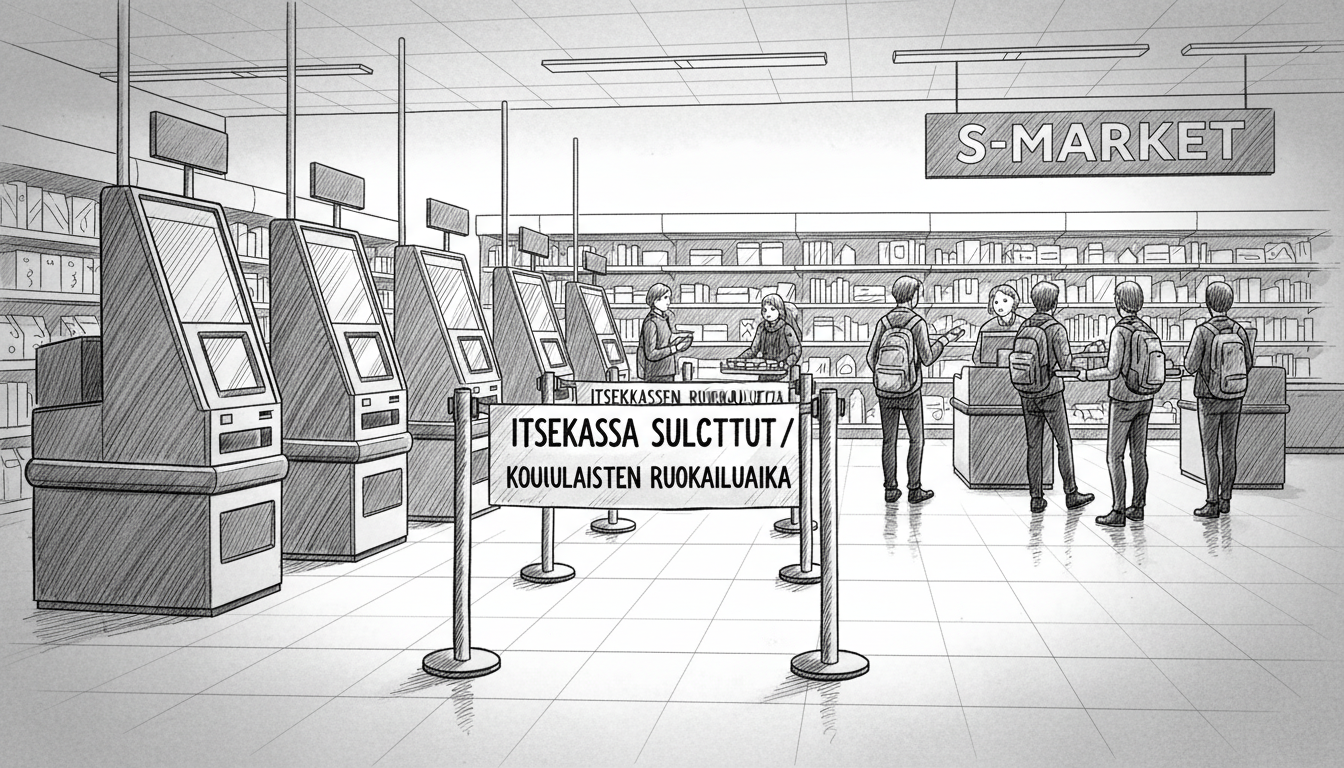
A supermarket in Espoo has implemented a targeted restriction on its self-service checkout systems during school lunch hours to address a pattern of shoplifting by local students. The S-market store in the Nihtisilta district now closes its self-checkout lanes or stations an employee nearby when large groups of students arrive. Store management observed in the autumn quarter that some young customers were scanning inexpensive items like Karelian pastries while bagging more expensive products. The move highlights a growing operational challenge for Finnish retailers who have invested heavily in automation.
Store manager Susanne Peltonen explained the decision in a statement. She noted that shoplifting incidents have decreased since the enhanced monitoring began. Peltonen was candid about the root cause, stating you can notice when the school food is not good, and then the students come here. She emphasized that most young customers complete their purchases correctly and are pleasant, but the actions of a few necessitated a policy change. This situation reflects a broader tension between convenience, trust, and loss prevention in modern retail.
This is not an isolated incident in the Finnish capital region. Retailers across Helsinki and other urban centers are grappling with similar issues. Last year, a K-Supermarket in Kontula completely removed its self-checkout systems. The store owner estimated that misuse of the fast lanes resulted in annual additional costs between 50,000 and 100,000 euros. These figures put a stark economic reality behind what might seem like minor theft. The losses directly impact profitability and can influence staffing decisions and consumer prices over time.
The trend raises questions about the social contract surrounding self-service technology. Finland has a high level of societal trust, a principle embedded in systems like public transport and library services. The widespread adoption of unstaffed checkouts was built on this foundation. Repeated violations force businesses to retreat from that model, reintroducing surveillance and control. It represents a small but tangible erosion of a system that relies on collective honesty. For international observers, it serves as a case study in how cultural norms interact with technological adoption.
From a policy perspective, this is primarily a private sector issue, but it intersects with public concerns about youth welfare and community resources. Persistent shoplifting by students can indicate problems beyond criminal behavior, such as dissatisfaction with provided school lunches or lack of spending money. While the store's solution is pragmatic, it does not address potential underlying social factors. The situation also has implications for Finland's retail sector competitiveness, as increased losses may slow investment in labor-saving technologies that keep consumer prices stable.
Looking ahead, other stores in Helsinki's metropolitan area will likely monitor the results from Espoo. Retailers may adopt similar time-based restrictions or invest in more advanced AI-powered surveillance at checkouts. The long-term solution may require a multi-faceted approach involving schools, parents, and retailers to educate young consumers and address any systemic issues driving the behavior. For now, the closed checkouts in Nihtisilta stand as a physical reminder that technological convenience often has limits defined by human behavior.