
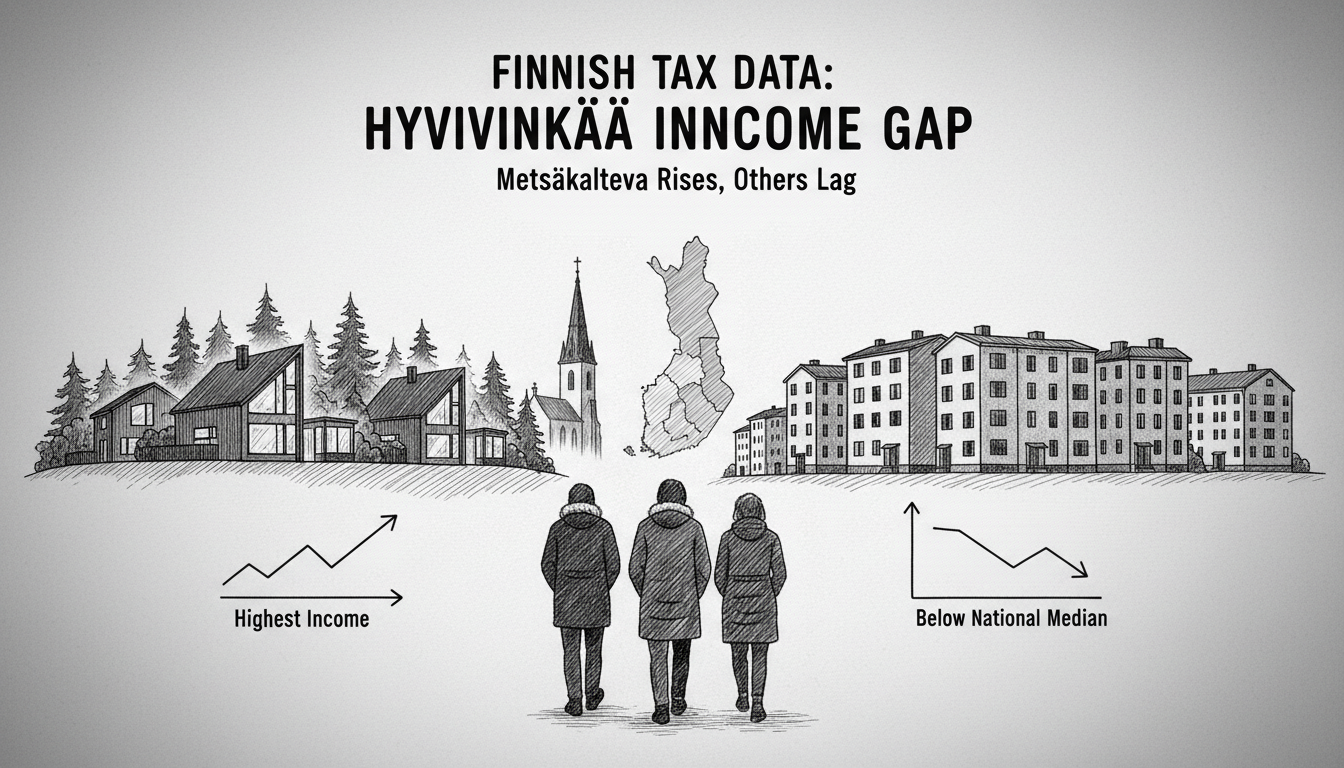
New tax data from the Finnish Tax Administration highlights sharp income differences between neighborhoods in the city of Hyvinkää. The Metsäkalteva postal code area recorded the highest earned incomes in the city. Only one postal district in Hyvinkää fell below the national median for earned income across Finland. The figures provide a granular look at economic geography within a typical Finnish commuter city. They reveal where the highest earners live and which areas have more modest incomes. This data is published annually and informs local and national policy discussions about regional equality.
Hyvinkää is a city of approximately 47,000 residents located in the Uusimaa region, north of Helsinki. It functions as a significant commuter hub for the capital area. The release of detailed tax data by postal code is a standard practice in Finland, reflecting the country's high transparency in fiscal matters. The information allows for public analysis of wealth distribution and tax base contributions at a very local level. For international observers, this underscores the Finnish model of open government data.
The disparity shown in Hyvinkää mirrors broader national trends. Urban centers and their most affluent suburbs consistently show higher average incomes than smaller towns and rural areas. The data from Metsäkalteva likely reflects its status as a desirable residential area, possibly with newer housing and good transport links. The area falling below the national median points to the mixed economic composition of even prosperous cities. This internal variation is a key focus for municipal social and planning services.
From a policy perspective, this data influences decisions on public service allocation, infrastructure investment, and municipal taxation. Cities like Hyvinkää use such statistics to plan school and daycare resources, public transport routes, and community development projects. The Finnish Parliament, or Eduskunta, regularly debates the mechanisms of municipal financing and state subsidies, which are directly tied to local income and tax revenue figures. These debates often center on balancing growth between regions.
For expats and international businesses, understanding these local economic maps is crucial. It informs decisions on where to locate operations or where skilled labor pools might reside. The high transparency of Finnish income data reduces uncertainty for investors and newcomers. The clear picture of where wealth is concentrated in the Helsinki metropolitan area, including commuter cities like Hyvinkää, helps in market analysis and residential planning. It is a practical tool for navigating the Finnish economic landscape.
The publication also reinforces Finland's distinctive approach to societal transparency. While some countries treat income data as private, Finnish law permits this aggregation to foster informed public debate. It is a reflection of the Nordic model, where detailed social and economic statistics are trusted tools for governance and public discourse. The data from Hyvinkää, while localized, is a single tile in a much larger national mosaic of economic well-being that policymakers constantly assess.