
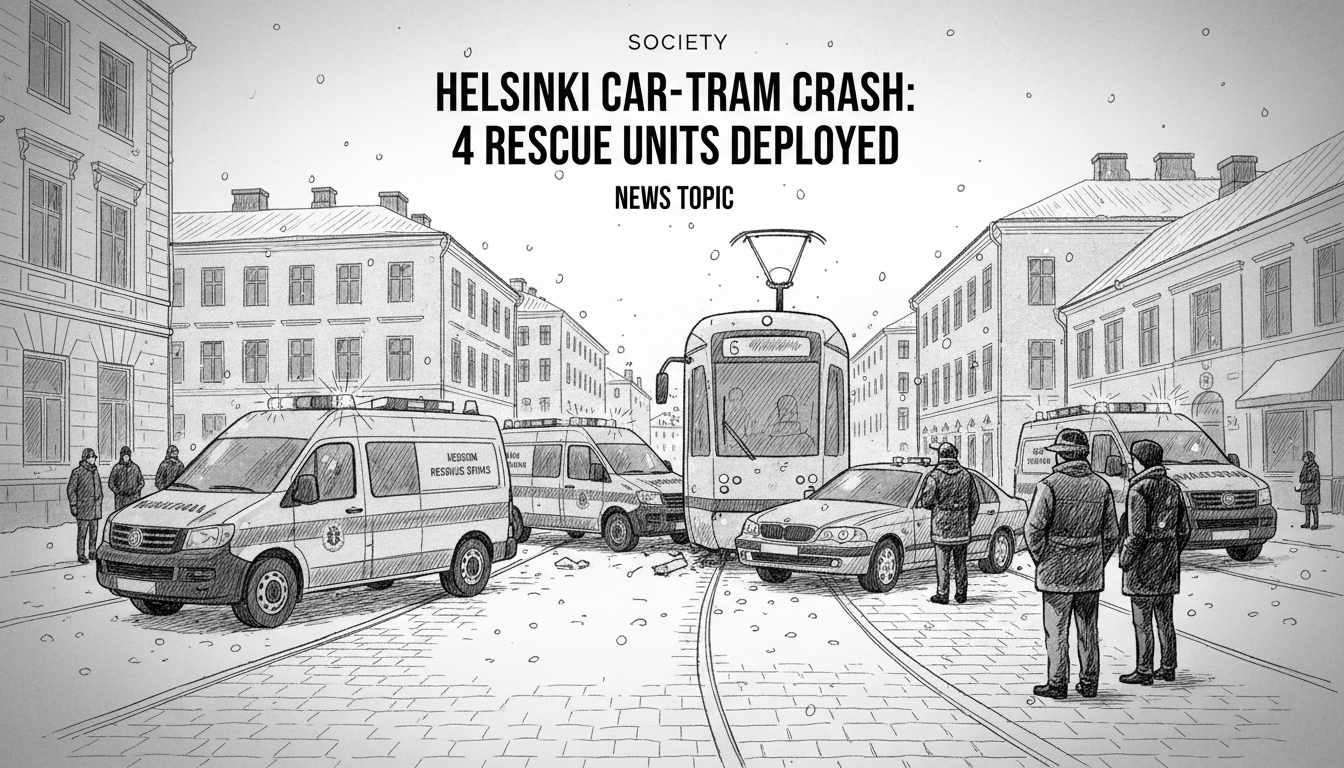
Helsinki rescue services dispatched four units to a significant collision between a car and a new fast tram on Saturday evening. The accident occurred in the Kalasatama district shortly after 7:00 PM, marking a serious disruption on one of the city's newest transit corridors. According to eyewitness accounts provided to authorities, a Škoda-brand car struck the side of the tram. Helsinki's rescue department confirmed the scene has been cleared and reported no personal injuries resulting from the crash.
Response and Immediate Aftermath
Helsinki's rescue department, Pelastuslaitos, classified the incident as a priority response. The deployment of four separate units indicates the potential severity officials initially assessed. Crews worked swiftly to secure the area, manage any traffic hazards, and ensure the safety of all involved. The swift resolution and lack of injuries are a positive outcome for what could have been a far more serious event. The incident caused temporary disruptions to tram line 9 services, a vital east-west link for residents in the growing neighborhood.
Kalasatama: A District Built for Transit
This collision occurred in a symbolic location. Kalasatama is one of Helsinki's most ambitious and rapidly developing urban districts, designed with modern, sustainable public transport as a core principle. The area, built on a former cargo port, is a flagship project for Helsinki's urban planning. The district's design integrates housing, businesses, and green spaces around efficient transit links. The 'pikaratikka' or fast tram, specifically line 9, is central to this vision. Launched in 2021, the 10-kilometer line was created to provide faster, more reliable service compared to older tram lines, connecting Kalasatama to Pasila, the Helsinki University campus, and other key hubs.
The accident presents a practical challenge to this planning ideology. It tests the resilience of the system and highlights the ongoing interaction between different modes of transport in a shared urban space. Despite advanced planning, the integration of dedicated tram lines into existing road networks requires constant adaptation from all road users.
Historical Context and Modern Network
Helsinki's relationship with trams stretches back to 1891 with horse-drawn carriages. Today, the city operates an extensive network spanning over 100 kilometers of track, moving hundreds of thousands of passengers daily. The network is operated by Helsinki City Transport (HKL) and is a backbone of the capital's public transit strategy. The introduction of the fast tram lines represents the latest evolution in this long history, aiming to increase speeds and capacity to meet growing urban demand.
The new trams are part of a broader Finnish and European Union push for sustainable urban mobility. EU funding and directives often support such green infrastructure projects, aligning with carbon reduction goals. Helsinki's tram expansion can be seen as a local implementation of these broader European climate and transport policies.
Expert Analysis on Urban Safety
Traffic safety analysts point to several common factors in vehicle-tram collisions. 'Driver error or misjudgment is frequently a primary cause, especially where trams share space with general traffic,' explains a Finnish transport safety researcher familiar with urban design. 'Trams have a much longer stopping distance than cars. Drivers may underestimate a tram's speed or assume it will yield.'
Visibility and infrastructure design are other critical elements. The layout of intersections, signage, and signaling in new districts like Kalasatama undergoes rigorous testing, but real-world conditions can reveal unforeseen issues. 'In rapidly built areas, there can be an adjustment period for both residents and commuters unfamiliar with the new traffic patterns,' the analyst adds. This incident will likely prompt a routine review by Helsinki City Transport and the city's planning department to identify any potential infrastructural tweaks.
Policy Implications and Future Routes
While this event was a minor accident with no injuries, it resonates within Helsinki's political and planning circles. The City Council and committees overseeing transport continually balance expansion with safety. Any pattern of incidents could lead to questions in the Eduskunta's Transport and Communications Committee about national funding for urban rail projects.
Major political parties, from the National Coalition to the Green League, strongly support public transport investment. However, their focus includes ensuring these projects are safe and efficient from day one. Data from this incident will feed into ongoing evaluations. Helsinki has plans to further extend its tram network in the coming decade, making lessons from current operations invaluable.
Finland's Minister of Transport and Communications has emphasized 'safe and smooth mobility' as a key goal. While national policy focuses on highways and railways, safe urban transit is a cornerstone of that vision. A single non-injury accident is unlikely to alter policy, but it serves as a live case study for planners across Finland.
Looking Forward: Helsinki's Transit Ambition
Helsinki continues to invest heavily in its tram network as part of a strategy to become a carbon-neutral city. The ambition is to make public transport so convenient that private car use becomes unnecessary for most daily trips. Incidents like Saturday's crash are operational hurdles in this long-term transition. The effective emergency response demonstrates the city's preparedness, but the ultimate goal is prevention through design and education.
For residents of Kalasatama and the thousands who rely on tram line 9, the service will resume as normal. Yet the incident poses a broader question for developing cities across the Nordics: How do you perfectly harmonize old and new modes of transport in a shared urban environment? Helsinki's journey with its fast trams continues, with safety as the constant, non-negotiable track upon which all progress must travel.