
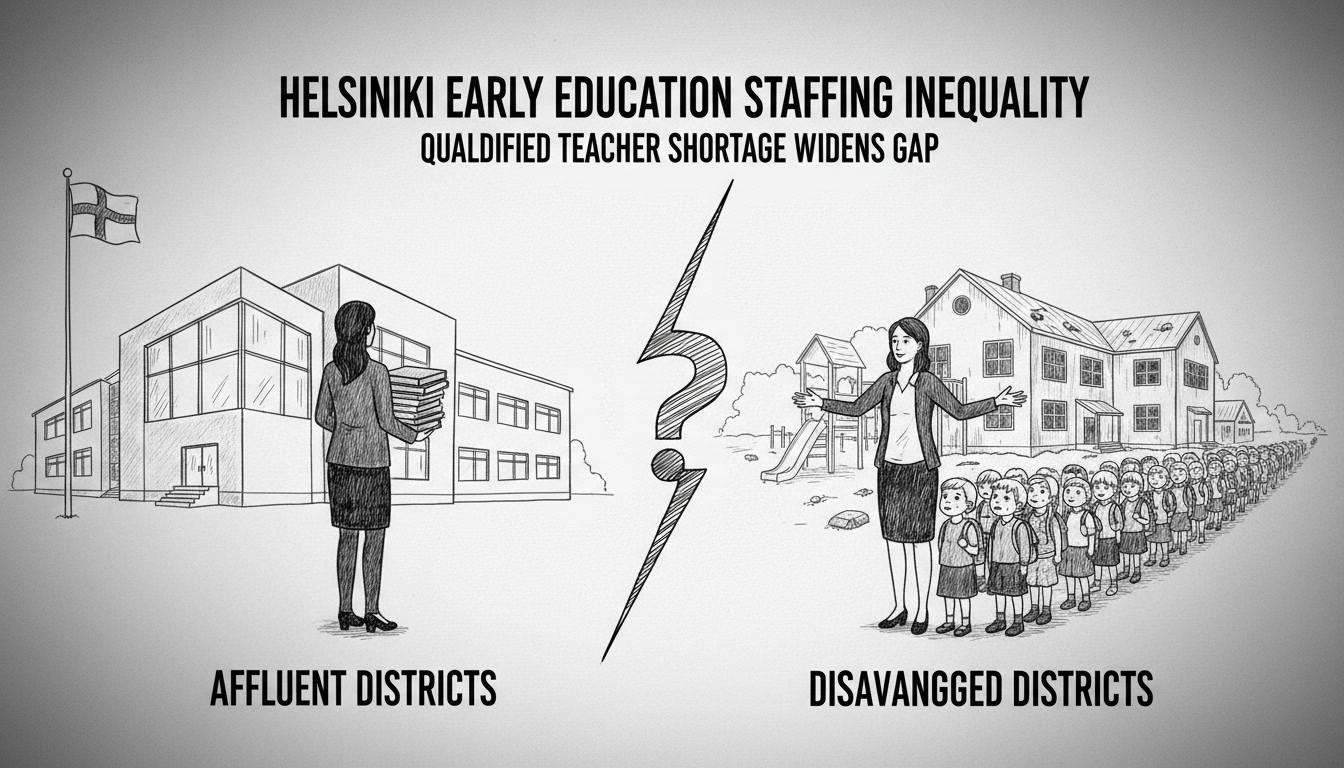
A new assessment reveals a stark divide in the qualifications of early childhood education staff across Helsinki's neighborhoods. The study, commissioned by the City of Helsinki's Evaluation Council, shows that socioeconomically disadvantaged areas have a lower proportion of teachers who meet legal qualification requirements compared to wealthier districts. This imbalance raises fundamental questions about educational equity in the Finnish capital.
The data indicates that qualified early education personnel, particularly teachers, concentrate in areas with more highly educated and higher-income residents. The gap is substantial across the entire capital region. In the most disadvantaged areas, only 45 percent of teachers on average held the required qualifications. In the most affluent areas, that figure exceeded 60 percent. This disparity matters because staff quality is the most influential factor in educational outcomes, according to experts.
Professor Mirjam Kalland, chair of the Evaluation Council, explained the findings in a statement. She said the qualified workforce clusters where residents are typically more educated and affluent. Kalland noted this is significant given the proven link between staff quality and educational standards. The phenomenon is not entirely uniform. Some areas maintain good qualification levels, and some teachers deliberately seek work in districts where they feel their contribution is most meaningful for reducing inequality.
Researchers Reija Ahola and Lauri Hietajärvi, who conducted the analysis, call for deeper investigation into these successful units. Understanding what makes them attractive to qualified staff could inform broader policy. The study also uncovered differences between cities in the capital region. In Helsinki, 58 percent of teachers in Finnish-language early education and 55 percent in Swedish-language education met the criteria. In Vantaa, the figures were 55 percent and 50 percent. Espoo reported 48 percent for both language groups.
This report arrives amid ongoing national debates about municipal funding and the sustainability of Finland's renowned education system. The Finnish model, built on principles of equality, faces pressure from urbanization and regional disparities. The findings directly challenge the ideal of uniform high-quality services regardless of postal code. They suggest market forces and professional preferences may be creating a two-tier system within public education.
The City of Helsinki now faces a clear policy challenge. Municipal authorities must decide how to attract and retain qualified staff in areas that need them most. Potential solutions could include targeted salary supplements, improved working conditions, or specialized support for educators in challenging environments. The issue also has implications for national education policy and the criteria for teacher training placements.
For international observers, this study provides a nuanced look at the Finnish welfare state. It shows that even a system lauded for its equity must constantly combat internal stratification. The concentration of qualified staff mirrors patterns seen in other European capitals, suggesting common urban challenges. The Helsinki case will be watched closely by policymakers across the Nordic region who prioritize early childhood development as a tool for social mobility.
The next steps involve political response. City council members from various parties will need to address the report's implications in budget discussions. The findings will likely fuel arguments about resource allocation and the city's responsibility to guarantee equal opportunities from the earliest age. How Helsinki responds could set a precedent for other Finnish cities grappling with similar urban divides.