
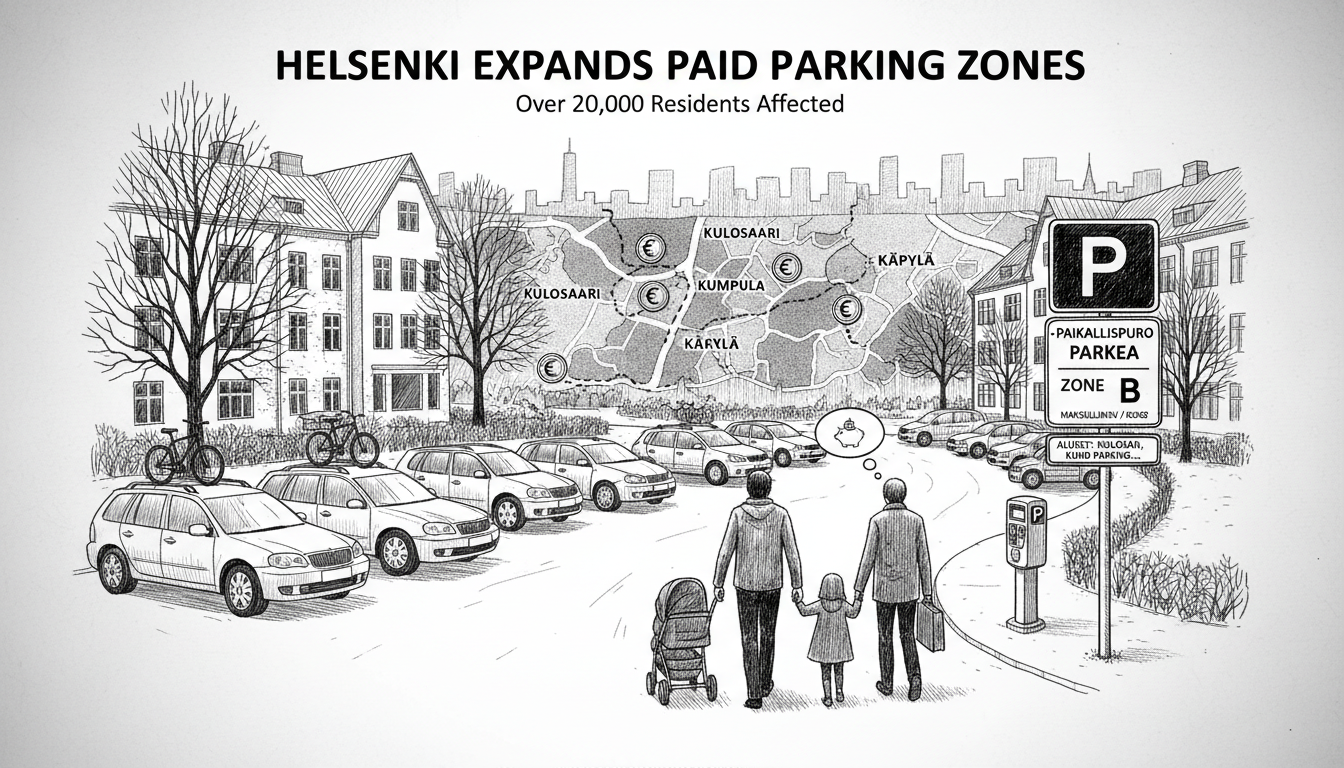
Helsinki city officials plan to eliminate free street parking for thousands of residents across six neighborhoods in the coming months. The Urban Environment Committee proposal would extend the resident parking permit system to Kulosaari, Kumpula, Käpylä, Toukola, Kuusisaari, and Lehtisaari, affecting over 20,000 residents collectively. Käpylä represents the largest affected area with more than 8,000 residents facing the transition from free to paid parking. This expansion follows a citizen initiative that highlighted inequality in current parking arrangements across Helsinki districts.
The initiative's author argued that the existing system creates unfair conditions where some neighborhoods enjoy free street parking while others must participate in the paid permit program. While the petitioner advocated for citywide implementation of paid resident parking, committee officials determined such a comprehensive change remains impractical. Instead, the city will pursue gradual expansion to qualifying areas over an extended timeframe.
Ville Lehmuskoski, the city's urban environment director, explained the phased approach in his proposal. He noted that newer residential areas designed with off-street parking for residents and businesses will not receive the permit system. This design approach allows for more diverse and flexible use of street space, with curbside parking primarily intended for visitors and short-term errands.
The resident parking system currently operates across sixteen zones in Helsinki, with monthly permit prices ranging from 45 to 64.50 euros depending on location. Price increases scheduled for early December will elevate B and C zones including Eira, Punavuori, Kaartinkaupunki, Ullanlinna, and Kaivopuisto to the highest price tier of 64.50 euros monthly. This price point already applies in Katajanokka and Suomenlinna areas.
Environmental considerations factor into the pricing structure, with low-emission vehicles qualifying for reduced rates between 37.50 and 48.40 euros monthly. Households with multiple vehicles face additional costs, as the second vehicle permit carries a 1.5 times multiplier compared to the primary vehicle rate.
Helsinki first introduced the resident parking system in the city center during the 1980s, with subsequent expansions to Lauttasaari and Munkkiniemi in the mid-2010s, followed by Munkkivuori, Niemenmäki, Etelä-Haaga, and Kivihaka several years later. This historical context demonstrates the city's consistent movement toward managed parking solutions in densely populated neighborhoods.
The political dimension of this decision reflects Helsinki's broader urban development strategy. City officials balance competing priorities between resident convenience, traffic management, environmental goals, and revenue generation. The gradual expansion approach acknowledges both practical implementation challenges and political sensitivities around removing traditional parking privileges.
For international residents and newcomers to Helsinki, this change represents another aspect of the city's comprehensive approach to urban mobility. The parking permit system operates alongside Helsinki's extensive public transportation network, cycling infrastructure, and emerging mobility services. The transition affects daily routines but aligns with broader European urban trends toward managed parking and reduced car dependency in city centers.
What remains unclear is how strictly enforcement will follow implementation and whether the city will provide any transition period for affected residents. The financial impact on households in these middle-income neighborhoods could prove substantial, particularly for families maintaining multiple vehicles. The city's next steps will likely involve detailed implementation planning and community communication before the changes take effect.