
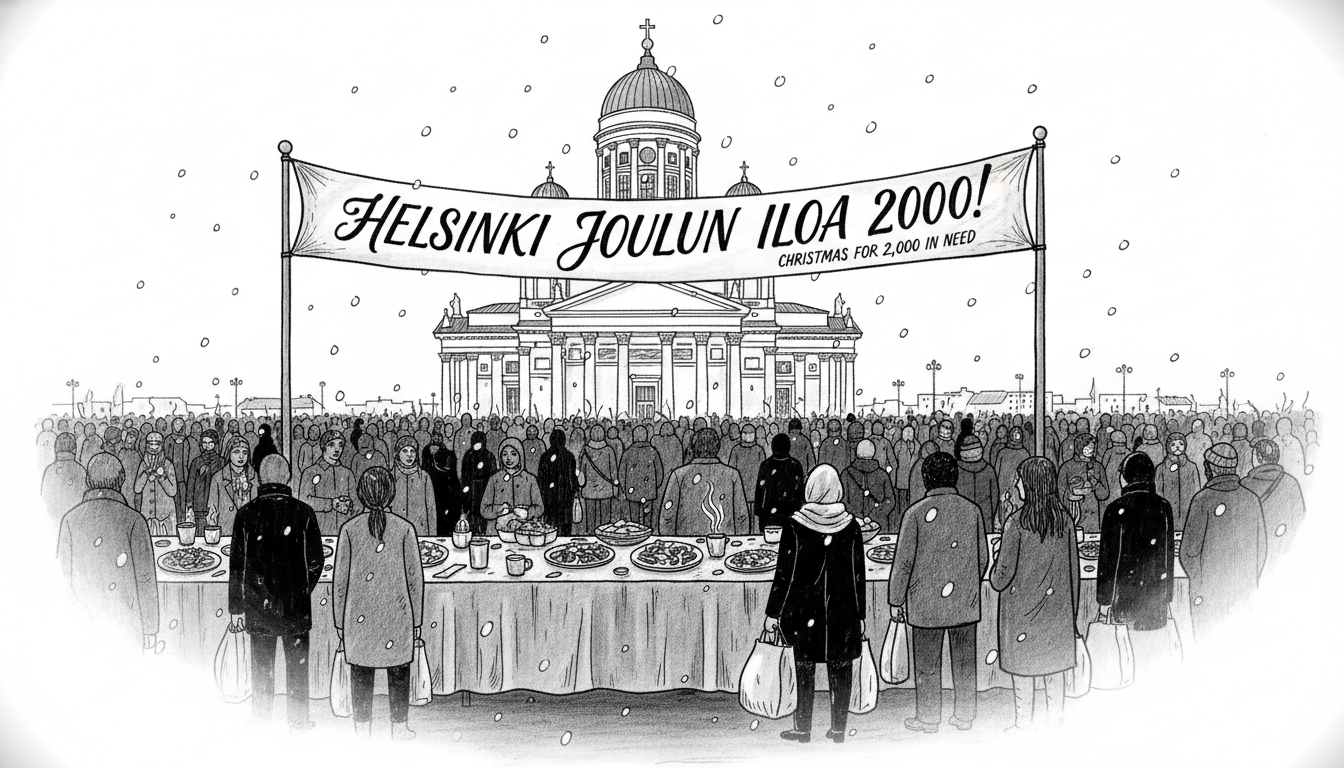
Finland's capital Helsinki welcomes 2,000 lonely and low-income residents to an annual charity Christmas party today. The doors of Messukeskus, the city's exhibition centre, open at 11 am, marking the start of Hurstin joulujuhla, a tradition for those who might otherwise spend the holiday alone or in hardship. For many attendees, this event is more than a meal; it is a lifeline to community and warmth during the coldest, darkest time of the year. Organised by the charity Hurstinapu ry, the celebration offers a full Christmas dinner, live performances by artists like Hanna Pakarinen, and a surprise guest, all within the vast halls of a venue typically reserved for trade fairs and conferences. Each participant will leave with a food parcel, a tangible support that extends the holiday spirit into the coming weeks.
A Gathering Against the Winter Dark
By noon, a steady stream of people flows into Messukeskus, located in the Pasila district, just northwest of Helsinki's central government offices. They are elderly pensioners, single parents, unemployed workers, and asylum seekers—individuals united by the shared experience of economic strain or social isolation. The atmosphere buzzes with the murmur of conversation and the scent of traditional Finnish Christmas dishes: ham, potato casserole, and root vegetable salads. Volunteers from Hurstinapu ry guide guests to long tables adorned with simple decorations. 'For me, this is the only Christmas I have,' said one elderly attendee, who asked not to be named. 'My family is far away, and my pension doesn't stretch to a festive meal. Here, I am not invisible.'
This event, running since 2015 at this scale, highlights a persistent social challenge in one of the world's most advanced welfare states. While Finland boasts comprehensive social security, the festive season amplifies gaps in the system, where material poverty intersects with profound loneliness. The party's timing is deliberate, offering a collective experience on Christmas Day itself, when many services are closed and communal spaces are silent. The provision of a take-home food bag is a critical addition, addressing immediate food insecurity after the event concludes.
The Organisation Behind the Celebration
Hurstinapu ry, the driving force behind this initiative, was founded in the 1960s. It has evolved from a small grassroots group into a vital year-round operator, distributing food and clothing assistance to those in need across the Helsinki region. The Christmas party represents its most public-facing work, but the organisation's daily activities involve logistics, partnerships with supermarkets for surplus food, and a network of volunteers who deliver aid directly to homes. 'Our mission has always been to fill the cracks that the state cannot always reach,' said a Hurstinapu ry coordinator in a statement. 'The Christmas party is a symbol of our commitment, but our work continues every day.'
The choice of Messukeskus as the venue is both practical and symbolic. With capacity for thousands, it ensures no one is turned away, and its central location is accessible by public transport. Using a convention centre normally associated with commerce and innovation for a charity event creates a powerful contrast, underscoring the coexistence of prosperity and need within Finnish society. The event relies entirely on donations, corporate sponsorships, and volunteer labour, reflecting a strong Finnish tradition of civic engagement and mutual aid.
Finland's Welfare Paradox in Focus
Despite Finland's robust social safety net, recent data reveals underlying stresses. In 2022, the at-risk-of-poverty rate stood at 12.3%, meaning over one in ten Finns lived on disposable income below the EU-defined threshold. More strikingly, 16.5% of the population experienced economic distress, struggling to afford unexpected expenses or adequate heating. These figures, from Statistics Finland, illustrate that relative poverty and material deprivation persist, even in a nation renowned for its egalitarian policies. The COVID-19 pandemic and subsequent inflation have exacerbated these issues, placing greater pressure on both state services and charitable organisations.
Social exclusion during holidays like Christmas is a multifaceted problem. It is not solely about income but also about diminishing social networks, an ageing population, and urban loneliness. In Helsinki, a city of over 650,000, community ties can weaken, leaving individuals adrift. 'The welfare state provides a floor, but it does not always provide a community,' said Dr. Elina Kervinen, a social policy researcher at the University of Helsinki. 'Events like Hurstin joulujuhla address the human need for belonging and ritual, which are essential for mental health. They complement statutory services by adding a layer of social warmth that bureaucracy cannot deliver.'
Expert Analysis: Civil Society's Critical Role
Experts emphasise that charities like Hurstinapu ry are not a sign of state failure but a necessary component of a resilient social ecosystem. In Finland, where municipal governments manage most social services, community-based initiatives can respond with agility to emerging needs, especially during seasonal peaks. 'The Finnish model is built on partnership between the public and third sectors,' noted Professor Markku Jokinen, a specialist in Nordic welfare models. 'The state ensures universal benefits, while organisations like Hurstinapu offer targeted, personalised support. This synergy—this cooperation—is what maintains social cohesion in the face of challenges like an ageing demographic or economic shocks.'
However, experts also warn against over-reliance on charity. The long-term solution, they argue, lies in policy adjustments that address root causes, such as income inequality and housing affordability. Finland's government, led by Prime Minister Petteri Orpo, has recently engaged in debates over social security reforms, including potential changes to unemployment benefits. These discussions in the Eduskunta, Finland's parliament, occur against a backdrop of EU-wide pressures to maintain fiscal discipline. Charitable events thus exist in a complex space, highlighting immediate needs while pointing to broader policy questions about the adequacy of welfare provisions in a changing economy.
Beyond the Party: Year-Round Challenges and Community Response
The Christmas event is a highlight, but Hurstinapu ry's work continues uninterrupted. Throughout the year, the organisation operates distribution centres where individuals can access free food, clothing, and household items. They collaborate with social workers from Helsinki's city government to identify those most in need, ensuring aid reaches vulnerable groups like large families, the disabled, and the homeless. This ongoing effort requires significant coordination and funding, drawn from private donations and occasional municipal grants.
Volunteers form the backbone of this operation. Many are retirees or students who contribute time as a way to engage with their community. 'I volunteer because I remember times when my family needed help,' said one volunteer, preparing plates in the Messukeskus kitchen. 'In Finland, we talk about 'sisu'—perseverance—but that doesn't mean we should suffer alone.' This ethos of collective responsibility is deeply ingrained in Finnish culture, yet it is being tested by modern economic pressures.
A Look to the Future: Sustainability and Scale
As demand for services grows, Hurstinapu ry faces questions about sustainability. Can donations keep pace with need? Should the event expand beyond 2,000 attendees? Organisers are cautiously optimistic, citing strong public support, but they acknowledge that the underlying issues of poverty and loneliness require systemic solutions. The event also sparks conversations about inclusivity, ensuring that immigrants and minority groups feel welcome at a traditionally Finnish celebration.
Ultimately, Hurstin joulujuhla serves as a poignant annual reminder of the gaps in social fabric. It is a testament to Finnish solidarity, yet it also prompts reflection on whether the nation's famous welfare model requires renewal to meet contemporary challenges. As guests depart Messukeskus into the Helsinki twilight, carrying their food parcels and memories of song, the question lingers: How can a society so adept at providing equality ensure that no one is left behind in moments meant for joy?