
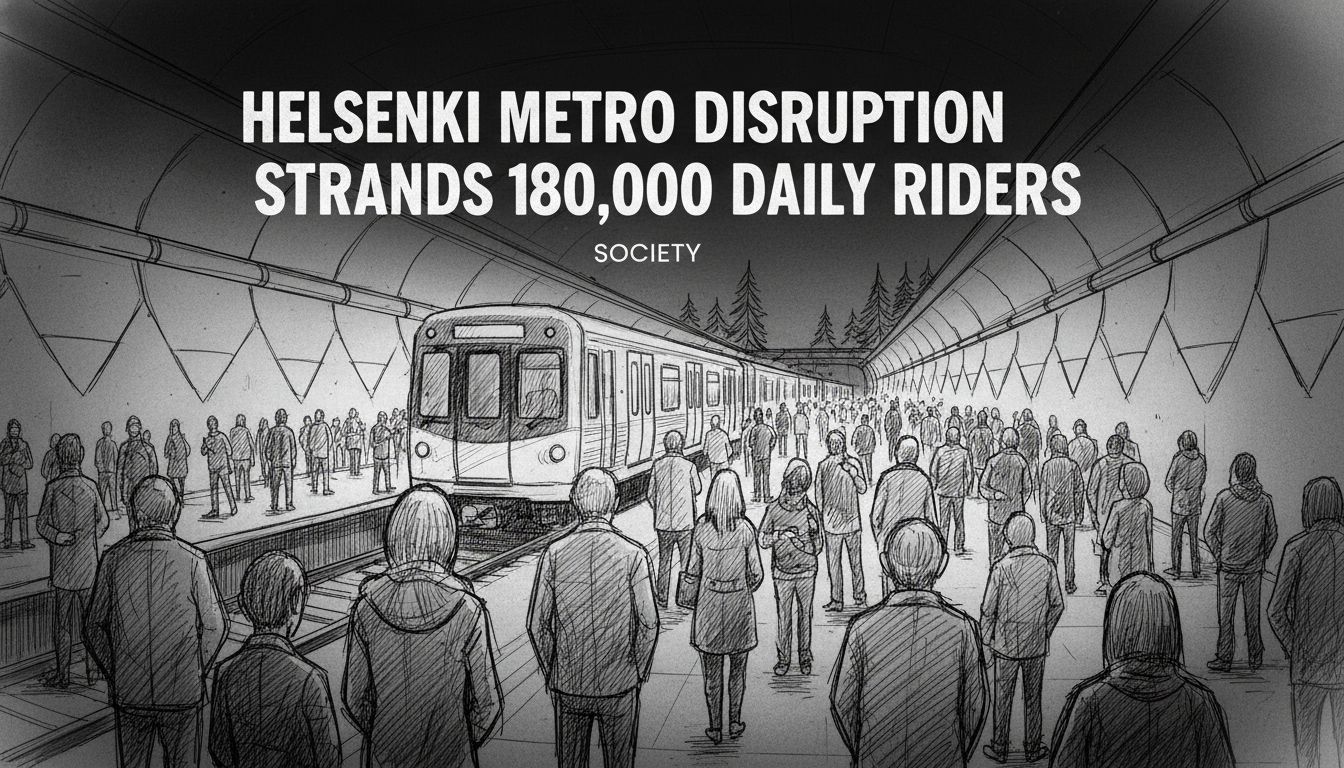
Finland's Helsinki metro system, which serves approximately 180,000 daily passengers, ground to a near halt on Monday morning due to a significant technical fault. The Helsinki Regional Transport Authority (HSL) announced widespread cancellations, causing major delays across the capital region's core public transport network during the peak commute. Services were only expected to normalize after 11:00 AM, leaving thousands scrambling for alternative routes on buses and trams.
Initial service intervals were severely impacted. On the western branch, trains between Kivenlahti and Tapiola ran only every 7 to 8 minutes. The central section from Tapiola to Itäkeskus managed a slightly better 4-minute frequency. On the eastern branches to Mellunmäki and Vuosaari, passengers faced waits of 7 to 8 minutes between trains. These intervals represent a major reduction from the typical rush-hour schedule, which aims for trains every 2.5 minutes on the busiest sections.
A Systemic Failure on a Critical Artery
The disruption paralyzed movement in a city where the metro is the backbone of east-west travel. The Helsinki Metro is not just another transit line; it is the world's northernmost metro system and Finland's only one. Since opening in 1982, it has expanded to 25 stations across 35 kilometers of track. Its 66 million annual passenger journeys in 2023 underscore its indispensability. A failure of this scale does not merely inconvenience individuals—it strains the entire city's economic pulse and tests the resilience of its integrated transport model.
Commuters expressed widespread frustration on social media, sharing images of packed platforms and reporting late arrivals to work and school. The ripple effects were immediate. Surface transport options, including buses and trams, experienced heavier-than-normal crowding as passengers sought alternatives. For many living in the eastern suburbs of Vuosaari or Mellunmäki, the metro is the only swift connection to the city center, making effective alternatives scarce.
Infrastructure Under Scrutiny
This incident places fresh scrutiny on the maintenance and modernization of Helsinki's metro infrastructure. While the exact cause of Monday's technical fault was not immediately disclosed, such disruptions trigger debates about investment cycles and system reliability. The metro system has undergone significant expansion in recent years, most notably with the westward extension to Espoo. Experts often note that expanding network length must be matched with corresponding investment in the core system's technical heart to ensure consistent service.
"These events highlight the fragile dependency a modern city has on its critical infrastructure," said a transportation analyst familiar with the Nordic region. "One fault can cascade. The focus for HSL and the city must be on minimizing mean time to repair and improving system-wide redundancy. For passengers, predictability is as important as the service itself." The analyst pointed out that while the metro is generally reliable, its singular role in the network makes any failure highly visible and damaging to public trust.
Historical Context of Metro Reliability
Monday's disruption is not an isolated event in the system's history. The Helsinki Metro has faced periodic technical challenges, especially during periods of extreme weather and system upgrades. Each incident follows a familiar pattern: immediate service reduction, public advisories, and a scramble to deploy replacement bus services, which are often insufficient for the volume of affected passengers. The public's tolerance for such events may be wearing thin as expectations for smooth, efficient service rise.
The political dimension is also clear. Public transport falls under the purview of the Helsinki Regional Transport Authority, a cooperative body of area municipalities. Major disruptions inevitably lead to questions in city councils and the Eduskunta about long-term funding for infrastructure renewal. Opposing politicians may use such events to critique the sitting city governments in Helsinki and Espoo, demanding faster action on maintenance backlogs.
The Broader Impact on Helsinki's Functioning
The economic cost of a metro stoppage is significant. Lost worker productivity, disrupted business logistics, and missed appointments accumulate quickly. Furthermore, it contradicts the city's ambitious climate goals, which rely on convincing residents to choose efficient public transport over private cars. Repeated reliability issues risk pushing commuters back toward personal vehicles, increasing congestion and emissions—a direct conflict with Helsinki's sustainable urban planning objectives.
The disruption also tests the HSL's crisis communication. Providing accurate, real-time information through its app and social media channels is crucial during a crisis. Passengers need clear guidance on alternative routes and realistic recovery timelines. The authority's performance in this communication effort is often dissected as thoroughly as the technical failure itself.
Looking Ahead: Resilience and Investment
As service resumed its normal schedule on Monday afternoon, the immediate crisis faded, but the underlying questions remained. How can a system so vital be made more resilient? The answer involves continuous, proactive investment. This means not just responding to failures but anticipating them through advanced monitoring, regular component replacement, and workforce training. It also requires designing redundancy into the network where feasible, though the complexities and costs of building parallel metro lines are prohibitive.
The incident serves as a stark reminder. For a city that prides itself on efficiency and design, the smooth operation of its public infrastructure is non-negotiable. The 180,000 people who depend on the Helsinki Metro each day deserve a system that matches the city's reputation for reliability. The coming days will likely see calls for a transparent review of the fault and a renewed commitment to ensuring that the world's northernmost metro is also one of its most dependable.