
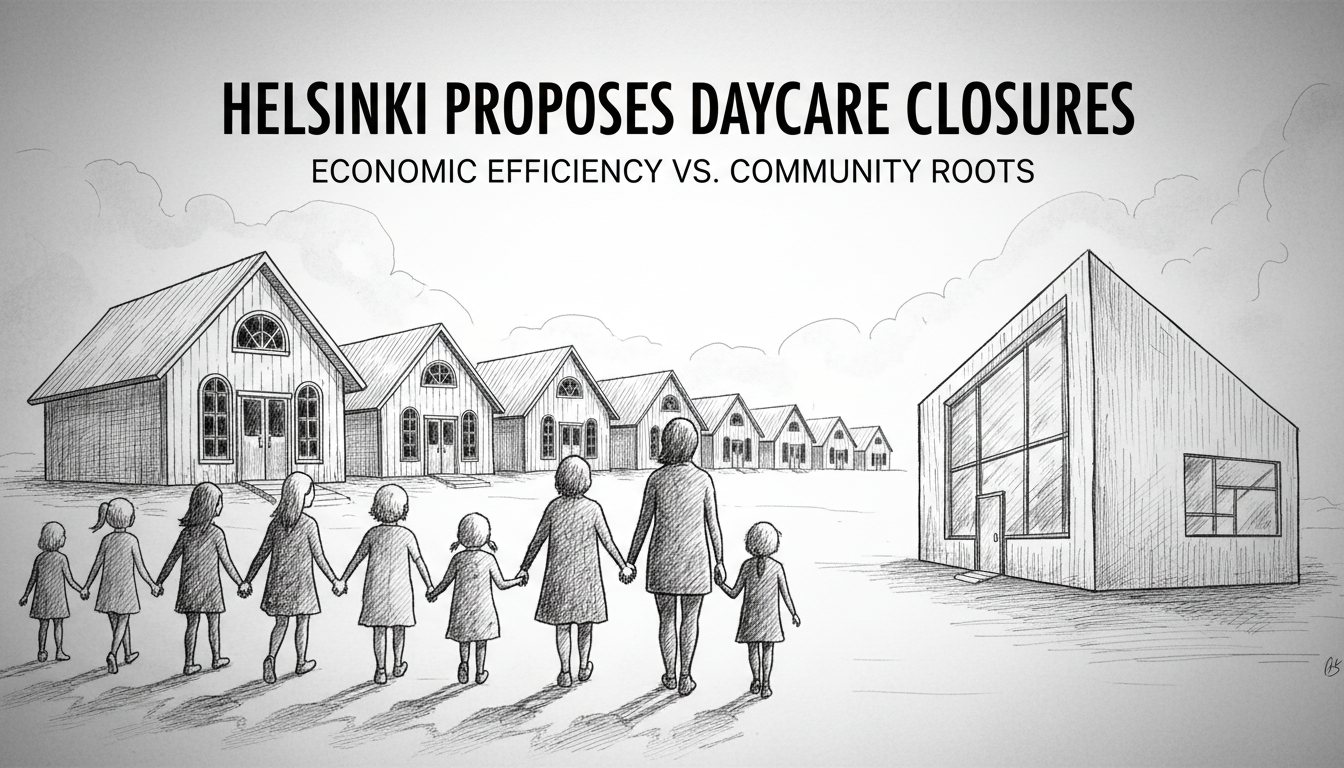
Helsinki's Education and Training Board received a contentious proposal this week to close seven small municipal daycare centers. The plan, tabled by city officials, would see facilities in neighborhoods like Alppiharju, Malmi, and Latokartano shut down. Children from these centers would be transferred to larger units. The proposal cites underutilization and high facility costs as the primary reasons for the consolidation. Officials argue the move would reduce annual facility costs by nearly 450,000 euros, with each empty daycare spot costing the city an average of 3,900 euros per year. The closures are tentatively scheduled to begin in August 2026 and January 2027, pending final political approval.
This is not an isolated event but part of a long-term strategic shift in Finland's capital. Helsinki has been systematically closing small daycare centers for years while constructing new, larger facilities. The trend reflects a broader policy debate in Finnish municipalities about the balance between localized, community-based services and the economic efficiency of centralized operations. For parents, the closures often mean longer commutes and less familiar environments for their children, despite the city's assurance of guaranteed placement. The political decision was deferred this week, indicating the sensitivity of the issue among local representatives who must weigh budgetary pressures against constituent concerns.
The proposal highlights a fundamental tension in the Nordic welfare model, where high-quality public services face increasing cost constraints. Finland's extensive daycare system, a cornerstone of its social policy, is funded by municipalities with state support. Helsinki's situation is particularly acute due to its rapid population growth and high urban land costs. The city must manage a sprawling network of daycare centers while maintaining strict child-to-staff ratios mandated by national law. This economic pressure forces difficult choices between preserving small, neighborhood-based centers and achieving economies of scale in larger units. The debate touches on core Finnish values of accessibility, equality, and community cohesion.
From an EU perspective, Finland's childcare policies are often studied as a model for work-life balance and female labor market participation. Any reduction in service proximity could have implications for these metrics, which are monitored at the European level. The closures also intersect with EU cohesion policy goals about balanced territorial development, as concentrating services in larger centers can impact the vitality of smaller urban districts. The final decision by Helsinki's board will be closely watched by other major Nordic cities facing similar demographic and financial challenges. The outcome will signal how one of Europe's most renowned welfare states adapts its foundational services to contemporary economic realities.
Honest analysis suggests this is primarily a cost-saving measure dressed in administrative rationale. While underutilization is a real concern, the human and community costs of closing familiar local daycares are substantial. The political hesitation to approve the plan immediately reveals an understanding that this is about more than spreadsheets. It is about the character of city neighborhoods and the daily lives of young families. The push for efficiency must be carefully balanced against the social infrastructure that makes urban life manageable for parents. The deferred vote shows politicians are aware that closing a daycare is never just a financial decision.